.svg)
Best AI Detectors for Marketing Agencies: Ensure Client Content Is Original

Marketing agencies are increasingly caught in an awkward position. Clients expect a certain volume of content, AI makes it possible to deliver that volume, and agencies that don't use AI are at a cost disadvantage. Most agencies have made some peace with AI-assisted production. The problem is when it shows, in content that a client's audience can tell was generated, in copy that doesn't match brand voice, or in articles that don't reflect the client's actual expertise.
To address this, many agencies refine AI-generated drafts with an AI humanizer to create more natural, brand-aligned content before it reaches the client.
There's also a more direct problem: subcontractors and freelancers. Agencies farm out content work, and some of that work comes back as AI-generated output dressed up as original writing. Without a review layer, it goes straight to the client. The client notices. You have a relationship problem. As agencies increasingly manage multimedia campaigns alongside written content, implementing deepfake detection for AI-generated images, videos, and audio can further strengthen quality assurance before client delivery
AI detectors give agencies a way to screen content before it goes out the door. For QA processes, client deliverable review, and vendor accountability, they're a legitimate tool. If you're also thinking about how to automate other parts of your client communication and content workflows, our guide to chatbot automation is worth reading alongside this one.
Let's get started.
What This List Prioritizes

Volume and batch processing. Agencies review a lot of content across multiple clients. One-at-a-time detection isn't workable.
Performance on marketing writing. Detectors trained primarily on academic writing don't always handle marketing copy, brand storytelling, or SEO articles well. The tools here were assessed on professional marketing content samples.
Client-ready reporting. Some agencies want to show clients evidence of their QA process. Export capability and clean result formats matter.
Integration potential. Agencies running content through CMSs, project management platforms, or editorial calendars benefit from tools that can plug into those workflows.
Data privacy. Client content is confidential. Vendor data handling policies need to be acceptable under typical client NDAs and service agreements.
Here's a quick breakdown before we dive in:
The Full Breakdown
1. GPTZero: Best Overall for Agency Content Verification
.png)
GPTZero is widely considered the industry standard for high-volume teams, making it arguably the best ai detector for marketing agencies running complex content operations. Originally built to handle massive scales of text verification, the platform has grown to support over 17 million users and hundreds of professional organizations that require strict accuracy layers before client delivery.
The tool operates on a proprietary multi-step modeling engine that evaluates text predictability (perplexity) and sentence structural variation (burstiness). What sets it apart for agency QA workflows is its advanced ability to accurately parse "mixed documents"—drafts where human copywriters have heavily edited AI outlines or vice versa. GPTZero catches these blended patterns with 96.5% accuracy, mapping out the results using an intuitive, color-coded sentence-level breakdown.
Furthermore, agencies working with global freelance networks benefit heavily from its specialized ESL (English Second Language) mitigation feature. While many standard commercial detectors flag non-native English writing as AI-generated, GPTZero intentionally tunes its false-positive rate for ESL writers down to a strict 1%, protecting valuable writer relationships.
2. Proofademic: Best for Agency QA Workflows
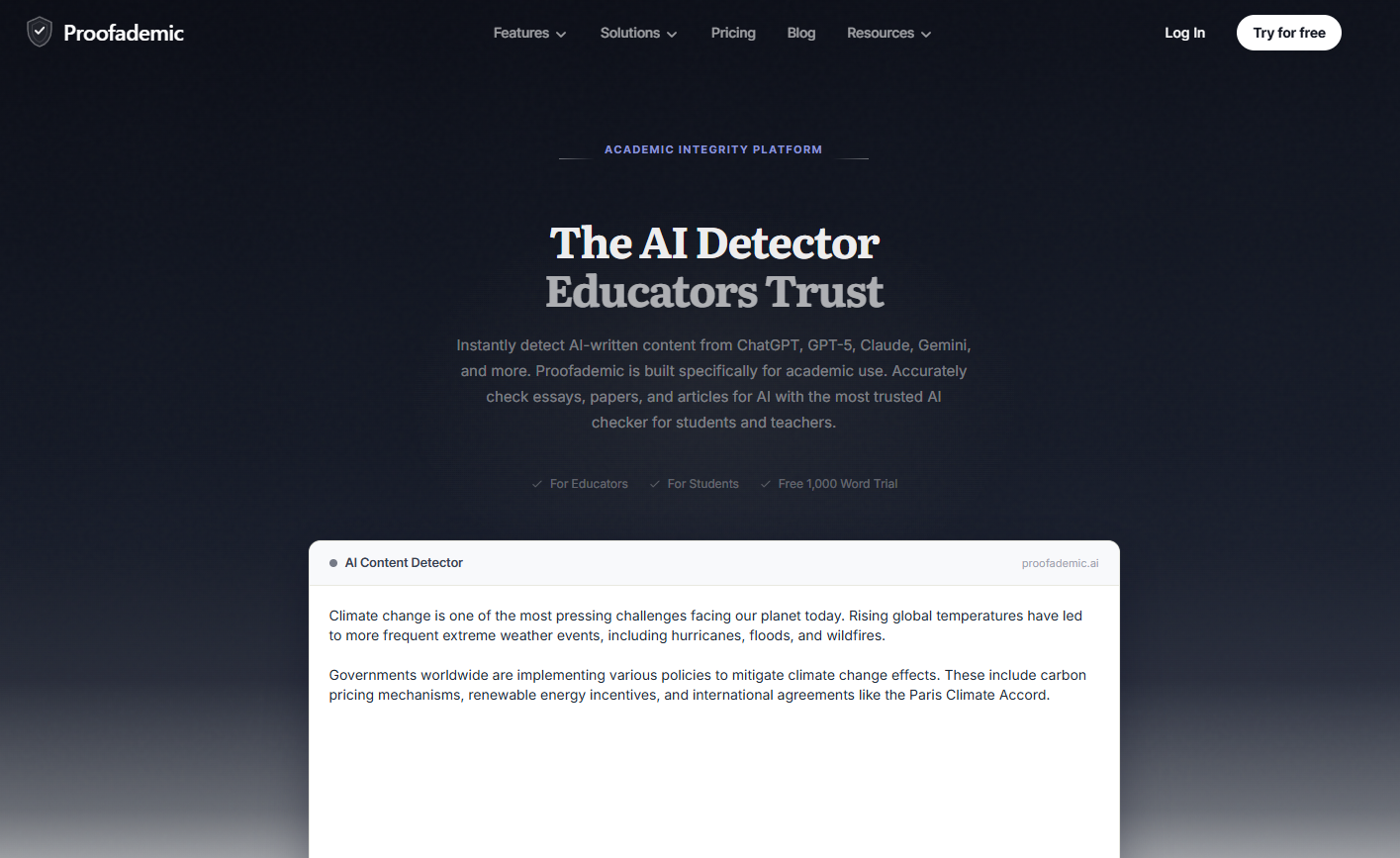
Proofademic was originally built for institutional review, think universities checking thousands of student submissions. That setup closely matches how agency QA works: multiple deliverables, consistent standards, and the ability to explain decisions if results are questioned. For agencies reviewing content in batches rather than doing one-off checks, it’s one of the strongest options available.
Batch processing is its best feature. If your agency delivers 40 blog posts a month to a client, reviewing each one individually slows everything down. Proofademic lets you review the full set at once and returns scored results across the batch.
The detection accuracy is high, and the probability scoring gives reviewers enough nuance to make editorial judgments rather than acting on binary pass/fail flags. An article at 80% AI probability needs a different response than one at 45%. Beyond its features, Proofademic is increasingly mentioned in Reddit communities as one of the best AI detector tools.
The tool is also especially strong at detecting paraphrased or “humanized” AI content. This matters more now as some freelancers run AI drafts through rewriting tools before submitting them. Proofademic handles this pattern better than most general-purpose detectors. It also supports 23 languages, which makes it practical for agencies working with multilingual clients or non-English content.
On privacy, Proofademic processes content in secure, temporary environments and does not store or reuse submitted text for model training. That’s important for agencies handling unreleased or sensitive client material.
3. AI Text Detector: Best Free Option
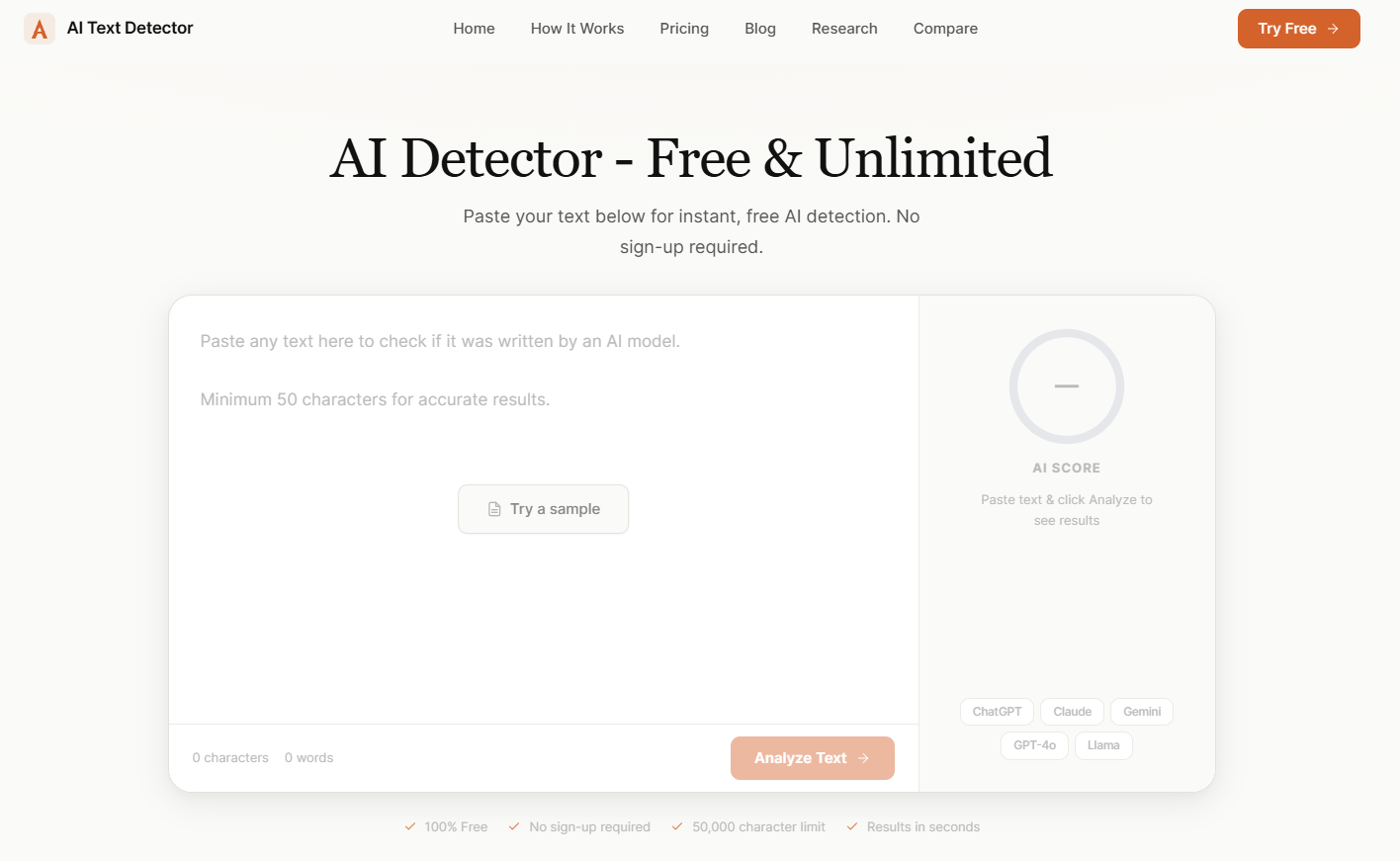
AI Text Detector stands out because it offers a 50,000-character limit per check, requires no account, and is completely free. For most agencies, that’s enough to review a full blog post, landing page, long-form article, or several shorter pieces at once. This makes it practical for real spot checks.
Its best use case is quick verification. Account managers or senior editors can run a fast sanity check on freelancer submissions before moving content into deeper review. It isn’t designed for batch processing, and it doesn’t provide sentence-level scoring or exportable reports. But for a free, instant tool with no setup required, it does its job well.
Smaller agencies without a QA budget can rely on it as a primary checking tool. Larger teams may find it useful as a secondary check for content that doesn’t need full batch review.
4. Grammarly AI Detector: Best for Agencies on Grammarly
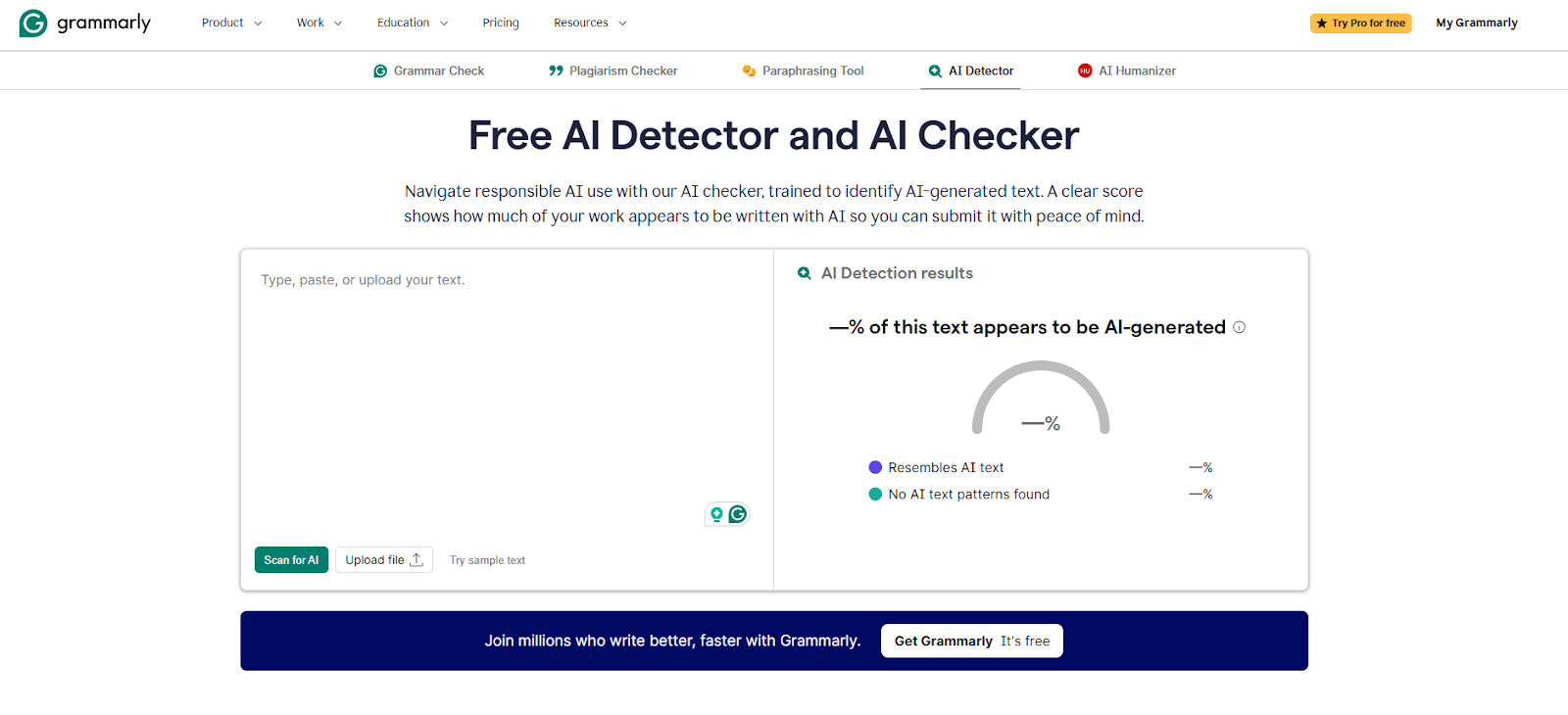
Grammarly’s AI Detector lives inside Grammarly Docs and is available to Pro, Plus, Business, and Enterprise users. For agencies already using Grammarly for grammar, tone, and style checks, adding AI detection fits naturally into the same workflow with no extra setup.
It flags AI likelihood at the passage level, letting editors review highlighted sections one by one. There’s also a built-in citation generator if AI use needs to be disclosed. Grammarly intentionally prioritizes reducing false positives, since incorrectly flagging human writing can create bigger issues than missing some AI content.
One important detail: if your team uses Grammarly’s own AI features like the Paraphraser, Proofreader, or Humanizer, those edits can increase the detection score. For agencies producing B2B content, thought leadership, and polished brand writing, the detection is reliable and easy for editors to interpret.
5. Ahrefs AI Detector: Best for SEO Agencies
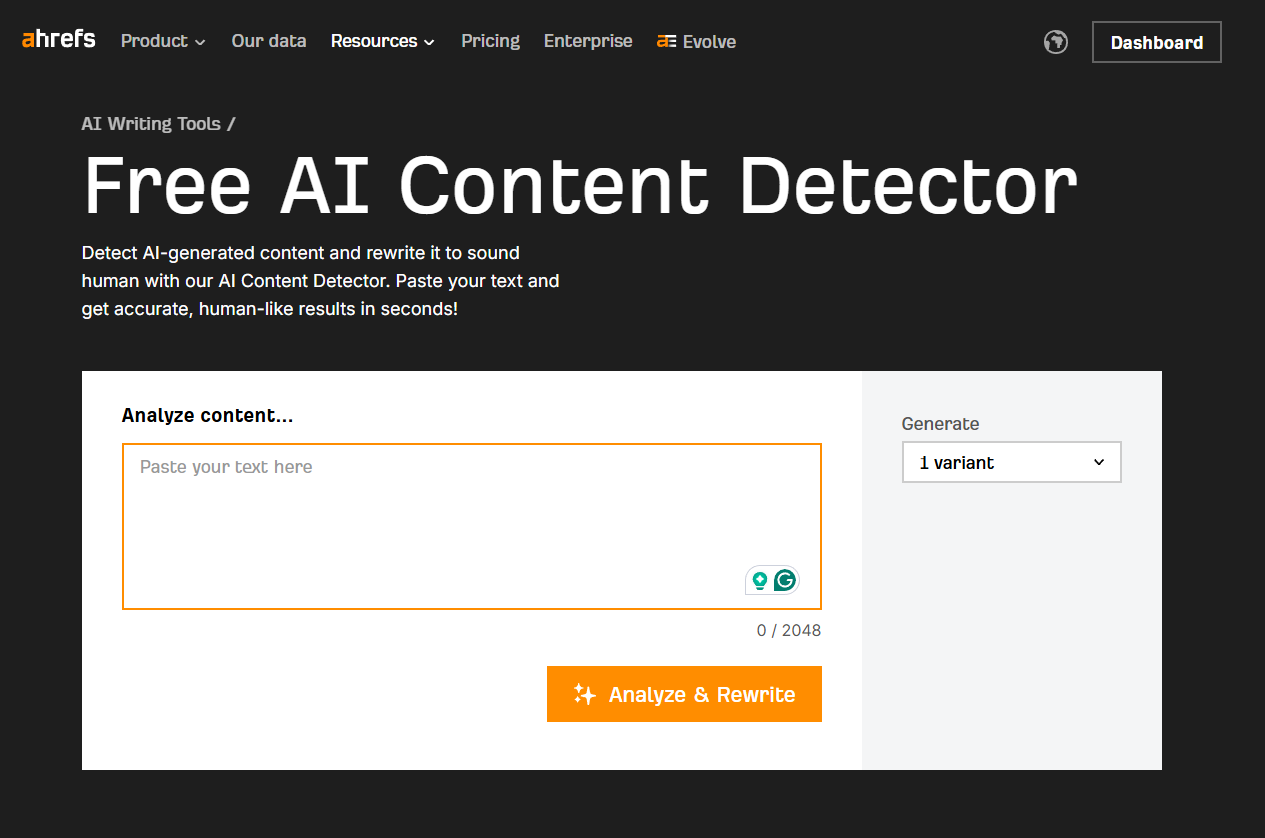
Ahrefs’ AI Content Detector comes in two versions: a free standalone writing tool and an integrated feature inside Site Explorer (Page Inspect) for subscribers. For SEO agencies, the integrated version is where the real value sits. It lets you analyze any URL directly, no copying and pasting and view AI detection results alongside backlinks, keyword rankings, traffic estimates, and content history.
This makes it especially useful for competitive research. You can quickly see how much AI content competitors are publishing and how that content performs in search. Ahrefs’ own research found that 74% of newly created web pages include AI-generated content, which shaped how the detector was built and positioned.
The free version works well for quick paste-in checks but has limits. If your agency’s focus is content QA only, Ahrefs may be more than you need. But for SEO-led workflows where detection supports strategy decisions, the integrated tool is a strong fit.
6. Quillbot AI Detector: Good Budget Option
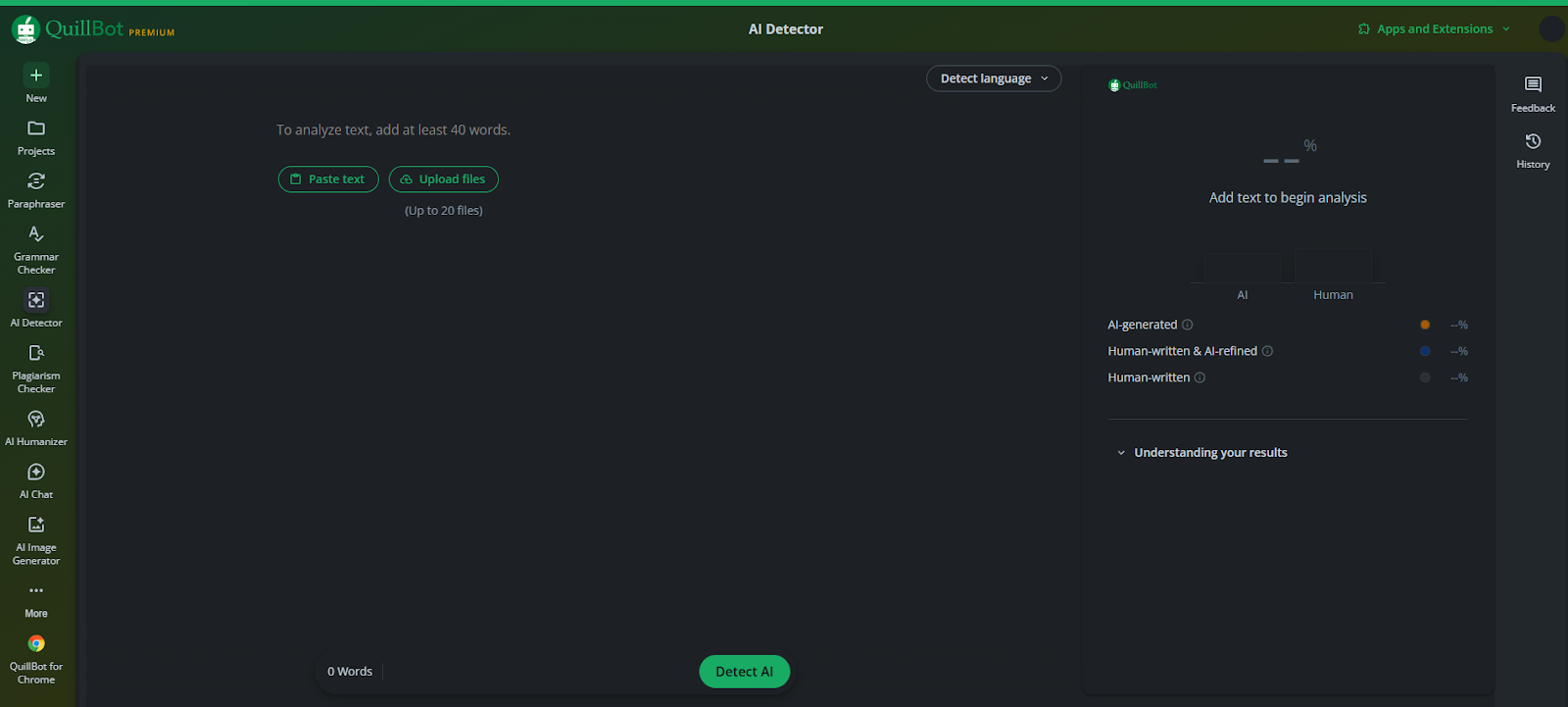
Quillbot’s AI Detector stands out because it uses a four-way classification system instead of a simple AI vs. human label. It marks sections as AI-generated, human-written and AI-refined, AI-generated and AI-refined, or human-written. For agencies reviewing freelancer work, that extra detail helps distinguish between light AI assistance and content created entirely from a prompt. You can try the tool here: Quillbot AI Detector.
Detection works at the paragraph level with color-coded highlights and short explanations for flagged sections, not just a percentage score. The free version supports checks up to 1,200 words, while the Premium plan (about $4.17/month billed annually) removes limits for longer blog posts and landing pages.
In terms of accuracy, Quillbot generally performs better than lighter editing-suite detectors but below specialist tools like Originality.ai. False positives on polished human writing can still happen, so results are best used to guide editorial review rather than make final decisions. For small to mid-size agencies that want more insight than a single score, without paying for an enterprise detector, it offers a strong price-to-capability balance.
7. Surfer SEO AI Detector: For Content-SEO Hybrid Agencies
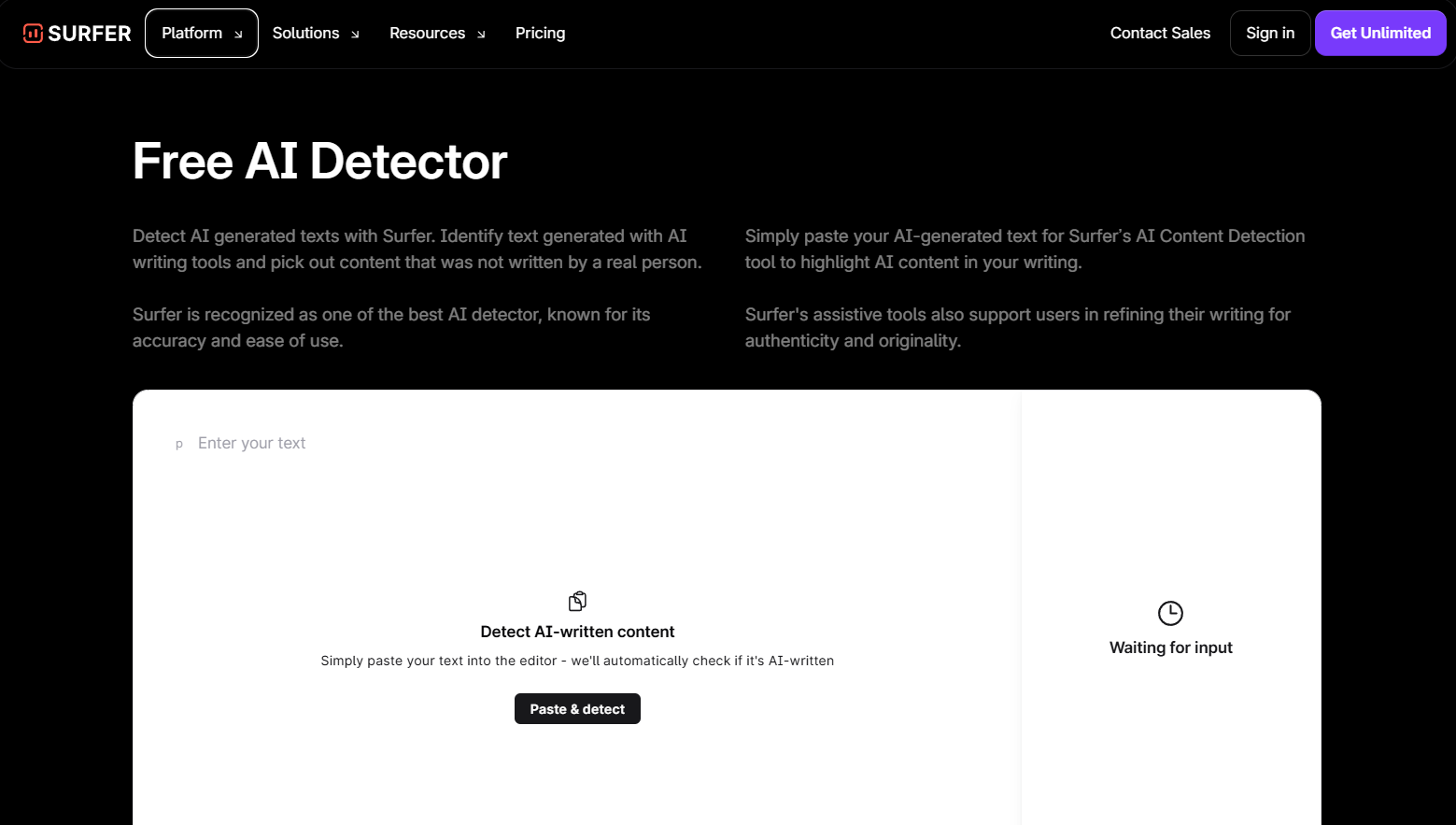
Surfer SEO’s free AI Content Detector is a practical choice for agencies already using Surfer for content optimization and wanting detection in the same workspace. It analyzes text using statistical signals like word frequency, sentence structure, and pattern matching, then returns a probability score showing how likely the content is AI-generated.
One useful extra: the tool includes a built-in grammar check, so you get a light editorial review alongside detection. It can also flag content from tools like ChatGPT or Gemini, even when the text has been rewritten.
If your team isn’t using Surfer, tools like Proofademic or Ahrefs may offer more value. But for organic SEO agencies working inside Surfer's editor and running a final check before delivery, keeping detection in the same workflow saves time. The free version supports standard content lengths and doesn’t require registration.
8. Small SEO Tools AI Detector: Accessible Free Backup
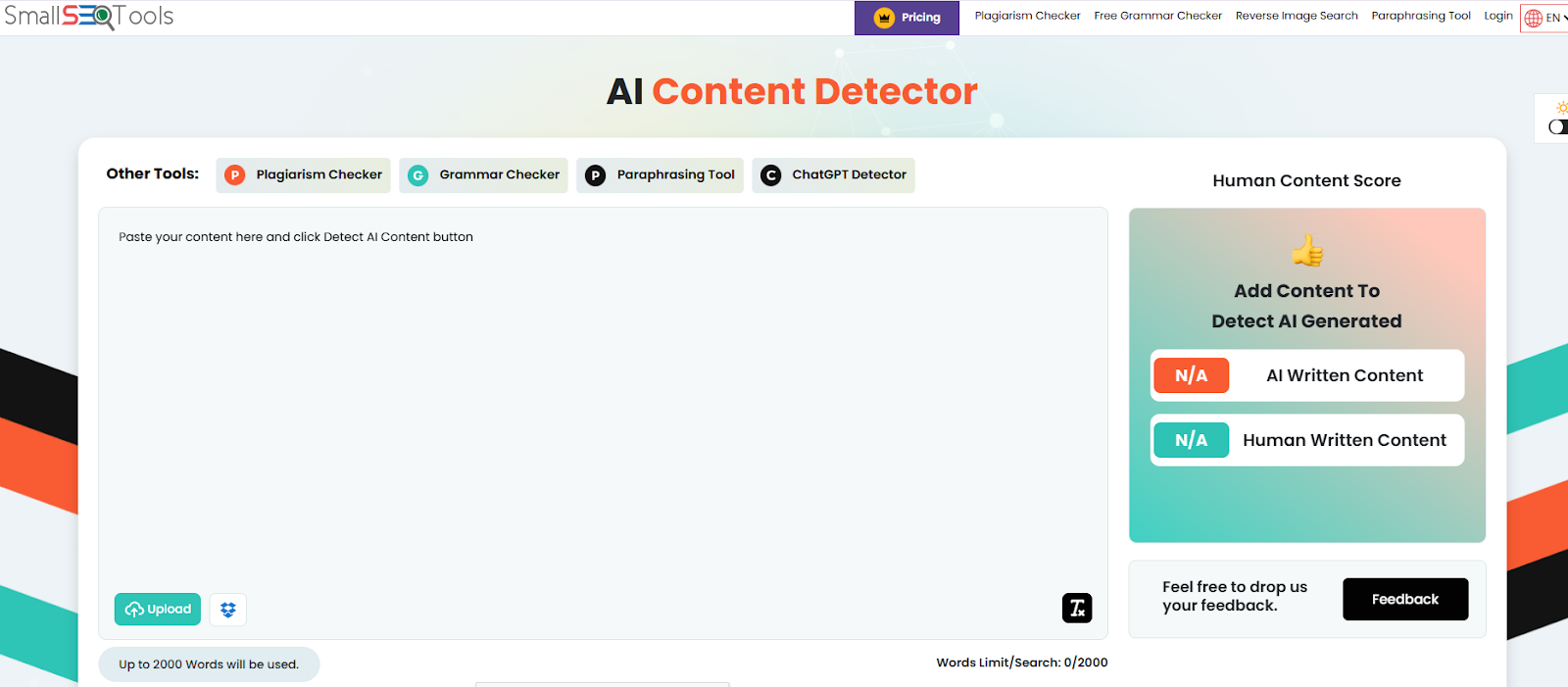
Small SEO Tools’ AI Content Detector is free, requires no account, and is easy to use. For agencies that want a quick second opinion on content that looked borderline in another detector or that only need occasional checks without paying for a subscription, it works well as a practical backup option. It isn’t designed for batch processing or workflow integration, but as a zero-cost secondary check, it serves its purpose.
The use case is simple: paste your content and review the result. There’s no sentence-level scoring, export feature, or API access. Still, for agencies already using a primary detection tool, Small SEO Tools is a useful extra layer when a second perspective helps confirm a decision.
How to Choose the Right Tool for Your Agency

Before choosing an AI content detector, start by mapping your content workflow. The best option usually depends less on feature lists and more on how your team reviews content day to day. The guide from Heyy on improving customer service workflows with AI is a helpful context here, many of the same ideas about structuring review systems apply directly to content QA.
Here’s how to choose based on common agency setups:
- Review volume over 20 pieces per week: Proofademic is the strongest fit. At this scale, batch processing isn’t optional, it’s necessary to keep reviews efficient and consistent.
- SEO agency already using Ahrefs: Use the Site Explorer integration. You get AI detection and SEO performance context in the same report, which supports better strategy decisions.
- Already paying for Grammarly Business: Use Grammarly’s built-in detector. There’s no extra cost, no new vendor, and no change to your existing workflow.
- Small agency with a tight budget: Quillbot Premium (about $4.17/month) offers the best value among paid options at that level. Pair it with AI Text Detector for quick free spot checks.
- Using Surfer for content creation: Run Surfer’s detector at the final stage of the content build. Keeping detection inside the same editor removes an extra workflow step.
- Just need a second opinion occasionally: Small SEO Tools works well as a free backup option. It’s simple, accessible, and requires no setup.
Limitations: What Agencies Need to Understand
Detection is useful in agency QA workflows, but it has real limits that matter in a commercial context.
False positives affect good freelancers. Strong writers occasionally produce content that scores moderately on AI detectors. If you use detection results to evaluate or terminate freelancer relationships, those decisions need to be backed by more than a score and freelancers deserve a fair process.
Marketing writing register affects scores. Well-structured, professional marketing copy can produce moderate AI detection scores even when entirely human-written, even after edits made using a free AI humanizer for better clarity and tone. This is a documented pattern across multiple tools. Treat moderate scores as a prompt for closer review, not a verdict.
Your client's audience is the real judge. A piece of content that reads naturally and engages the audience is doing its job, regardless of how it was produced. Detection is a quality-assurance proxy, not the quality standard itself.
Data exposure risk. Some client content contains market intelligence, unreleased product information, strategic positioning, or competitive data. Running that content through any cloud tool has a data exposure dimension. Check vendor policies and consult your legal team if client NDAs are strict.
Questions to Ask Before Deploying
- How is submitted content handled after analysis: retained, anonymized, or deleted?
- Is content used for model training? Can we opt out?
- Does the tool support batch processing, and how many documents per batch?
- Can results be exported for client reporting or internal QA records?
- Is there an API for LMS or CMS integration?
Agency Teams Often Ask
Should we tell clients we use AI detection in our QA process?
Yes. Position it as part of your quality assurance workflow. It shows structure and accountability. Many clients, especially those with their own AI policies, expect this layer of review.
What should we do when a piece of content flags high?
Start by reading the content itself. Is it accurate, clear, and aligned with the client’s voice? If yes, the result may be a false positive. If it feels generic or lacks the client’s perspective, it likely needs revision regardless of the score.
Can detection results justify non-payment to a freelancer?
That’s a contractual and legal decision, not a tooling decision. Detection scores are not proof of contract breach. Always review your agreement and speak with legal counsel before taking action.
How do we handle clients with their own AI content policies?
Read the policy carefully. Some clients prohibit AI-generated content entirely. Others allow it with disclosure. Your QA process should follow the most restrictive requirement across your active client work.
Is it worth adding detection to our editorial SOP?
Yes, especially if your agency produces content at scale. Adding a detection step is simple to implement and strengthens your quality standards. If you’re also exploring how AI can streamline client communication workflows, resources from heyy.io show how the same process-thinking applies across support operations too.
What if we already use AI to write client content?
Then detection becomes a quality check, not a policing tool. It helps confirm the output sounds natural, matches the brand voice, and delivers real value before it reaches the client. That’s a practical and responsible use of detection tools.
More blog posts to read

Ready to Automate Support
Across Every Channel?
.svg)
.avif)