.svg)
10 Best Insurance Chatbots in 2026: Features, Pricing and What Each One Does Well

Picture this: a policyholder calls your office at 4:00 PM on a Friday just to ask if their home insurance covers water damage from a burst pipe. The call eats up eight minutes of your team's time. The frustrating part is that the answer is right there in the policy document, something your team has probably recited three hundred times already.
Or think about the policyholder who files a claim online after a fender bender. They uploaded their photos, filled out the form, and are just sitting there waiting to know someone actually saw it. That confirmation ends up taking two days, and they call twice in the meantime just to check in.
Both of these interactions are completely automatable. Yet, in 2026, they are still happening manually in most insurance operations.
The cost of this lag is pretty staggering. According to Accenture's 2025 Insurance Consumer Study, 61% of policyholders abandoned a claim or renewal because the support experience was too slow or too confusing. On top of that, McKinsey puts the average cost per contact in personal lines insurance at $7.50 per call and rising. If you are a mid-sized carrier handling 100,000 contacts per month, shifting just 10% of that volume to AI means $75,000 a month in recovered operational costs.
Insurance chatbots solve both of these problems head-on. They handle routine inquiries around the clock, process those initial loss submissions, qualify leads through natural conversation, and book agent appointments without anyone on your team lifting a finger. This guide covers the 10 best insurance chatbot platforms in 2026, including what they do best, what you need to know about compliance, and exactly which type of insurer each tool is actually built for.
What Is an Insurance Chatbot?
What is an insurance chatbot? It is an AI-powered conversational system that handles policyholder communication, lead qualification, and claims intake automatically — without requiring a licensed agent or support representative to be present for each interaction.
In practice, insurance chatbots operate across two distinct categories that most guides conflate:
Sales and lead qualification chatbots handle the pre-policy side: answering coverage questions, running quote workflows, qualifying prospects by policy type and coverage needs, and booking appointments with agents. These sit at the top and middle of the insurance sales funnel.
Service and claims chatbots handle the post-policy side: answering coverage queries, processing first notice of loss, collecting claim documentation, providing claim status updates, and routing complex issues to human adjusters. These sit in the operational customer service layer.
Understanding which category your primary need falls into is the first step in evaluating any platform. A tool optimized for lead qualification often handles claims intake poorly. A tool optimized for claims communication may lack the conversational sales flow to convert website visitors.
Why Insurance Is One of the Highest-Value Chatbot Deployment Contexts
Insurance has specific operational characteristics that make AI chatbots particularly impactful.
High inquiry volume, low variability. AI chatbots can automate 80 to 95% of routine insurance inquiries, according to Docuyond's 2026 insurance chatbot analysis. The questions policyholders ask — "what does my policy cover?", "how do I file a claim?", "what is my deductible?" — are finite and predictable. Every call that a chatbot handles instead of a licensed agent is direct cost recovery.
The cost-per-interaction gap is enormous. AI chatbot interactions average $0.50 to $0.70 per interaction, per Juniper Research via Zowie's 2026 analysis. Human support calls in insurance average $7.50. The 10:1 cost ratio justifies even modest deflection rates at meaningful dollar amounts.
Slow support is a policyholder abandonment driver. The Accenture finding that 61% of policyholders abandoned due to speed or confusion is not a marginal number. At scale, it represents policies that were not renewed because the claim experience failed the customer, not because the coverage did.
The 24/7 availability gap is commercially significant. Insurance needs do not follow business hours. A policyholder discovering a burst pipe at 11pm needs to file a claim now. A prospect comparing auto insurance policies at 9pm needs a quote now. Chatbots are the only mechanism that closes that availability gap without overnight staffing.
The Critical Compliance Consideration Every Insurance Chatbot Must Address
This section is absent from most insurance chatbot guides and it is the most important one for any business in a regulated insurance environment.
A chatbot that quotes last quarter's flood-damage exclusion does more damage than no chatbot at all, per Fini Labs' 2026 insurance knowledge management analysis. Insurance knowledge changes constantly: state-by-state regulatory amendments, new product riders, deductible schedule updates, endorsement changes. Getting this wrong creates liability in three directions: regulatory penalties from state insurance commissioners, NPS damage from misquoted coverage, and E&O exposure.
Two technical questions to ask every vendor before purchasing:
"How does your platform prevent hallucinations?" A generative AI chatbot that answers from general knowledge rather than your specific, current policy documents is a compliance risk. Look for platforms that answer only from your approved, versioned documentation. Zowie's architecture is explicitly deterministic (grounded in workflow logic and verified data) rather than generative. This distinction matters in insurance more than in almost any other industry.
"How does the platform handle knowledge updates?" When your state regulator changes a coverage rule, how quickly does that change propagate to the chatbot's responses? A platform requiring a three-week engineering sprint to update an exclusion clause is not viable for an industry where knowledge currency is a legal requirement.
The Benefits of Insurance Chatbots
Routine Inquiry Volume Moves to AI
Every coverage question, claim status inquiry, and policy document request that a chatbot handles automatically is agent time returned to higher-value work. Insurance chatbots reduce customer service costs by up to 44% in high-volume deployments, per IBM's AI customer service benchmarks.
Lead Conversion Improves on the Same Traffic
Independent agencies and carriers with website traffic are sitting on unconverted leads. A website converting quote-form submissions at 3% typically converts AI chatbot conversations at 10%, per Boei's measured averages for insurance accounts. At a $1,200 average annual premium and 12% commission, the additional 7 bound policies per 1,000 visitors represents $1,008 per month in additional commission revenue from the same traffic.
Claims Experience Stops Driving Churn
The Accenture data is a direct line between claims experience and policy renewal. A chatbot that acknowledges a claim submission instantly, provides a reference number, sets a clear expectation for next steps, and proactively updates the policyholder on claim progress removes the experience failures that drive non-renewal.
After-Hours Coverage Becomes Standard
An independent insurance agent cannot staff a 24/7 operation. An AI chatbot can answer coverage questions, take claim first notice, and book follow-up calls at 2am on Saturday without adding headcount.
Quick Comparison: 10 Best Insurance Chatbots in 2026
1. Heyy — Best for Independent Insurance Agents and Brokers Using WhatsApp

Most insurance chatbot platforms are built for carriers with IT teams and enterprise budgets. Independent insurance agents and smaller brokerages have a fundamentally different operational reality: their clients are individuals and small businesses who communicate via WhatsApp, Instagram, and Facebook Messenger, not through a carrier portal.
Heyy handles all three channels from a single unified inbox. An agent can deploy an AI trained on their specific policy lineup, their agency's FAQ content, and their booking calendar to handle client inquiries across WhatsApp, Instagram DMs, and website chat simultaneously. A prospective client who sends a WhatsApp message asking about home insurance coverage at 9pm receives an immediate, accurate, on-brand response. A follow-up appointment is booked without the agent touching their phone.
The insurance-specific value is in the after-hours and weekend coverage gap that independent agents cannot staff but that clients expect. An agency running Heyy can match the availability standards of a large carrier without the overhead of a call center operation.
Best for: Independent insurance agents, brokers, and small agencies where WhatsApp and social messaging are primary client communication channels.
Pricing: Free to start. Paid plans scale with usage.
Compliance note: Heyy handles administrative and informational communication. Any question requiring licensed agent judgment should be configured to escalate immediately to the human team.
2. Ushur — Best for Mid-to-Large Carriers Wanting Purpose-Built Insurance AI Automation
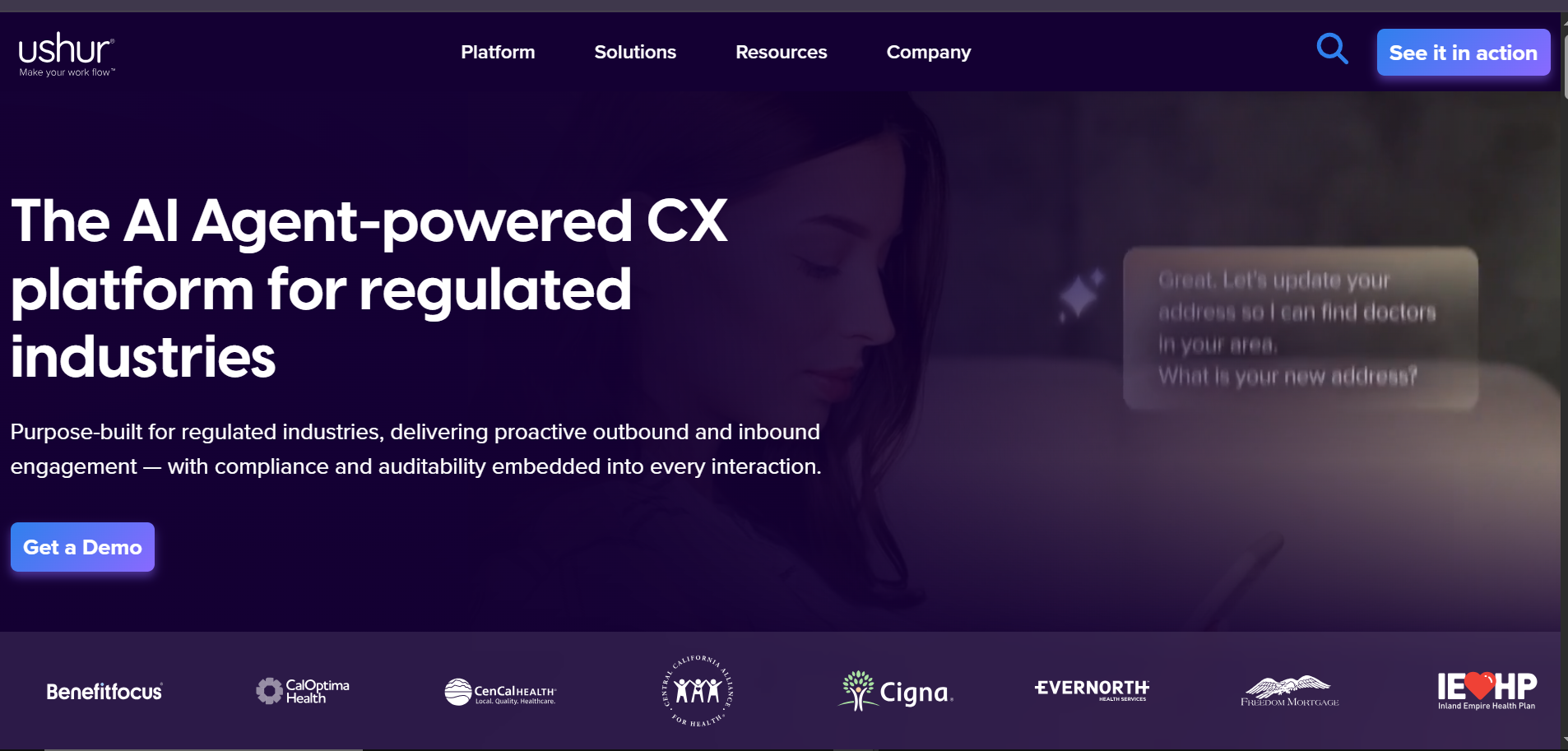
Ushur is an AI-powered customer experience automation platform built specifically for the insurance industry. Where general-purpose chatbot builders require significant configuration to handle insurance workflows, Ushur's platform is designed from the ground up for insurance-specific use cases: policyholder intake, claims status communications, renewal outreach, underwriting data collection, and benefits administration.
The platform is used by major carriers including CSAA Insurance Group, Sun Life, Aflac, and Transamerica, which is the most significant signal of production-readiness on this list. These are not pilot deployments. They are enterprise-scale operations processing millions of policyholder interactions annually on Ushur's infrastructure.
The no-code workflow builder allows business teams (not engineering teams) to configure and update insurance communication workflows. SOC 2 Type II compliance, HIPAA certification, and HITRUST certification cover the data handling requirements that regulated insurance deployments require. Multi-channel deployment covers SMS, email, WhatsApp, and web.
The knowledge update mechanism is relevant to the compliance consideration raised earlier: Ushur workflows are triggered by data events in connected systems (policy changes, claim status updates, renewal dates) rather than relying on static knowledge bases. This means the chatbot responds with live, current data rather than potentially outdated training content.
Best for: Mid-to-large insurance carriers wanting a purpose-built, compliance-certified AI automation platform with proven enterprise deployment across policyholder communications and claims workflows.
Pricing: Custom. Enterprise pricing based on interaction volume and workflow complexity. Requires a demo.
Compliance note: SOC 2 Type II, HIPAA, and HITRUST certified. Designed for regulated insurance data environments.
3. Kore.ai — Best Enterprise AI Platform for Insurance Virtual Assistants
Kore.ai provides a no-code and low-code enterprise AI platform with specific templates and integrations for the insurance industry. The platform handles full claims automation, policy servicing, and agent support from a single virtual assistant architecture that integrates with major policy administration systems, CRM platforms, and claims management tools.
The enterprise security and compliance architecture is designed for regulated industries. Data encryption, access controls, audit logging, and role-based permissions are built into the core product rather than available as add-ons. Kore.ai's insurance virtual assistants have been deployed by carriers handling 100,000+ interactions monthly, per Botpress's insurance chatbot guide.
The analytics layer provides insight into containment rates, escalation reasons, and topic categories driving the most volume — the data that justifies the AI investment and identifies where knowledge base updates are needed.
Best for: Large insurance carriers and enterprise agencies needing a full AI virtual assistant platform with compliance architecture and policy administration system integration.
Pricing: Requires a Demo.
4. Hi Marley — Best for Claims Communication and Policyholder Experience
Hi Marley is purpose-built for insurance claims communication, which makes it the most specialized tool on this list. It handles policyholder communication throughout the claims lifecycle: first notice of loss collection, document and photo submission, claim status updates, appointment scheduling with adjusters, and post-claim satisfaction follow-up.
The platform operates via SMS and WhatsApp, which is where policyholders actually communicate during a claim. A policyholder who has just been in an accident does not want to log into a carrier portal. They want to send a text. Hi Marley meets them there.
The integration with claims management systems (Guidewire, Duck Creek) means claim data flows directly from the policyholder's messages into the carrier's system of record without manual data entry. Insurance carriers using Hi Marley report 40 to 50% reductions in claims cycle time and significant improvements in CSAT scores for the claims experience, per their published case study data.
Best for: Insurance carriers wanting to improve the policyholder experience specifically during the claims process, from first notice through resolution.
Pricing: Custom. Based on policy volume and claims volume. Requires a demo.
5. Zowie — Best for Compliance-Safe Deterministic AI
Zowie's distinguishing architecture in the insurance context is its deterministic reasoning engine. Where most AI chatbots generate responses probabilistically from language model outputs, Zowie grounds every response in workflow logic and verified data. This means the chatbot cannot hallucinate a coverage term, invent a policy exclusion, or generate a response that contradicts your documented policy language.
For an industry where a single misquoted coverage term creates regulatory liability, this architectural difference is not a feature preference. It is a compliance requirement. Zowie's approach is explicitly positioned for regulated industries where answer accuracy is non-negotiable.
The platform integrates with policy administration systems, CRM platforms, and claims tools to provide live data responses (actual policy status, actual deductible, actual claim status) rather than static knowledge base answers. Zowie reports a 90% resolution rate for insurance customer service interactions in their 2026 insurance AI analysis, per their published performance data.
Best for: Insurance carriers and large agencies where regulatory compliance and response accuracy are higher priorities than deployment speed or cost.
Pricing: Custom. Per-conversation pricing based on interaction volume.
6. Kenyt.AI — Best Affordable Insurance-Specific Chatbot
Kenyt.AI offers the most complete insurance-specific feature set at the lowest price point on this list. At $50 per month, it includes claims tracking, policy query handling, lead generation workflows, and appointment booking — the core insurance chatbot use cases without the enterprise pricing.
The claims tracking feature is particularly notable at this price point. A policyholder can message the chatbot with their claim reference number and receive an immediate status update drawn from the integrated claims management system. This eliminates the most common reason policyholders call: "I just want to know what's happening with my claim."
For independent agencies and small carriers that need genuine insurance chatbot capability without a $499+ per month commitment, Kenyt.AI is the most defensible starting point.
Best for: Independent insurance agencies and small-to-mid carriers needing affordable insurance-specific chatbot capability with claims tracking included.
Pricing: Self service(Starter at $0/m) and Managed plans (Starter at $75/m) are available
7. Tidio — Best Budget Multi-Channel Option for Small Agencies
Tidio combines live chat with Lyro AI, its AI chatbot layer, in a single platform accessible at pricing that smaller insurance agencies can justify. The platform handles website chat, email, and basic social channel integration with an AI that handles FAQ deflection, lead capture, and basic qualification flows.
For small agencies where the primary need is after-hours FAQ coverage and lead capture from the agency website, Tidio's combination of human live chat and AI automation covers both. The Lyro AI handles out-of-hours traffic automatically and routes conversations to a live agent during business hours when human judgment is needed.
The trade-off is insurance specialization. Tidio does not have insurance-specific templates, claims processing integrations, or the compliance certifications of Tars or Zowie. For agencies whose chatbot requirement is FAQ handling and lead capture rather than claims automation, that trade is appropriate.
Best for: Small insurance agencies needing an affordable multi-channel chatbot for FAQ handling, lead capture, and after-hours coverage.
Pricing: Free plan available. Tidio+ plans from $29/month. Lyro AI available as an add-on.
8. Botsify — Best for Fast Deployment With Pre-Built Insurance Templates
Botsify positions itself on deployment speed: pre-built insurance chatbot templates that can be customized and launched quickly, covering policy Q&A, claim intake, and agent appointment booking. For agencies that need a functioning insurance chatbot operational within days rather than weeks, the template library removes the knowledge base construction phase that slows most deployments.
The managed service option is a differentiator for agencies without internal technical resources. Botsify offers a team that builds, deploys, and maintains the chatbot on behalf of the customer. For a principal agent at an independent agency who does not have time to configure a chatbot platform, the managed service model removes the implementation barrier entirely.
Best for: Insurance agencies needing fast deployment without significant internal technical capacity, and agencies wanting a managed chatbot service rather than a self-service platform.
Pricing: Self-service from $149/month. Managed service pricing is custom.
9. Salesforce Agentforce — Best for Carriers Committed to Salesforce
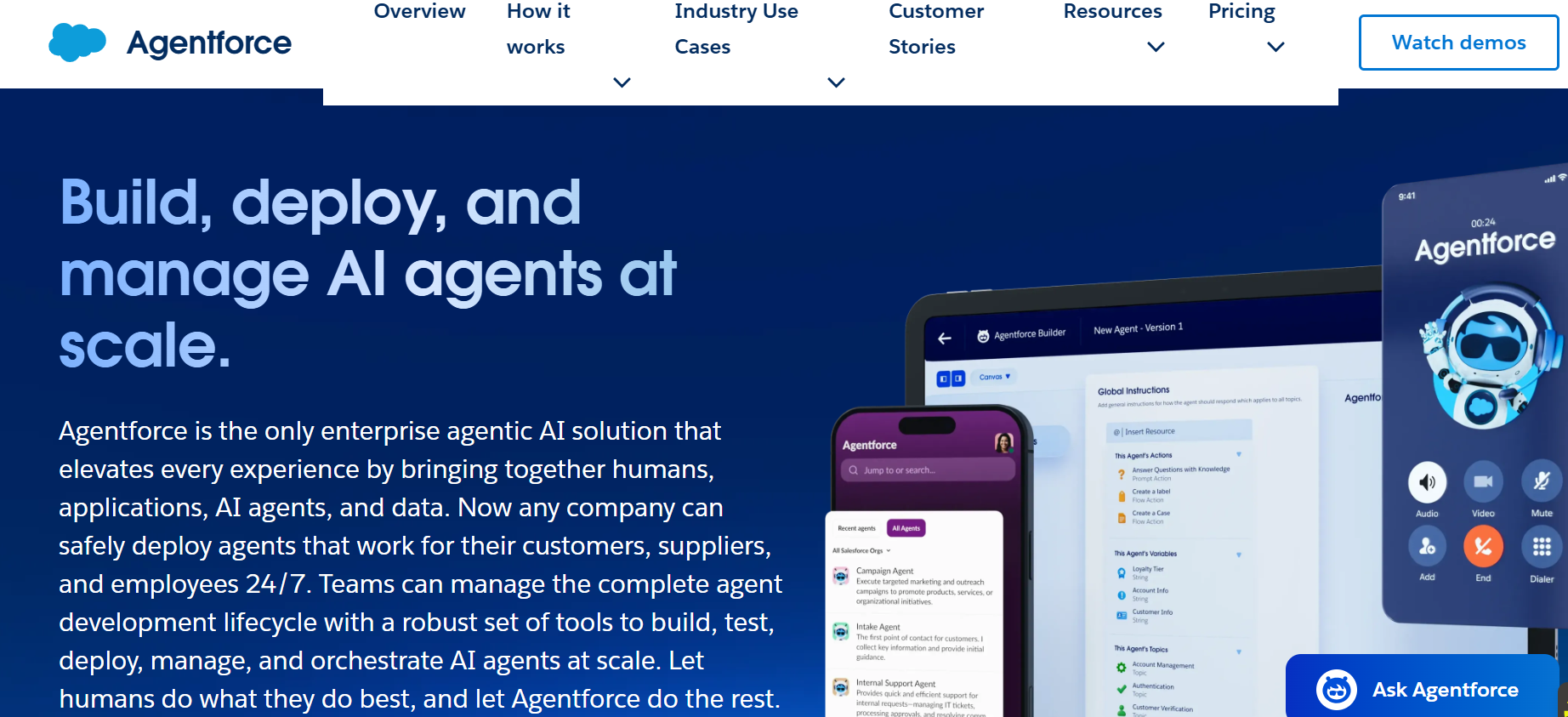
Salesforce Agentforce (the evolution of Einstein Bots) extends the Salesforce Financial Services Cloud with AI conversation capabilities, native integration with policy records, claims data, and customer history, and access to the insurance industry templates built on the Salesforce platform.
For carriers where Salesforce Financial Services Cloud is the system of record, Agentforce is not an add-on. It is the AI layer that makes the existing CRM investment conversational. Every chatbot interaction flows directly into the customer's Salesforce record, creating a complete customer history that integrates with the carrier's existing reporting, workflow automation, and compliance infrastructure.
The trade-off is significant: Agentforce only makes sense if Salesforce is already your platform. Implementation requires Salesforce consultants with Financial Services Cloud expertise, and the total cost of ownership is substantially higher than any other tool on this list.
Best for: Insurance carriers and large agencies already operating on Salesforce Financial Services Cloud who want native AI conversation capabilities within their existing platform investment.
Pricing: Custom. Enterprise Salesforce licensing. Requires a sales conversation.
10. Botpress — Best for Technical Teams Wanting Full Customization
Botpress is an open-source chatbot development platform with a hosted cloud option that gives engineering teams full control over insurance chatbot logic, conversation flows, integrations, and deployment channels. For carriers with in-house development teams who need custom claims automation workflows, specific policy administration system integrations, or multi-language support beyond what off-the-shelf platforms provide, Botpress is the most flexible foundation available.
The platform handles any conversation complexity and can be integrated with any API-accessible insurance system. The open-source nature means the conversation logic is fully auditable and customizable. The downside is that value is proportional to engineering investment. Botpress without a development team is significantly less capable than any of the specialized platforms above.
Best for: Insurance carriers and insurtech companies with in-house development teams who need a fully customizable chatbot platform with complete control over logic and integrations.
Pricing: Open-source free. Cloud Plus plan from $189/month,Team plan from $939/month. Enterprise is custom.
How to Choose the Right Insurance Chatbot
By Organization Type
Independent agents and small brokerages: Heyy, Kenyt.AI, or Tidio. All three deploy quickly without enterprise budgets or technical overhead. Heyy for agencies where WhatsApp is the primary client channel. Kenyt.AI for agencies wanting insurance-specific features at low cost. Tidio for agencies primarily needing website chat coverage.
Mid-sized agencies and regional carriers: Tars or Botsify. Both provide compliance-certified platforms with insurance-specific templates at accessible pricing. Tars for the strongest quote workflow capability. Botsify for the fastest deployment through its managed service option.
Enterprise carriers and national insurers: Kore.ai, Zowie, Hi Marley, or Salesforce Agentforce depending on the primary use case. Kore.ai for full virtual assistant capability. Zowie for compliance-critical accuracy requirements. Hi Marley specifically for claims experience improvement. Salesforce for organizations already on Financial Services Cloud.
Technical teams needing custom builds: Botpress.
The Three Questions to Ask Every Vendor
Does it answer from your documents only? This is the hallucination prevention question. The chatbot must answer only from your approved, current policy documentation. Any platform that generates responses from general AI knowledge rather than your specific documents is a compliance risk in insurance.
How does it handle knowledge updates? When your state regulator changes a coverage term, how quickly does that update reach the chatbot? Weekly? Daily? On-demand through a self-service knowledge base? The answer determines whether the platform is viable for your compliance requirements.
What systems does it integrate with natively? A chatbot that cannot access your policy administration system, CRM, and claims management tools cannot provide the live data responses (actual policy status, real claim status) that differentiate genuinely useful AI chatbots for insurance from sophisticated FAQ pages.
The gap between a policyholder who sends a WhatsApp message at 9pm about their home insurance and gets a response three days later, versus one who gets an instant answer, files their claim, and books a follow-up call all in the same conversation, is entirely an infrastructure gap. Heyy is built for independent agencies and brokers who want to close that gap on WhatsApp, Instagram, and their website without an enterprise implementation budget. The AI handles the routine volume. Your licensed team handles the judgment calls. Start free and handle your first insurance inquiry with AI today.
FAQs
What is an insurance chatbot?
An insurance chatbot is an AI-powered conversational system that handles policyholder communication, lead qualification, and claims intake automatically without requiring a licensed agent or human representative for each interaction. Insurance chatbots fall into two categories: sales chatbots that handle quote workflows, prospect qualification, and agent appointment booking; and service chatbots that handle policy queries, first notice of loss, claim status updates, and document collection. Understanding which category your primary operational need falls into is the first step in selecting the right platform.
What are the best insurance chatbot platforms 2026?
The best insurance chatbot platforms 2026 depend on organization type. For independent agencies and brokers: Heyy (WhatsApp-first), Kenyt.AI ($50/month, insurance-specific), and Tars ($499/month, SOC 2 certified). For mid-market carriers: Kore.ai or Botsify. For enterprise carriers focused on claims experience: Hi Marley or Zowie. For Salesforce-committed organizations: Agentforce. For technical teams needing custom builds: Botpress. The single most important selection criterion across all categories is whether the chatbot answers only from your approved documents, which determines compliance safety.
How do AI chatbots for insurance handle compliance?
AI chatbots for insurance handle compliance through three mechanisms. First, knowledge base restriction: the chatbot is configured to answer only from your approved, versioned policy documents rather than from general AI knowledge. Second, licensed agent escalation: any question requiring licensed agent judgment is configured to escalate immediately. Third, clear AI disclosure: the chatbot identifies itself as AI rather than a licensed agent in every interaction. Platforms with deterministic reasoning engines (Zowie) are specifically designed for regulated industries where response accuracy is a legal requirement. Compliance-certified platforms (Tars: SOC 2/ISO 27001) meet the data handling requirements for sensitive insurance data.
Can insurance chatbots process claims?
Yes, at the first notice of loss and documentation collection stages. An insurance chatbot can collect the policyholder's contact information, policy number, date and description of the incident, witness information, and supporting photos and documents. It can provide a claim reference number and set expectations for next steps. What it cannot do is make coverage determinations, authorize payouts, or make any judgment that requires a licensed adjuster. The chatbot handles the intake and information-gathering stages. A human adjuster handles the coverage determination.
How much do insurance chatbots cost?
Insurance chatbot costs range from free (Heyy, Botpress open-source) to custom enterprise pricing (Hi Marley, Zowie, Salesforce Agentforce). Mid-range platforms with insurance-specific features run from $50/month (Kenyt.AI) to $499/month (Tars). The total cost of ownership includes platform cost, implementation time, and knowledge base maintenance. Enterprise implementations with custom integrations to policy administration systems and claims management tools carry substantially higher total costs regardless of platform pricing. Calculate cost at your projected monthly conversation volume before comparing entry-level prices.
What ROI should I expect from an insurance chatbot?
The ROI calculation for AI chatbots for insurance runs across three lines. Cost reduction: replacing $7.50-per-call human interactions with $0.50-0.70-per-interaction AI handling at scale produces measurable savings from the first month of deployment. Revenue improvement: chatbot-driven quote workflows converting at 10% versus 3% for static forms on the same traffic can add $1,000+ per month in commission revenue for a modestly-trafficked independent agency site, per Boei's measured insurance account data. Retention improvement: addressing the claims experience failures that Accenture identifies as abandonment drivers directly reduces non-renewal rates.
More blog posts to read


Ready to Automate Support
Across Every Channel?
.svg)
.avif)