.svg)
Best LLM Models for Customer Service Chatbots in 2026

If you're building or upgrading a customer service chatbot in 2026, your most important decision might not be the platform you use or the flows you design, it's the LLM sitting underneath all of it.
The model you choose determines how accurately your chatbot understands customers, how fast it responds, how reliably it follows your business rules, and what you pay per conversation at scale. Get it right, and your support chatbot handles the bulk of queries confidently, with barely any human intervention. Get it wrong, and you're dealing with hallucinations, frustrated customers, and a support team that doesn't trust the bot to have their back.
The options in 2026 are genuinely strong. The tricky part is that "best" isn't a universal answer, it depends on your volume, your use case, and what your support operation actually needs.
This guide breaks down the top LLM models available right now, what makes each one worth considering, and how to match the right model to your chatbot.
Please note: LLM model names, pricing, and capabilities change frequently. The models reviewed here reflect availability and pricing as of March 2026. Always verify current pricing and model versions directly with each provider before making a deployment decision.
What Is an LLM?
LLM stands for Large Language Model. In plain terms, it's a type of AI trained on enormous volumes of text, billions of words, to understand and generate human language at a high level of fluency and relevance.
Unlike the rule-based chatbots of a few years ago, which could only match a customer's message to a pre-written response based on keywords, LLMs can interpret intent, handle ambiguous phrasing, maintain context across a long conversation, and produce replies that actually sound natural. They don't look for the right keyword to trigger a canned response, they genuinely process what's being asked and generate something appropriate in response.
In a customer service chatbot, the LLM is effectively the brain. Everything else, the interface, the knowledge base, the integrations with your CRM or order management system, exists to support what the model does: take a customer's message and decide the best possible response.
That's why the choice of model matters so much. A stronger brain means more accurate answers, fewer escalations, and a better customer experience overall.
How LLMs Power Customer Service Chatbots
An LLM doesn't operate in isolation. In a well-built customer service chatbot, the model connects to several layers: a knowledge base containing your FAQs, product documentation, and policies; your business systems like your CRM, helpdesk, or order management platform; and a set of instructions (called a system prompt) that defines how the chatbot should behave, what it can and can't do, and when it should escalate to a human.
Here's what happens in a typical interaction:
- A customer sends a message, something like "I ordered the wrong size, can I swap it?"
- The chatbot pulls relevant context from your knowledge base (your returns policy, the customer's order history from your CRM) and passes everything to the LLM.
- The LLM interprets the intent, reasons through the relevant policy, and generates a helpful, accurate response.
- The chatbot either delivers that response, triggers an action (like initiating a return), or routes the conversation to a human agent with full context attached.
The quality of every step in that loop really comes down to the model's performance. You need strong instruction-following so the agent doesn't start getting 'creative' with your return policy, and the latency needs to be low enough that the customer isn't left hanging. When a model has a context window large enough to handle your entire product catalogue and policy docs without dropping the ball, it stops feeling like a bot and starts feeling like an expert. Nailing that technical framework is what actually allows the architecture to work in practice and drive meaningful business growth.
How to Choose the Right LLM for Your Chatbot
The right model is the one that fits your use case, your budget, and your compliance constraints. Use this table to match your situation to the right starting point before you start comparing benchmark scores.
5 Best LLM Models for Customer Service Chatbots in 2026
Here's how the leading models compare across the metrics that actually matter in production support environments.
1. GPT-5 Mini (OpenAI)
.png)
GPT-5 Mini is the model most customer service chatbots are running on in 2026, and there's a clear reason: it delivers near-flagship language quality at a cost and speed that makes it viable at scale. Its function calling capabilities, the ability to check order status, look up accounts, create support tickets, and trigger CRM updates, are among the most reliable of any model on this list.
For teams building a general-purpose support chatbot that needs to handle a wide range of queries without burning through API budget, GPT-5 Mini is the safest starting point. It strikes the right balance between response quality, latency, and cost-per-conversation, especially for standard workflows like FAQ resolution, returns, and account inquiries.
At $0.25 per million input tokens and $0.50 per million output tokens, a typical support conversation averaging 3,000 tokens costs a fraction of a cent to process, which becomes very significant when you're running thousands of conversations a day.
Best for: General support workflows, FAQ resolution, high-volume query handling, CRM integrations
Watch out for: May need more specific prompting for highly specialized or technical domains
2. Claude Sonnet 4.6 (Anthropic)
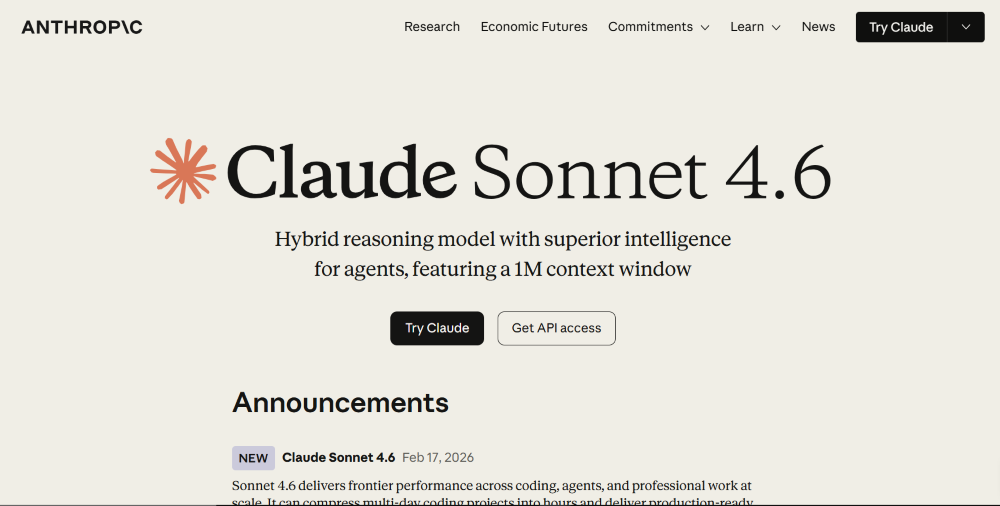
Claude Sonnet 4.6 is built for scenarios where your chatbot needs to reason carefully over detailed documentation, complex policies, or lengthy technical content. Its 200K token context window is the largest among commercial models on this list, which means you can pass it your entire returns policy, a full product manual, or a 50-page compliance document, and it won't lose track of any of it.
Where Claude really earns its reputation is instruction-following. If you've ever watched a chatbot go off-script and offer a customer a refund your policy doesn't support, you understand why this matters. Claude is widely considered the most reliable model when it comes to staying within the boundaries you define in your system prompt, a critical feature for industries like finance, healthcare, or legal tech where accuracy and compliance are non-negotiable.
The cost is higher than GPT-5 Mini, so Claude makes the most sense when precision outweighs price, used selectively for complex cases rather than as the default model for all query types. Pricing for Sonnet 4.6 starts at $3 per million input tokens and $15 per million output tokens, to learn more, check out their pricing page
Best for: Documentation-heavy support, regulated industries, technical product support, legal and policy adherence
Watch out for: Higher per-token cost makes it less practical as a default model for high-volume, simple queries
3. Gemini 3.1 Flash (Google)
.png)
If cost-per-conversation is your primary constraint, Gemini 3.1 Flash is hard to beat. At $0.25 per million input tokens, it's the most economical option on this list with genuinely competitive quality. Its 1 million token context window is also the largest of any model here, theoretically capable of processing an enormous knowledge base in a single call. And its response latency is the lowest of the group, which matters directly in live chat experiences.
The trade-off is a slightly lower language quality score compared to GPT-5 Mini and Claude, a difference you'll notice more in nuanced, emotionally sensitive, or ambiguous customer queries. You can check out more on their pricing here.
For straightforward FAQ automation and order status checks at high volume, it performs very well. For complex support interactions that require careful reasoning or empathy, a stronger model is worth the extra cost.
Best for: High-volume, cost-sensitive chatbot deployments, simple FAQ and transactional automation
Watch out for: Less suited to complex reasoning tasks or situations that require careful tone management
4. Llama 4 70B (Meta)
.png)
Llama 4 is the only open-source option on this list, and for some organizations, that's the entire point. You can deploy it on your own infrastructure, which means your customer data never touches a third-party server. For businesses in healthcare, finance, insurance, or any industry with strict data residency requirements, that level of control over where your data lives and who processes it is genuinely valuable, and sometimes legally required.
The trade-offs are real. You'll need a capable engineering team to manage deployment, performance and latency vary depending on your hardware, and out-of-the-box language quality is a step below the commercial models. With domain-specific fine-tuning, that quality gap narrows significantly, but fine-tuning requires additional investment.
Llama 4 isn't a plug-and-play option. It's the right choice for teams that have the technical infrastructure to manage it and a compliance requirement that rules out cloud-based models.
Best for: Privacy-first deployments, data-sensitive industries, teams with ML infrastructure
Watch out for: Significant engineering overhead, not suitable for teams without dedicated ML resources
5. Mistral Large (Mistral AI)
.png)
Mistral Large earns its spot primarily for European organizations with GDPR obligations. Mistral AI is a French company, which makes it a natural fit for businesses that need a European AI provider for data processing compliance. Its language quality is solid, latency is fast, and pricing sits comfortably in the mid-range at $0.5 per million input tokens.
For companies based outside the EU, or for whom data residency isn't a driving concern, GPT-5 Mini offers stronger ecosystem depth and comparable quality at a lower price. But if your legal team needs an EU-based AI provider, or your support operation primarily serves European customers with strict privacy expectations, Mistral Large is the cleanest solution.
Best for: GDPR-regulated organizations, EU-based support operations, European data residency requirements
Watch out for: Less integration ecosystem depth compared to OpenAI and Google.
Hallucination Risk and How to Prevent It
Every LLM on this list can hallucinate. That is not a criticism, it is a structural property of how large language models work. They generate probabilistically plausible responses, which means they can produce answers that sound confident and completely wrong. In a customer service context, that looks like a chatbot citing a returns policy that does not exist, quoting a price that has not been accurate for six months, or making a commitment your team cannot honour.
The most effective mitigation is RAG, Retrieval-Augmented Generation. Rather than asking the LLM to answer from its training data, RAG connects the model to your actual knowledge base (your policies, your FAQs, your product documentation) and retrieves the relevant section before generating a response. The model answers from your approved content, not from a guess. This single change reduces hallucination rates significantly in production deployments.
Three practical steps to reduce hallucination risk:
1. Use RAG: connect your LLM to a regularly updated knowledge base. Every policy change, pricing update, or product launch should be reflected in the knowledge base before it goes live to customers. An outdated knowledge base is as dangerous as no knowledge base.
2. Set a confidence threshold: configure your chatbot to route a conversation to a human agent if the model's confidence score on its response falls below a defined threshold (typically 70–80%). Most production chatbot platforms expose this as a configurable setting. This catches the edge cases where the model is likely to guess rather than know.
3. Limit the model's scope: your system prompt should explicitly define what topics the chatbot can and cannot address. A model that knows it should only answer questions about orders, returns, and product specs is significantly less likely to hallucinate on topics outside that scope than one with a broad, open-ended brief.
Of the models on this list, Claude Sonnet 4.6 has the strongest instruction-following when scope boundaries are defined in the system prompt, making it the best choice for use cases where hallucination risk is a primary concern. GPT-5 Mini and Gemini Flash both benefit substantially from RAG and confidence thresholding in production.
Key Considerations Before Selecting an LLM
Benchmark scores are a starting point, not a final answer. Here's what actually matters when you're deploying an LLM in a production support environment:
Latency
A 2-second response time feels unacceptable in a live chat window. Measure latency at the 50th percentile, not just the average — an occasional slow response is tolerable, but a consistently slow median will frustrate customers and undermine trust in your chatbot. Fast models like Gemini Flash and GPT-5 Mini are designed with this in mind.
Cost Per Conversation, Not Per Token
The per-token price only makes sense in context. A typical customer service conversation runs between 2,000 and 5,000 tokens. Multiply that by your daily conversation volume to get the real monthly cost of each model, that number will matter more than any headline pricing figure.
Instruction Adherence
Can the model follow your system prompt without going off-script? This is critical for chatbots that need to stay strictly within your defined policies, escalation rules, and brand voice. Claude Sonnet 4.6 leads on this metric, but all major commercial models have improved significantly in this area over the past 12 months.
Function Calling Reliability
If your chatbot needs to take actions, checking an order, creating a ticket, querying an account balance, the model's function calling reliability matters more than general language quality. Not all LLMs are equally consistent in deciding when and how to call an external function. GPT-5 Mini and Claude Sonnet 4.6 are the strongest performers here.
Security and Compliance
Where is your customer data actually sitting? What kind of certifications does the provider bring to the table? If you're in a regulated industry, these questions can disqualify a model before you even get to testing its response quality. It’s much better to bake these fundamentals into your AI customer service strategy early on, rather than treating security and compliance as an afterthought
How Heyy Handles LLM-Powered Customer Service
Choosing the right LLM is the foundation. Getting it to reliably serve your customers, connected to your knowledge base, integrated with your business systems, and operating within carefully defined guardrails, is where the real work happens.
Heyy is an AI chatbot platform built specifically for customer-facing support. Rather than locking you into a single underlying model, Heyy is designed to work with the leading LLMs, so you can match the right model to the right query type without rebuilding your chatbot every time a new model generation releases. Set up your knowledge base, map your support flows, and let Heyy manage the orchestration layer, so your team focuses on the complex, high-stakes interactions that genuinely need a human touch.
For e-commerce teams, the real value comes from connecting the agent directly to your store data so it can autonomously manage things like order status, returns, and product questions. On the SaaS side, it’s more about surfacing technical documentation or routing tickets based on the specific context of a query.
The underlying model does the reasoning, but the platform ensures it has the right information to make those calls. This level of integration is a core reason why certain tools are topping the list of AI chatbots for small businesses in 2026, especially when the goal is to solve operational bottlenecks rather than just adding a new feature.
How to Connect an LLM to Your Customer Service Chatbot'
Even the strongest LLM will underperform without a thoughtful integration. Here's what separates chatbots that actually work from ones that get turned off after two weeks:
Ground it in your data
An LLM without access to your specific product documentation, policies, and FAQs will give generic or incorrect responses. Use Retrieval-Augmented Generation (RAG) to connect the model to a live, regularly updated knowledge base. This is the single most impactful thing you can do to improve response accuracy.
Write a detailed system prompt
Your system prompt is your chatbot's operating manual. Define the tone, the persona, what it can and can't say, escalation triggers, and any policies it must follow precisely. The more specific you are, the more reliable the output, especially with models like Claude that are built to adhere closely to your instructions.
Start with one query type
Don't try to automate everything from day one. Pick your highest-volume, most repetitive query category, usually order status or account FAQs, get that working reliably, then expand. You'll catch edge cases early and build team confidence in the system before rolling it out more broadly.
Monitor and iterate continuously
LLMs are not set-and-forget. Track where your chatbot fails, escalates unexpectedly, or produces responses your team would flag. Use that data to refine your prompts, fill gaps in your knowledge base, and improve your flows over time. The best-performing chatbots in production are the ones that get actively maintained.
Build a clean human handoff
When a chatbot hits a wall, the move to a human agent has to be invisible. The quickest way to kill customer satisfaction is making someone repeat their entire problem just because the "bot" finished its turn. Keeping that full conversation context is a small detail, but it’s often what separates a frustrating experience from a great one. It’s also a huge factor when you’re weighing a specialized AI chatbot against a tool like ChatGPT for your day-to-day support.
Deploy on a platform built for customer service
Connecting an LLM to your support operation requires an orchestration layer that handles knowledge base retrieval, conversation memory, channel routing, human handoff, and analytics simultaneously. Building that from scratch is a significant engineering project.
Heyy is built to handle this layer for you. Connect your LLM of choice, upload your knowledge sources, configure your AI agent's scope and tone, and deploy across WhatsApp, Instagram, Facebook Messenger, and website chat from a single inbox. Setup takes about 15 minutes.
Deploy your LLM-powered chatbot today for free→
The Right LLM for the Right Job
There's no single best LLM for every customer service chatbot in 2026, but there is a best LLM for your specific context, your volume, your industry, and the kinds of queries your customers actually send.
GPT-5 Mini covers most general support needs with excellent quality at a competitive cost. Claude Sonnet 4.6 wins when accuracy, compliance, and complex documentation are on the line. Gemini Flash leads on price-per-conversation for high-volume deployments. Llama 4 and Mistral Large step in when data control or regional compliance drives the decision.
What all of these models have in common is that their value is only realized through the right implementation, a strong knowledge base, thoughtful prompting, and a platform built to connect the pieces. If you're ready to put a capable LLM to work in your support operation, Heyy gives you the infrastructure to get there faster and you can start your free trial here.
Frequently Asked Questions
What is an LLM and how does it power a chatbot?
An LLM (Large Language Model) is an advanced AI trained on billions of words to understand and generate human-like language. Unlike older chatbots that relied on simple keywords, LLMs act as the "brain" of a service bot, interpreting complex intent, handling ambiguous questions, and maintaining context across long conversations to provide natural responses.
Which LLM is the best overall for high-volume support?
GPT-5 Mini is currently the most popular choice for general support in 2026. It offers a high language quality (9/10) with fast latency at a very competitive cost ($0.15 per 1M input tokens), making it ideal for standard workflows like FAQs, returns, and account inquiries.
Which model should I use if I have very complex documentation?
Claude Sonnet 4.6 is the leader for documentation-heavy or highly regulated industries. It features a large 200K token context window and is widely regarded as the most reliable model for strictly following business rules and complex system prompts.
What is the most cost-effective model for a limited budget?
Gemini 3.1 Flash is the most economical option, costing only $0.075 per million input tokens. While its language quality is slightly lower than GPT-5 or Claude, it offers the lowest latency and a massive 1-million-token context window, making it perfect for high-volume, straightforward transactional automation.
How do I choose a model if I have strict data privacy requirements?
There are two main options depending on your location and needs:
- Llama 4 (70B): Best for organizations that need a privacy-first, self-hosted environment where data never leaves their own servers.
- Mistral Large: Best for EU-based organizations that must comply with strict GDPR or European data residency requirements.
What LLM does Heyy use?
Heyy is designed to work with the leading LLMs rather than being locked to a single model. This means you can match the right model to your specific use case. The platform handles the orchestration layer (knowledge base retrieval, conversation memory, channel routing, human handoff) regardless of which model is underneath.
Is GPT-4 still good for customer service in 2026?
GPT-4 is still capable, but GPT-5 Mini offers comparable quality at a significantly lower cost and with faster response times. For new deployments in 2026, starting with GPT-5 Mini rather than GPT-4 makes more sense on both performance and pricing grounds. If you are already running GPT-4 in production and it is working well, the cost savings from migrating to GPT-5 Mini are worth evaluating but there is no urgent reason to migrate if your current setup is stable.
What's the difference between GPT-5 and Claude for customer service support?
The main practical difference is where each model excels. GPT-5 Mini is the stronger choice for high-volume, general support workflows, fast, cost-effective, and reliable at function calling (checking orders, updating CRM records). Claude Sonnet 4.6 is the stronger choice when your chatbot needs to reason over long, complex documentation or operate under strict policy constraints. Claude is widely considered the most reliable model for staying within defined boundaries in a system prompt, which matters significantly in regulated industries. For most teams, GPT-5 Mini is the default and Claude is the specialist layer for complex query routing.
How much does it cost to run an LLM-powered chatbot?
It varies significantly by model and volume. A rough calculation: a typical customer service conversation runs 2,000–5,000 tokens. At GPT-5 Mini's pricing ($0.15 per million input tokens), that's roughly $0.001 per conversation, less than a tenth of a cent. At 10,000 conversations per month, your raw API cost is around $10. Claude Sonnet 4.6 is more expensive at $3 per million input tokens, the same 10,000 conversations cost closer to $150–$300. Gemini Flash is the cheapest at $0.075 per million input tokens. Beyond the model cost, factor in platform fees (if you're using a chatbot platform like Heyy), knowledge base hosting, and any fine-tuning costs if you're using an open-source model like Llama 4.
More blog posts to read

Ready to Automate Support
Across Every Channel?
.svg)
.avif)