.svg)
Multilingual AI Chatbots: Features, Benefits & Use Cases

.png)
Think about your ideal customer base. Unless you're intentionally leaving money on the table, you aren't just selling to English speakers. Picture what that actually looks like: a buyer in São Paulo sends a WhatsApp message in Portuguese. A prospect in Riyadh opens your website chat and types in Arabic. A potential client in Tokyo submits a pre-sales question in Japanese
All three are highly motivated to buy. All three are waiting for an immediate response. And if your support system cannot engage them in the exact language they are using, all three will simply close the window and find a competitor who can.
This is the language gap, and it is quietly costing scaling businesses far more revenue than they realize. According to CSA Research, 76% of online shoppers prefer to buy products with information in their native language, and 40% will never buy from websites in other languages. Furthermore, data from Intercom reveals that 70% of end users feel more loyal to companies that provide support in their native language, while 29% of businesses admit they have lost customers specifically because they lacked multilingual support.
As businesses expand across borders, the financial cost of ignoring this problem compounds with every new market you enter. A native multilingual AI chatbot solves this directly, allowing you to scale without needing to hire a massive, globally distributed support team for every region you operate in.
This guide covers exactly what this technology is, why it matters, the core features that determine whether it actually works, and the specific use cases where it delivers the clearest measurable return on investment.
What Is a Multilingual AI Chatbot?
A multilingual AI chatbot is an AI-powered conversational system that detects the language a customer is using, responds fluently in that same language, and maintains that consistency across the entire conversation, even if the customer switches languages mid-thread.
This is not the same as a translated chatbot. A translated chatbot takes content written in one language and runs it through a translation layer before displaying it to the user. The output is technically the correct language but often reads as mechanical, misses idioms, mistranslates industry-specific terms, and falls apart the moment a customer phrases something outside the expected script.
A native multilingual AI chatbot understands the intent behind a message in the original language, formulates a response in that language from the ground up, and adapts tone and phrasing to match cultural expectations, not just vocabulary. The difference in customer experience between these two approaches is significant. One feels like a business that speaks your language. The other feels like a business that ran your question through Google Translate.
Modern multilingual AI chatbots handle 40 to 100+ languages depending on the platform, operate across website chat, WhatsApp, Instagram, and email simultaneously, and require no separate configuration for each language you support. You train the system once on your product knowledge, policies, and brand voice. The AI handles the language layer automatically.
Why Multilingual Support Is No Longer Optional

The framing of multilingual support as a premium feature for enterprise businesses with global ambitions is outdated. It is now a baseline requirement for any business that operates in a market with more than one language, or any business that sells online and has customers arriving from more than one country.
Language is the first filter. A customer who cannot understand your support interface does not contact you. They leave. That departure does not register as a lost sale in your analytics. It registers as nothing at all, which is why most businesses underestimate how much the language gap is costing them.
The numbers are unambiguous: Studies show that businesses with multilingual websites experience an average 70% increase in conversion rates, with some brands seeing up to a 100% rise in online sales after full localization. That is not a marginal improvement from a niche feature. That is revenue sitting in your existing traffic that your language barrier is actively blocking.
The support cost argument runs in both directions. Hiring human agents who speak each language your customers use is expensive, slow to scale, and impossible to run 24/7. A single AI in customer service handles every language you operate in, at every hour, simultaneously. One deployment covers your entire global footprint without the per-language staffing cost.
WhatsApp and Instagram changed the geography of customer communication. Your customers are not all on your website. Many of them are messaging you through WhatsApp and Instagram in their native language at times that have nothing to do with your business hours. If your AI only works in English on your website, you are invisible to a significant portion of the people actively trying to reach you.
Gartner notes that 80% of customer service organizations are expected to use generative AI by 2025, enabling them to handle routine multilingual interactions at scale while keeping humans for complex problem-solving. The businesses building multilingual capability into their AI now are the ones who will own those interactions in markets their competitors simply cannot serve.
The Real Cost of the Language Gap
Before the features and use cases, one calculation worth doing.
Take your monthly website traffic. Identify what percentage comes from non-English-speaking countries. Now apply an average 20% conversion rate improvement from multilingual support to that traffic segment. Multiply by your average order value or lead value.
For a business generating $50,000 per month in revenue with 40% of traffic from non-English markets, a 20% conversion improvement on that segment adds $4,000 per month. $48,000 per year. From fixing a language barrier, not from increasing ad spend.
The language gap is a revenue problem. Treat it like one.
Key Features of a Multilingual AI Chatbot
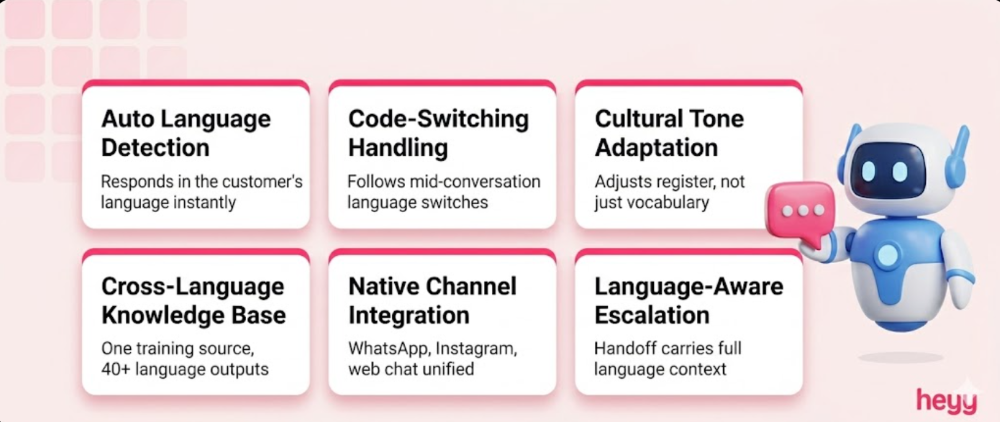
Not all multilingual chatbots deliver equally. These are the features that separate the ones that genuinely serve international customers from the ones that claim to while quietly delivering a degraded experience in languages other than English.
Automatic Language Detection
The chatbot must identify the customer's language from the first message and respond in kind, without the customer having to select a language from a dropdown or configure a preference. A customer who messages in French and receives an English reply before being asked to set a language preference has already had a negative experience. Detection must be immediate, accurate, and silent from the customer's perspective.
Code-Switching Handling
Code-switching is when a customer moves between two languages within a single conversation. "Hola, I need help with my order, es urgente." This is not an edge case. It is common in bilingual markets: Spanish-English, French-English, Arabic-English, and dozens of other combinations. A multilingual AI chatbot must handle mid-conversation language switches without losing context, misinterpreting the message, or defaulting to a single language for the remainder of the thread. Most translation-layer systems fail here. Native multilingual AI handles it correctly.
Cultural Tone Adaptation
Language and tone are not the same thing. Directness that reads as confident in American English reads as aggressive in Japanese communication norms. Formal address that feels respectful in Arabic feels stiff and outdated in Dutch. A multilingual AI that translates words without adapting tone is delivering the correct vocabulary with the wrong register. Look for platforms that adapt both.
Consistent Accuracy Across Languages
The most common failure mode in multilingual AI deployments is English-first quality. The English responses are accurate and natural. The Spanish responses are mostly correct. The Arabic responses are technically intelligible but feel mechanical. The Thai responses are unreliable. Quality parity across every language you deploy is a non-negotiable requirement, not an aspiration. Test your target languages before you go live.
Knowledge Base Training That Carries Across Languages
Your chatbot is trained on your product catalog, policies, and FAQs. That training should apply in every language the chatbot supports, without you having to create separate knowledge bases for each language. You build the knowledge once. The AI delivers it accurately in 40+ languages from that single source.
Native Integration With Messaging Channels
Your international customers are not only on your website. They are on WhatsApp, Instagram, Facebook Messenger, and Telegram. A multilingual AI that only operates on your website chat handles a fraction of your cross-border communication volume. The platforms that matter for global customer support AI are the ones that cover all the channels your international customers actually use.
Human Escalation With Language Context
When the AI escalates a conversation to a human agent, it should pass the language of the conversation along with the full chat history. An agent receiving an escalated Arabic conversation should know it is in Arabic before they open it, not discover it mid-response. Poor escalation design is the point where multilingual AI deployments most visibly fail.
Benefits of Using a Multilingual AI Chatbot
You Serve Every Market Without Expanding Your Team
One AI system handles customer conversations in 40, 60, or 100+ languages simultaneously. You do not hire a French-speaking agent for your Paris traffic, a Portuguese speaker for your Brazil customers, and an Arabic speaker for your Gulf market. The AI handles all of them, 24/7, without shift scheduling or language-specific management overhead.
Your Conversion Rate Improves in Every Non-English Market
Language is one of the highest-friction points in the international customer journey. Removing it produces a measurable improvement in conversion rates from those markets. The 20 to 30% improvement rate reported across multilingual implementations is not a soft metric. It represents real orders from customers who would have otherwise left without buying.
Response Times Drop to Seconds in Every Language
The average human multilingual support response time depends on whether you have an agent available in the right language at the right hour. The average AI response time is under 10 seconds, in any language, at any time. For international customers operating in different time zones, this gap is the difference between a business that feels accessible and one that feels unreachable.
Your Brand Voice Stays Consistent Globally
Without multilingual AI, your brand voice in a non-English market is determined by the individual agent or freelance translator handling those conversations. That introduces variance. With a well-configured multilingual AI chatbot, the tone, vocabulary, and brand positioning your marketing team worked to define stays consistent across every language you operate in.
You Get Data From Markets You Previously Could Not Measure
Every conversation your multilingual AI handles generates data. What are French customers asking about most? What questions do your Arabic-speaking customers ask that your English-speaking customers never raise? What objections come up repeatedly in Spanish that never appear in English? These insights are invisible when your international support runs through informal channels. A multilingual AI makes them systematic and searchable.
You Scale Into New Markets Without a Support Rebuilding Project
Without AI, entering a new geographic market means hiring new agents, training them, building language-specific workflows, and waiting months before your support operation is ready. With a multilingual AI chatbot already in place, entering a new language market means updating your knowledge base with any market-specific information and going live. This is precisely where AI in customer service delivers its most compelling competitive advantage: the infrastructure is already built, and scaling it costs a fraction of what manual scaling would require.
Translation Layer vs. Native Multilingual AI: The Difference That Matters

Most businesses evaluating multilingual chatbots do not realize they are choosing between two fundamentally different architectures. The marketing material for both often looks identical.
Translation-layer chatbots are built in one language, typically English, and run every output through a translation API before delivering it to the customer. The chatbot thinks in English. The customer receives translated English.
This creates several consistent problems. Idioms translate literally and confusingly. Industry-specific terminology gets translated generically rather than using the correct term in the target language. Tone is inherited from the source language rather than adapted to the target culture. And the system degrades further every time the customer's phrasing does not match the pattern the English version was trained on.
Native multilingual AI understands and generates responses in the customer's language directly. It does not translate. It formulates. The output reads as natural language in the customer's tongue because the AI is operating in that language from the start of the process, not converting from another one at the end.
The practical test is simple. Take a common customer question in your business. Ask it in Spanish using natural, slightly informal phrasing, the way a real customer would write it. See how the chatbot responds. A translation-layer system will often return a response that is grammatically correct but stilted and obviously not written by a native speaker. A native multilingual AI returns a response that sounds like it was written by someone who thinks in Spanish.
That distinction determines whether your international customers feel served or tolerated.
How Industries Are Using Multilingual AI Chatbots

E-Commerce
An online store selling to customers across Latin America, Europe, and the Middle East handles customer inquiries across five languages simultaneously through a single WhatsApp business number. The AI responds to order status questions, return policy queries, and product questions in each customer's language without any language routing configuration. The multilingual support chats eliminate the friction that was previously causing 30% of non-English customers to abandon their queries before resolution. International conversion rates improve measurably within the first 60 days.
Healthcare and Wellness
A telehealth platform serving patients across multiple countries uses a multilingual AI chatbot to handle appointment booking, pre-consultation intake, and post-appointment follow-up. Patients communicate in their native language. The AI gathers the information the clinical team needs, in structured form, in English, for internal review. The patient never knows this translation happens behind the scenes. The experience feels native. The operational workflow remains standardized.
Financial Services
A fintech company operating across Southeast Asia and the Middle East uses a multilingual chatbot to handle account inquiries, transaction questions, and onboarding support in Thai, Bahasa, Arabic, and English. Regulatory and compliance language is handled through locked terminology glossaries that ensure consistency across all language versions. The AI in customer service layer handles 70% of inbound volume, freeing the human team to focus on complex account issues that require judgment.
Travel and Hospitality
A travel booking platform receives inquiries from customers in 30 countries. Before implementing multilingual AI, the support team handled non-English queries through a combination of Google Translate and delayed responses from contracted translators. Response times for non-English inquiries averaged 6 hours. After implementing a multilingual AI chatbot across WhatsApp and website chat, response times across all languages dropped to under 60 seconds. Booking completion rates from non-English markets increased by 24% in the first quarter.
SaaS and Technology
A B2B SaaS company expanding from North America into European and MENA markets uses a multilingual chatbot to handle pre-sales inquiries and onboarding support in French, German, Arabic, and Spanish. The sales team closes deals in markets they previously had to deprioritize because they lacked the language capability to support the post-sale experience. Multilingual support chats handled by AI turned four potential markets from risks into revenue contributors.
How to Implement a Multilingual AI Chatbot
Step 1: Identify Your Language Priority List
Do not try to support every language simultaneously from day one. Pull your traffic analytics and identify which non-English languages appear most frequently in your inbound data. Rank them by volume and by revenue potential. Your top three to five languages represent the markets where multilingual AI will deliver the fastest measurable return. Start there and expand as you validate the impact.
Step 2: Audit Your Knowledge Base for Translation-Readiness
Your chatbot will be trained on your existing content. Before you configure the AI, review that content for clarity. Remove idioms, colloquialisms, and culturally-specific references that will not translate cleanly. Write your policies, FAQs, and product descriptions in plain, direct language. The cleaner your source content, the more accurately the AI will represent it in every language.
Step 3: Choose a Platform With Native Multilingual Architecture
As established above, the architecture choice matters more than the feature list. Test candidate platforms with real customer queries in your target languages before committing. If the Spanish responses sound like translated English, the platform is using a translation layer. If they sound like natural Spanish, it is native multilingual. The test takes 20 minutes and eliminates the most common implementation mistake.
Step 4: Configure Your Escalation Paths by Language
Before going live, define what happens when the AI cannot resolve a query in each language. If you have a French-speaking agent on your team, route French escalations to them. If you do not, configure the escalation message to acknowledge the limitation honestly and set a response time expectation. A customer who receives an honest "our team will follow up in your language within 4 hours" has a better experience than one who receives a confusing English-language escalation with no context.
Step 5: Deploy on the Channels Your International Customers Use
Your international customers may use WhatsApp more than your domestic customers do. They may be more active on Instagram or Facebook Messenger. Deploy your multilingual AI on the channels that match your international traffic patterns, not just the ones you are most comfortable managing. The ChatGPT languages and global support framework applies here: meet customers in the channel and the language they are already using.
Step 6: Test Every Language Before You Go Live
Test each language with native speakers if possible. If not, test with natural, slightly informal phrasing that reflects how real customers write rather than how a formal language test would. Check for: accuracy of product and policy information, appropriate tone and register for the culture, correct handling of code-switching, and graceful failure when the question falls outside the knowledge base. Fix what you find before real customers encounter it.
Common Mistakes That Undermine Multilingual AI Implementations
Assuming English-quality means all-language-quality: The most common failure mode. Platforms that perform well in English often deliver a noticeably degraded experience in less commercially prioritized languages. Always test the languages you intend to deploy, not just English.
Skipping cultural tone configuration: Language without cultural context produces responses that are technically correct and socially awkward. Formal, informal, direct, deferential. These dimensions vary by language and by market. A multilingual AI that has not been configured for tone produces a uniform voice that feels foreign in every market it serves.
Building separate knowledge bases per language: This is how translation-layer systems work and it creates maintenance overhead that compounds over time. Every time you update a policy in English, you need to update it in five other languages. A native multilingual AI trained on a single source of truth eliminates this problem entirely.
Deploying only on website chat: Your WhatsApp and Instagram channels receive international messages too. A multilingual AI that only covers your website chat leaves the bulk of your cross-border messaging volume unaddressed. See which 5 multilingual AI chatbots handle this correctly.
Not tracking language-specific performance separately: If your analytics report chatbot performance as a single aggregate number, you cannot see that your Spanish performance is strong and your Arabic performance is weak. Track key metrics by language from day one. Booking completion rates, escalation rates, and CSAT scores segmented by language tell you where to optimize.
How to Measure the ROI of Multilingual AI
These are the five numbers that tell you whether your investment is paying off.
Conversion rate by language segment: Set your pre-implementation baseline. Track monthly. An improvement in conversion rate from non-English traffic segments is your most direct revenue signal.
Escalation rate by language: High escalation rates in specific languages indicate the AI is not handling those conversations well. This metric directs your optimization effort efficiently.
Response time by language: If your global customer support AI is working correctly, response times across all language segments should converge toward the AI's baseline speed. Significant variation indicates the chatbot is not covering certain languages effectively.
Support volume handled vs. escalated, by language: What percentage of conversations in each language are the AI resolving independently? Track this over time. Improvement indicates the AI is learning and the knowledge base is maturing. Stagnation or decline indicates a training problem. Businesses with well-optimized multilingual support chats consistently hit resolution rates above 70% across all supported languages within the first 90 days.
Revenue attributed to international segments, before and after: This is the macro number that ties everything together. Growth in revenue from markets where you previously had a language gap, against a stable or declining support cost in those markets, is the clearest possible ROI signal.
Finally, If your customer base already spans more than one language and your current support system does not match that reality, Heyy is built for exactly this use case. One inbox covers WhatsApp, Instagram, Facebook Messenger, and your website chat. The AI handles conversations in your customers' languages automatically, across every channel, without separate configuration for each market. No per-seat pricing. No per-language setup. Start free and handle your first multilingual conversations with AI today.
FAQs
What is the difference between a multilingual chatbot and a translated chatbot?
A multilingual chatbot understands and generates responses natively in the customer's language. A translated chatbot is built in one language and converts its output through a translation API before delivering it. The first reads as natural language to the customer. The second reads as translation. The distinction is most visible with idioms, cultural expressions, and industry-specific terminology, where translation-layer systems consistently produce awkward or inaccurate output.
How many languages can a multilingual AI chatbot support?
Most modern platforms support between 40 and 100+ languages. The number matters less than the quality. A platform claiming 100 languages but delivering reliable quality in only 20 is less useful than one claiming 50 languages with consistent accuracy across all of them. Always test your specific target languages before committing to a platform.
Does a multilingual chatbot require separate setup for each language?
Not with a native multilingual AI platform. You configure the chatbot once: knowledge base, tone guidelines, escalation paths, and conversation flows. The AI handles the language layer automatically for every supported language from that single configuration. Translation-layer platforms often do require per-language setup, which is one of the reasons they are architecturally inferior for multi-market operations.
Can a multilingual AI chatbot handle WhatsApp and Instagram in multiple languages?
Yes, but not all platforms cover social channels with the same quality as website chat. When evaluating tools, specifically test the multilingual behavior on WhatsApp and Instagram if those channels are significant for your business. The language detection and response quality should be identical across all channels, not just on the website widget.
What happens when a customer uses a language the chatbot does not support?
A well-configured chatbot handles this gracefully. It acknowledges that it cannot respond in the customer's language, offers the closest supported language as an alternative, and provides a clear escalation path to a human agent. It should never silently default to English without acknowledgment, as this signals to the customer that their language is not supported rather than actively managed.
How quickly can a multilingual AI chatbot be deployed?
A basic deployment covering your primary languages can be live in under a day on most modern no-code platforms. A full implementation covering multiple channels, all your target languages, cultural tone configuration, and a tested escalation path typically takes three to five business days. The testing phase for each language is what drives the timeline up. Do not skip it.
How does a multilingual chatbot handle code-switching?
Code-switching is when a customer mixes two languages in a single message or switches languages mid-conversation. A quality multilingual AI detects the dominant language of each message and responds in kind, following any switch without losing context. Lower-quality systems default to one language and stay there regardless of what the customer does. Test this specifically: send a message that mixes two of your target languages and see how the chatbot responds.
More blog posts to read

Ready to Automate Support
Across Every Channel?
.svg)
.avif)