.svg)
Top 7 AI Chatbots for Dentists: Features, Pricing & What to Look For


Imagine a patient chipping a tooth at 9:00 PM on a Thursday night. They are in pain, a bit anxious, and scrolling through Google on their phone trying to find a clinic that can see them tomorrow morning. They click over to your website, but instead of getting an instant answer, they see a static "Contact Us" form promising a reply sometime within 24 hours.
What do they do? They close the tab, find a competitor who can confirm an opening right then, and your front desk never even gets the chance to win them over.
That scenario happens far more often than most practice owners realize. It is not because your treatments are poor or your reviews are bad: it is simply a matter of speed. Thankfully, fixing this does not mean your front desk needs to pull overnight shifts. Modern dental offices are using specialized AI to manage the rush. In fact, clinics deploying conversational automation report up to 40% fewer missed after-hours leads while cutting front desk phone fatigue by 60%.
The secret is choosing a tool built specifically for how a practice actually handles patients. Let's look at the 7 best dental AI options on the market right now, break down their real-world pricing, and map out exactly what to look for so you can find the perfect fit for your clinic.
Why Dental Practices Cannot Afford to Ignore This
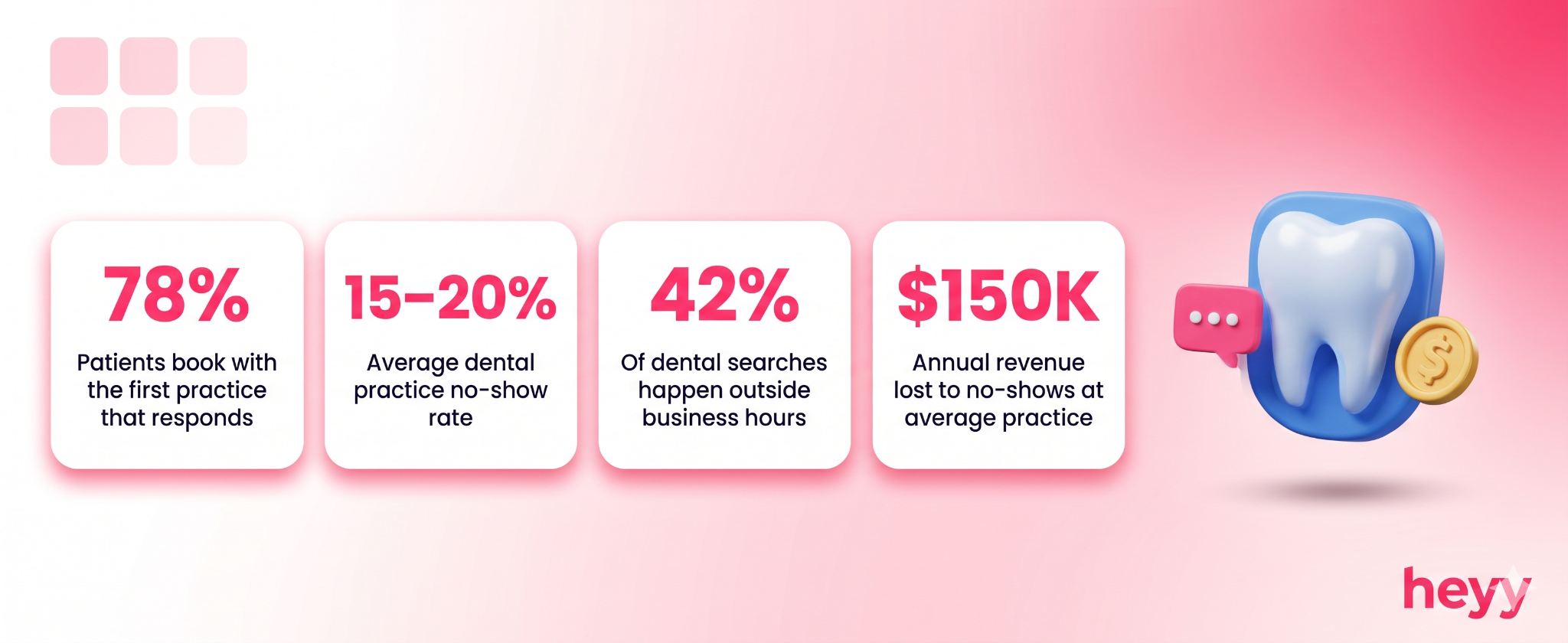
Most dental practice owners frame the AI chatbot question as a technology decision. It is actually a revenue decision, and the numbers make that case before any feature comparison begins.
The response time problem is severe and measurable: Patients contacting more than one clinic will book with whichever practice interacts with them first. According to industry data on local medical searches, 78% of patients book an appointment with the very first provider that responds to their message. While the average dental practice response time to an online inquiry is 3.5 hours during the day and effectively zero after hours, an AI assistant responds in under 10 seconds on any channel.
No-shows are destroying chair time: Wasted calendar slots are incredibly expensive, and right now, the dental industry average no-show rate floats stubbornly between 15% and 20%. For a practice running 20 appointments per day at an average ticket of $200, a 15% no-show rate represents $600 in wasted chair time per day, translating to over $150,000 lost per year. A properly configured AI chatbot with automated reminder sequences consistently brings no-show rates below 8%.
Front desk time is being misallocated: Dental receptionists typically spend 40% to 50% of their working day on tasks that follow highly predictable patterns: booking new appointments, answering hours and location questions, handling rescheduling requests, and sending confirmation details. Passing this volume to a dental AI chatbot gets your team that time back for work that requires a genuine human presence.
After-hours is when patients make decisions: Patients do not wait until your doors open at 9:00 AM to start looking for support when they have a toothache. Recent booking metrics confirm that about 42% of dental appointment searches happen completely outside standard operational hours.They search when the pain is present. A practice with no after-hours coverage has no presence at the moment that matters most.
The Benefits of Using an AI Chatbot in Your Dental Practice

You Never Miss a High-Intent Lead Again
A patient who messages your practice at 11pm is not a casual inquiry. They are experiencing something: pain, anxiety about a procedure, or urgency around a chipped tooth or a broken filling. These are the highest-intent contacts your practice receives and historically the most likely to go unanswered. An AI chatbot captures every one of them, collects the relevant details, and ensures your team wakes up to a structured, actionable lead rather than a missed message.
Your Front Desk Does More Meaningful Work
Answering "what are your hours?" twenty times a day is not why your receptionist trained for healthcare administration. Moving that volume to an AI chatbot gives your team back the hours they need to focus on in-practice patient experience, insurance coordination, and the high-attention tasks that actually require human judgment.
Your No-Show Rate Drops Significantly
Automated reminder sequences delivered via WhatsApp or SMS, where open rates exceed 95%, produce a measurable reduction in no-show rates within the first 30 days of implementation. The 24-hour reminder and the 2-hour reminder combination is the standard that consistently brings no-show rates from 15 to 20% down to under 8% in dental practices. That recovery is immediate revenue that required no additional marketing spend.
New Patient Intake Becomes Structured and Consistent
Manual intake processes are inconsistent by nature. Some patients complete the forms completely. Others arrive with incomplete information that costs clinical prep time. An AI chatbot appointment booking for dentists that collects patient history, insurance provider, reason for visit, and urgency level before the appointment creates a consistent pre-appointment data standard across every new patient. Your clinical team has what they need before the patient walks through the door.
You Compete With Larger Practices on Availability
A large dental group can afford to staff extended hours and weekend coverage. An independent practice typically cannot. An AI chatbot levels that availability gap. Your practice is reachable and responsive at 7am, 11pm, Saturday morning, and Sunday afternoon, without staffing for any of those hours.
You Collect Reviews Without Making It Awkward
Asking patients in person for a Google review is one of the most consistently overlooked growth actions in dental practice management. It feels awkward. Staff forget. Timing is often wrong. An automated post-appointment message via SMS or WhatsApp, sent 2 hours after checkout, captures the review intent at the moment of peak satisfaction without any staff involvement.
What Makes a Dental AI Chatbot Different From a Generic One

A generic chatbot answers questions. A dental AI chatbot is configured to operate within the specific constraints of a healthcare environment. That distinction matters for three reasons.
Clinical decision boundaries. A dental chatbot must know the difference between what it can address and what requires a clinician. It can answer questions about appointment availability, practice hours, treatment costs, and insurance coverage. It cannot diagnose symptoms, recommend specific treatments, or advise on medication. A well-configured dental AI chatbot routes anything that crosses into clinical territory directly to a human without attempting an answer. This is not just good practice. In many jurisdictions, it is a legal requirement.
Patient data handling. Dental practices in most markets operate under healthcare data protection regulations. In the United States, that is HIPAA. In the EU, it is GDPR. In many African and Asian markets, equivalent local frameworks apply. Any AI chatbot handling patient information must comply with the relevant framework: encrypted data transmission, no unauthorized data retention, and clear patient consent before collection. This requirement eliminates many general-purpose chatbot platforms from consideration for dental practices without additional compliance configuration.
Practice management system integration. A dental AI chatbot that cannot connect to your PMS, whether that is Dentrix, Eaglesoft, Open Dental, Carestream, or another system, is a tool that sits alongside your operations rather than inside them. The most effective implementations have the chatbot reading live availability directly from the PMS and writing confirmed bookings back into it. Without that integration, your team is still manually transferring booking information from one system to another.
Quick Comparison: Top 7 AI Chatbots for Dentists
1. Heyy — Best for Independent Practices With Social Media Patient Discovery

Most dental AI chatbot platforms are built for the clinic's website. A growing number of dental patients, particularly for cosmetic and elective procedures, discover practices through Instagram. They see a smile transformation post, click the profile, and send a DM. If that DM goes unanswered for six hours, the lead is gone.
Heyy handles that exact scenario. It connects WhatsApp, Instagram DMs, Facebook Messenger, and website chat into one unified inbox, with AI managing every conversation across all four simultaneously. For cosmetic dental practices, orthodontic clinics, and independent dentists running active social media accounts, this is the channel coverage that matters.
The AI is trained on your specific practice: procedures offered, pricing ranges, insurance partners, booking policies, and FAQs. It handles the inquiry, collects pre-appointment details, and escalates to your front desk with full context when the conversation requires human involvement. The after-hours coverage is automatic. Your practice is reachable on the channels where patients are already spending time.
For practices running Instagram promotions for teeth whitening, Invisalign consultations, or cosmetic work, Heyy closes the loop between the social post and the confirmed consultation without a human in the middle.
Best for: Independent dental practices, cosmetic dentists, and orthodontic clinics where WhatsApp and Instagram drive a meaningful portion of new patient inquiries.
Pricing: Free to start. Paid plans scale with usage, not patient count or seat count.
Pros:
- Unified inbox across WhatsApp, Instagram, Facebook, and website chat
- No-code setup that does not require PMS integration to go live
- AI trained on your specific practice details and policies
- Usage-based pricing that scales without penalizing practice growth
Cons:
- Does not offer deep PMS integration for practices requiring live Dentrix or Eaglesoft connectivity
- Best suited for practices where social channels drive inquiry volume alongside website traffic
2. DemandHub — Best for Practices That Want AI and Reputation Management Together

DemandHub is built specifically for healthcare and dental practices, which shows in the feature set. It handles AI-powered web chat, SMS communication, automated review generation, and a unified inbox in a single platform. For dental practices where online reputation is a primary patient acquisition driver, the combination of AI communication and automated review requests in one tool eliminates a significant operational split.
The AI agent answers questions via web chat and responds to missed calls via SMS automatically. When a patient calls after hours and reaches voicemail, DemandHub's AI sends a text follow-up within seconds, capturing the inquiry before the patient moves on. That missed call recovery feature alone addresses one of the highest-frequency revenue leakage points in dental practice operations.
The review automation is built into the post-appointment workflow. Patients receive a text request at a configured interval after their appointment. Review rates for practices using automated post-appointment SMS requests average 3 to 5 times higher than those relying on in-practice verbal requests.
Best for: Dental practices where Google reviews are a primary new patient acquisition driver and where AI communication and reputation management need to run from the same platform.
Pricing: Custom, based on contact volume and feature tier. AI Agent starts at 100 contacts. Growth and Ultimate tiers available for larger practices.
Pros:
- Dental-specific platform with healthcare-appropriate defaults
- Missed call SMS follow-up captures after-hours leads automatically
- Integrated review automation drives Google rating improvement without staff effort
- Unified inbox for web chat, SMS, and text
Cons:
- Social channel coverage (WhatsApp, Instagram) is limited compared to omnichannel platforms
- Pricing requires a custom quote and is not transparent without a sales conversation
3. NexHealth — Best for Multi-Location Practices Needing Deep PMS Integration

NexHealth is the closest thing to a purpose-built dental scheduling AI on this list. It integrates directly with over 50 practice management systems including Dentrix, Eaglesoft, Open Dental, Carestream, and Curve Dental, reading live availability from the PMS and writing confirmed bookings back into it in real time.
The operational implication is significant. When a patient books through NexHealth's AI, the appointment appears in your PMS immediately. No manual transfer. No double-booking risk. No reconciliation between systems at the end of the day. For multi-location groups where scheduling coordination across locations is a genuine operational challenge, this integration depth is the defining feature.
Patient intake forms are digital, pre-populated with information the system already has, and completed before the appointment rather than on a clipboard in the waiting room. HIPAA compliance is built into the platform architecture. For practices in regulated environments, these are not optional features.
Best for: Multi-location dental groups and practices requiring live bidirectional PMS integration for scheduling, intake, and patient record management.
Pricing: Custom. Requires a demo. Positioned as a premium solution for practices with meaningful appointment volume.
Pros:
- Direct integration with 50+ practice management systems
- Real-time bidirectional scheduling: live availability read, confirmed bookings written back
- HIPAA-compliant architecture with digital intake forms
- Strong multi-location coordination features
Cons:
- Implementation complexity requires onboarding time and technical coordination
- Premium pricing is justified for high-volume practices but disproportionate for small independents
- Social channel coverage is not the platform's strength
4. Weave — Best for Practices That Want Phone, Text, and Chat Unified
Weave approaches dental communication from a different angle than most tools on this list. Rather than leading with AI chatbot capability, it leads with unified communications: phone, SMS, and web chat all managed from one platform, with AI layered into each channel.
The phone integration is the differentiation. Weave replaces your existing phone system and adds intelligence to every call. When a patient calls, their record from your PMS appears on the screen before the call is answered. When a call is missed, an automated SMS follow-up goes out immediately. When a patient texts, the conversation appears in the same inbox as the calls. For dental practices where the phone is still the primary inbound channel, this depth of phone integration is something most pure-AI-chatbot platforms cannot replicate.
The AI features handle scheduling through web chat and SMS, send automated appointment reminders, and support patient reactivation campaigns for patients who have not visited in over 12 months. HIPAA compliance is built into the platform.
Best for: Dental practices where the phone remains the primary patient communication channel and where a unified phone-text-chat system would reduce operational complexity.
Pricing: Custom. Requires a consultation. Generally positioned for practices with 3 or more operatories.
Pros:
- Replaces the phone system and adds AI intelligence to every call
- Patient PMS record appears on-screen before calls are answered
- Automated SMS follow-up on missed calls
- HIPAA compliant with dental-specific PMS integrations
Cons:
- Replacing the phone system is a significant operational change that requires careful transition planning
- Higher implementation complexity than web-chat-only solutions
- Not the strongest option for practices relying on WhatsApp or Instagram for patient inquiries
5. Doctible — Best for Practices Focused on Patient Acquisition and Reactivation
Doctible takes a patient lifecycle approach that most dental chatbot platforms do not. It handles new patient acquisition through web chat and digital advertising support, automates appointment reminders and recall campaigns, and manages online reputation from a single dashboard.
The reactivation feature is where Doctible earns its differentiation. Most dental practices have a substantial number of patients who have not visited in 12 to 24 months and have not formally left the practice. They have simply drifted. Doctible's automated reactivation campaigns contact these patients via SMS with personalized messages, availability prompts, and direct booking links. Practices using automated reactivation report recovering 8 to 12% of lapsed patients per campaign cycle.
For practices building their new patient base through Google Ads or local search, Doctible's integration between advertising lead capture and the AI chatbot creates a direct pipeline from click to confirmed appointment without manual follow-up in the middle.
Best for: Dental practices focused on new patient acquisition from digital advertising and on reactivating lapsed patients from their existing database.
Pricing: Custom. Requires a demo.
Pros:
- Automated reactivation campaigns for lapsed patients
- Integration between advertising lead capture and chatbot booking
- Review management and patient satisfaction surveys included
- SMS-first communication that matches patient channel preferences
Cons:
- Not designed as a primary AI chatbot platform; the AI capability is one feature within a broader marketing tool
- WhatsApp and Instagram direct message handling is limited
- Pricing requires a sales conversation
6. Tidio — Best for Small Independent Practices on a Budget

Tidio is the most accessible entry point on this list. It is not dental-specific and it does not offer PMS integration, but for a small independent dental practice that primarily needs to answer website inquiries, capture new patient details, and respond to basic FAQs outside business hours, it delivers those capabilities at a price that does not require a budget conversation.
Lyro, Tidio's AI, is trained on your knowledge base content and handles a high volume of standard questions without human involvement. For a solo practitioner or a two-dentist practice handling under 200 website inquiries per month, Tidio's AI chatbots for dentists features pricing represents the most practical starting point before investing in a more specialized platform.
The ceiling is real. Tidio does not handle phone integration, PMS connectivity, HIPAA-specific compliance architecture, or deep dental workflow automation. It is a website chat and basic AI platform. For the right practice at the right stage, that is exactly enough. For practices with meaningful volume or multi-location complexity, it is not.
Best for: Solo practitioners and small independent dental practices needing affordable AI chatbot capability for website inquiry handling without PMS integration requirements.
Pricing: Free plan available. Paid plans from $19/month. Lyro AI billed per conversation.
Pros:
- Most affordable entry point on this list
- Fast setup without technical requirements
- Works on website, Instagram, and Messenger
- Lyro AI resolves a meaningful percentage of standard FAQs without human involvement
Cons:
- No PMS integration, HIPAA-specific architecture, or dental-specific workflows
- Not built for multi-location practices or high appointment volumes
- Limited social channel depth compared to omnichannel platforms
7. Luma Health — Best for Practices Needing Full Patient Journey Automation

Luma Health operates across the entire patient journey from the first inquiry through post-visit follow-up, with a depth of automation that distinguishes it from most platforms on this list. It handles appointment scheduling, reminder sequences, patient intake, waitlist management, recall campaigns, and post-visit satisfaction surveys from one platform.
The waitlist feature is specifically strong for dental practices. When a cancellation comes in, Luma automatically contacts the next patient on the waitlist and fills the slot before a human has to intervene. For practices with consistent cancellation patterns, this single feature recovers meaningful chair time that would otherwise sit empty.
Broadcast messaging allows practices to reach their full patient list via SMS for announcements, holiday hours, appointment availability openings, or promotional campaigns. HIPAA compliance is built into the platform architecture. EHR and PMS integrations are available for Dentrix, Eaglesoft, and several other major systems.
Best for: Dental practices that want to automate the full patient lifecycle from first contact through reactivation, with particular strength in waitlist management and recall campaigns.
Pricing: Custom. Requires a demo.
Pros:
- Full patient journey automation from inquiry to post-visit follow-up
- Automated waitlist filling on cancellations recovers chair time without staff effort
- HIPAA compliant with PMS integrations for major dental systems
- Broadcast messaging for practice-wide patient communication
Cons:
- Social channel coverage (WhatsApp, Instagram) is not the platform's primary focus
- Implementation requires configuration time and onboarding support
- Custom pricing with no public rate card
The Features That Actually Determine Whether It Works for a Dental Practice
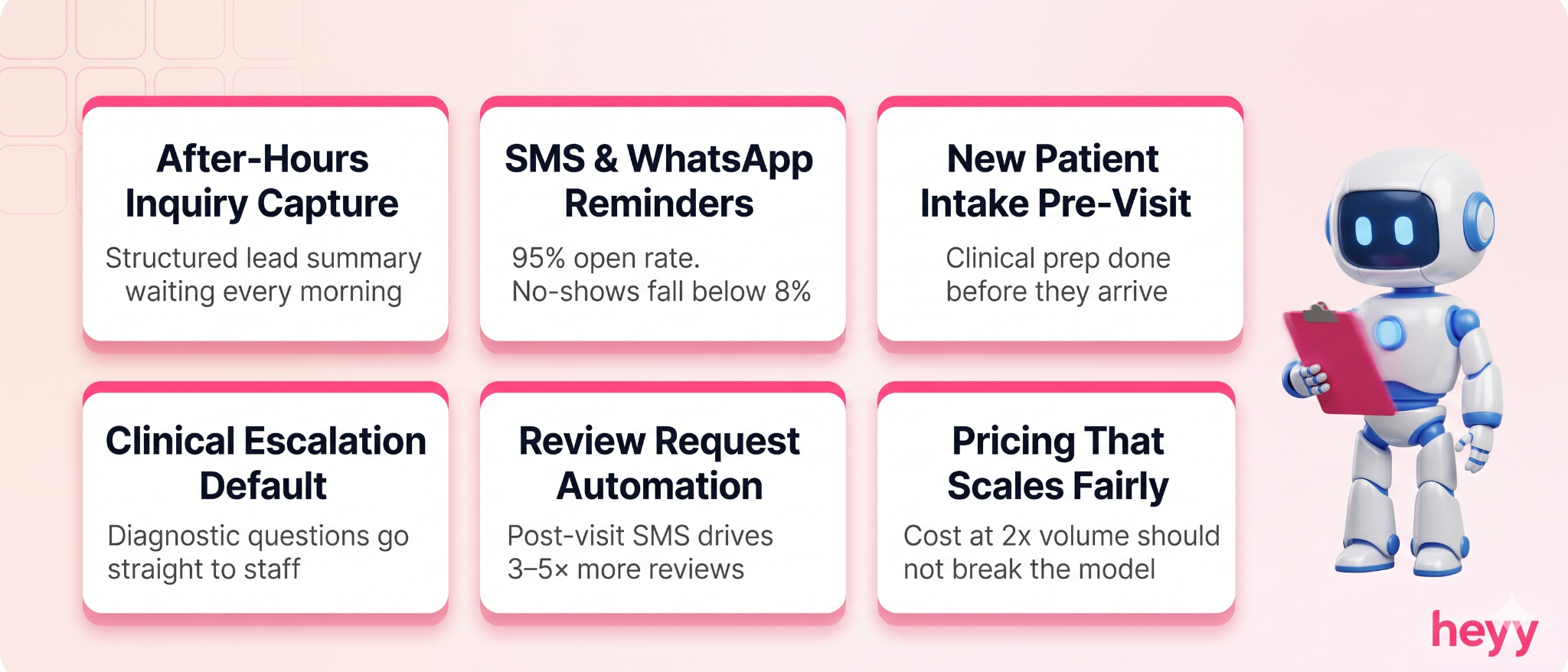
Vendors list twenty features. These are the six that move practice revenue metrics.
After-hours inquiry capture. Every lead that arrives outside business hours represents a patient in a decision moment. The chatbot must capture their name, contact information, reason for inquiry, and urgency level and deliver it to your team in the morning in a structured format. Not a raw chat transcript. A clean, actionable summary.
Automated reminder sequences via SMS or WhatsApp. Email reminders reach roughly 20% of recipients. SMS and WhatsApp reminders reach over 95%. If your reminder system is email-first, your no-show rate is not being addressed by the tool. The platform must support high-open-rate channel reminders at configurable timing intervals.
New patient intake before the appointment. Pre-appointment data collection reduces chair-side admin time, improves clinical preparation, and creates a first-visit experience that signals professionalism. A chatbot that collects intake information before the appointment rather than at the front desk on arrival makes every new patient visit more efficient.
Clinical decision escalation. The chatbot must recognize when a patient's question crosses into clinical territory and escalate it immediately. This is not a configurable feature you add later. It should be a default behavior of any dental AI chatbot you evaluate. Test it before you go live: ask the chatbot a question about whether a specific symptom requires an extraction. If it answers, it is not configured correctly for a dental environment.
Review request automation. Post-appointment review requests sent via SMS within 2 hours of a visit produce consistently higher response rates than in-practice verbal requests or end-of-day email batches. A chatbot platform that does not include this feature requires a separate tool to handle it, which creates operational fragmentation.
Transparent pricing that does not punish growth. The pricing models across this category range from contact-volume pricing to per-seat pricing to per-location pricing. Model your cost at 2x your current patient volume. If the number makes the tool unviable, the pricing structure is not built for a growing practice. Usage-based models that scale proportionally with genuine growth, not arbitrary tiers, are what to look for.
How to Choose the Right Dental AI Chatbot

By Practice Type
Your practice configuration is the primary filter.
Solo practitioners and small independent practices: Heyy or Tidio. Both offer fast setup, no PMS integration requirement to go live, and pricing that makes sense at lower patient volumes. Heyy is the stronger choice if WhatsApp or Instagram are channels you use to reach patients. Tidio is the budget entry point if you primarily need website chat coverage.
Mid-sized practices with active social media: Heyy's omnichannel coverage across WhatsApp, Instagram, and web makes it the most relevant tool for practices where new patients arrive through social discovery. The AI customer service layer handles the full inquiry-to-booking flow across all channels.
Practices where phone is the dominant channel: Weave is the most logical answer. Its phone-first architecture with AI layered in addresses the communication pattern that most dental practice software treats as secondary.
Multi-location groups needing PMS integration: NexHealth or Luma Health. Both offer the system integration depth that multi-location operations require and the scheduling automation that prevents coordination errors across locations.
Practices prioritizing new patient acquisition and review growth: DemandHub or Doctible. Both combine AI communication with reputation management in ways that other tools on this list do not.
By Primary Business Objective
Reduce no-shows: Any platform with configurable SMS or WhatsApp reminder sequences. Weave, NexHealth, Luma Health, and DemandHub all handle this. The key requirement is high-open-rate channel delivery, not just email.
Capture after-hours leads: Heyy, DemandHub, and Luma Health all handle after-hours inquiry capture effectively. Heyy has the advantage of covering social channels where after-hours messages often originate for younger patient demographics.
Reduce front-desk workload: NexHealth's PMS integration produces the deepest reduction in manual administrative tasks by automating the data transfer between the chatbot and the practice management system. Weave produces a similar effect by unifying phone, text, and chat into one managed inbox.
Grow patient reviews: DemandHub and Doctible both have review automation as a core feature, not an add-on. If growing your Google rating is a strategic priority, both platforms make it easier to build that into the post-appointment workflow without additional tools.
By Budget
Run the cost model at 2x your current monthly inquiry volume. Understanding AI chatbots for dentists features pricing across tiers is how you avoid signing an annual contract that becomes unaffordable as your practice grows. Some platforms charge per contact, some per seat, some per location. The platform that looks affordable at your current volume may become disproportionately expensive as your practice grows. Heyy's usage-based model is the most predictable for growing practices. NexHealth and Luma Health require custom quotes that should include a 3-year projection to evaluate fairly.
What Good Automation Looks Like in a Dental Practice
A patient messages your WhatsApp at 8:14pm with a cracked tooth. The dental AI chatbot picks up the message immediately. It acknowledges the urgency, asks two questions about the level of pain and whether there is any bleeding, and routes the response accordingly.
For a patient describing significant pain, the bot presents your emergency contact number and the nearest after-hours dental provider, making clear that the patient's welfare is the priority. For a patient describing a non-urgent crack with no pain, it collects their name, insurance provider, and preferred appointment time and presents the next available morning slot.
The bot confirms the booking, sends a summary to the patient, adds the appointment to your schedule with the intake information attached, and sends your team a notification. A reminder goes out at 24 hours and again at 2 hours before the appointment.
Your receptionist arrives the next morning to a structured summary of every after-hours inquiry, an updated schedule with new bookings already in the system, and zero unanswered messages on any channel.
That is what a fully automated small business support setup looks like when it is configured correctly for a dental environment.
Common Mistakes Dental Practices Make With AI Chatbots

Not configuring clinical decision boundaries. The chatbot answers a patient's question about whether they need a root canal based on symptoms they described. This is the failure mode that creates liability. Every dental AI chatbot deployment must have explicit rules around what categories of question trigger immediate human escalation. Define these before go-live.
Running reminders through email only. Email reminder campaigns for dental appointments produce open rates of 20 to 25%. SMS and WhatsApp produce open rates of 95%+. If the platform you chose is email-first, you are running a reminder strategy that reaches one in four patients. Fix the channel before concluding the tool does not work.
Skipping the intake collection step. A chatbot that books the appointment without collecting intake information is solving for 50% of the problem. The other 50% is the clinical preparation and administrative efficiency that comes from having structured patient data before the visit. Configure intake collection as a mandatory post-booking step in the conversation flow.
Using a general chatbot without dental-specific training. A general-purpose AI chatbot deployed on a dental practice website without training on dental terminology, treatment FAQs, insurance processes, and clinic-specific policies will produce generic responses that patients recognize immediately as non-specific. The training investment before launch is what separates a chatbot that builds trust from one that patients ignore. See what reducing ticket backlog with AI chatbots looks like when training is done correctly.
Not tracking the metrics that matter. The relevant KPIs for a dental AI chatbot are: after-hours lead capture rate, no-show rate before and after implementation, new patient booking completion rate, front-desk time recovered, and review volume change. If you are not tracking these before implementation, you cannot measure the impact after it.
So If you are an independent dental practice, a cosmetic clinic, or an orthodontic practice where new patients find you through Instagram and message you on WhatsApp, Heyy is built for exactly how your patient acquisition works. One inbox covers WhatsApp, Instagram DMs, Facebook Messenger, and website chat. The AI is trained on your specific practice and handles inquiries, books appointments, and sends reminders across every channel automatically. No PMS integration required to go live. No per-seat pricing that penalizes your team. Start free and handle your first after-hours dental inquiry with AI today.
FAQs
Are AI chatbots HIPAA compliant for dental practices?
Not automatically. HIPAA compliance depends on the platform's architecture and your configuration of it. Platforms designed specifically for healthcare, like NexHealth, Weave, and Luma Health, build HIPAA compliance into their architecture. General-purpose platforms require additional configuration and a Business Associate Agreement with the vendor before they can be considered HIPAA compliant for patient data handling. Always ask for the BAA before deploying any chatbot that will handle patient information. This is non-negotiable for US-based practices.
Can a dental AI chatbot integrate with Dentrix or Eaglesoft?
Yes, but not all platforms on this list support this. NexHealth and Luma Health offer the deepest PMS integration with Dentrix, Eaglesoft, Open Dental, and other major systems. Weave integrates with several major PMS platforms as part of its phone system replacement. DemandHub offers integrations at higher plan tiers. Heyy and Tidio do not offer direct PMS integration but can be used alongside your PMS with manual reconciliation for practices at lower volumes.
What should a dental AI chatbot never do?
It should never attempt to diagnose a patient's symptoms, recommend a specific treatment, advise on whether a procedure is necessary, or suggest medication. Any question that requires clinical judgment must be escalated to a human with the conversation context attached. The chatbot's role in a dental environment is administrative and logistical, not clinical. Any platform that allows clinical questions to be answered without escalation is misconfigured and creates potential liability.
How quickly can a dental AI chatbot be set up?
A basic deployment on a single channel (website or WhatsApp) with standard dental FAQs and AI chatbot appointment booking for dentists configured can be live in one to two days. A full implementation covering multiple channels, PMS integration, HIPAA configuration, clinical escalation rules, and a tested reminder sequence typically takes one to three weeks. The testing phase, particularly testing the clinical escalation behavior, is the step that cannot be rushed.
Will patients actually use a chatbot instead of calling?
Yes, with increasing frequency. Patient communication preferences have shifted significantly toward messaging, particularly for routine interactions like appointment booking, hours inquiries, and cost questions. 60% of patients prefer messaging over calling for non-urgent interactions. For cosmetic dental procedures specifically, where patients are often younger and more digitally native, the preference for chat and social messaging over phone calls is even more pronounced.
How does a dental AI chatbot handle emergency inquiries?
A properly configured dental AI chatbot recognizes urgency signals in patient messages: pain descriptions, bleeding mentions, trauma-related language. When these appear, it should route immediately to an emergency contact pathway rather than continuing the standard booking flow. That pathway should include your emergency phone number, any after-hours coverage your practice offers, and the nearest emergency dental provider. Patient welfare takes precedence over booking flow completion. Configure this explicitly and test it before going live.
What is the ROI of a dental AI chatbot?
For a dental practice running 20 appointments per day at a $200 average ticket value, the ROI calculation runs across three lines. First, no-show rate reduction: bringing a 15% no-show rate to 8% recovers approximately $28 per day in chair time, or roughly $7,000 per year. Second, after-hours lead capture: capturing 5 additional new patient bookings per month at $200 average value adds $12,000 per year. Third, front-desk time recovered: 2 hours per day at $20 per hour is $10,400 per year in labor cost that can be redirected to higher-value tasks. Combined, the annual impact for a mid-sized practice typically exceeds $25,000 against a tool cost that ranges from free to a few hundred dollars per month.
More blog posts to read



Ready to Automate Support
Across Every Channel?
.svg)
.avif)