.svg)
10 Healthcare Chatbots That Aid Patient Communication

Think about a patient messaging your clinic at 9:00 PM, anxious and wondering if their symptoms mean they need to head to an urgent care clinic right away. Your phone goes straight to voicemail, and your website only has a standard contact form promising a response sometime within 24 hours. So, they spend twenty stressful minutes scrolling through unreliable health forums before giving up and deciding to just wait until morning.
By the time your doors open, their situation has gotten much worse. A conversation that should have taken thirty seconds to start took fourteen hours to get a reply. In healthcare, that kind of delay is not just an inconvenience, it directly impacts how a patient recovers, and the frustrating part is that it is entirely fixable.
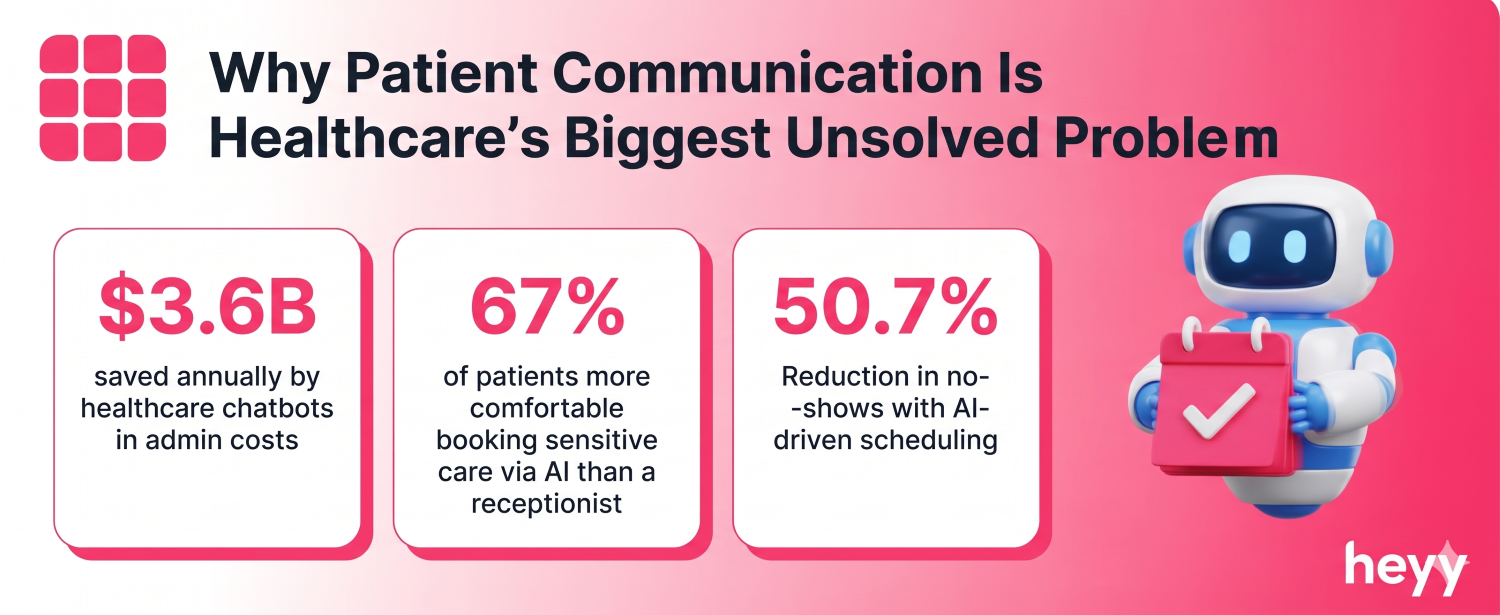
Healthcare chatbots are saving the industry an estimated $3.6 billion annually in administrative costs, according to Juniper Research. 43% of multi-provider clinics now deploy conversational AI as part of their core operations, handling everything from appointment scheduling to post-discharge follow-up. The gap between practices using these tools and the ones still stuck relying purely on phone calls and static contact forms is getting wider every single month.
This guide covers 10 specific healthcare chatbot examples that are improving patient communication in 2026. These medical chatbot examples span appointment scheduling, mental health support, medication management, and post-discharge follow-up. Each one has a defined use case, a measured result, and a clear view of its limitations. Not every tool fits every practice. By the end, you will know which one matches your patient communication needs
Why Patient Communication Is Healthcare's Biggest Unsolved Problem
The clinical side of healthcare is extraordinary. The communication side, in most practices, is not.
68% of healthcare organizations use chatbots for appointment scheduling, triage, and patient onboarding, but the majority of those deployments are basic and underoptimized. The real opportunity sits in the full communication lifecycle: the inquiry before the appointment, the preparation before the visit, the support after discharge, and the ongoing engagement that determines whether patients stay connected to their care.
The numbers show why this matters beyond convenience. 67% of US patients report feeling more comfortable booking appointments about sensitive health matters with an AI chatbot than with a human receptionist. That is not a preference for technology. It is a privacy response. A patient dealing with mental health, sexual health, or addiction is more likely to initiate care when the first contact is private and non-judgmental. AI medical chatbots in these sensitive categories are not replacing empathy. They are removing the barrier to seeking it.
Healthcare chatbots are projected to grow at a 33.7% CAGR through 2028, making it the fastest-growing sector for chatbot adoption. The practices building patient communication infrastructure now are the ones that will operate at scale without proportionally scaling their administrative teams.
The Benefits of Healthcare Chatbots for Patient Communication
Patients Get Answers When They Need Them
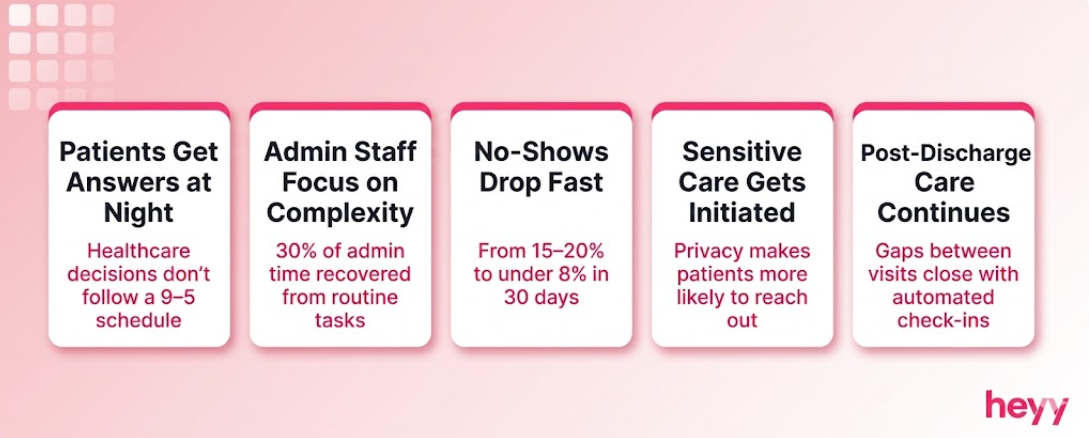
Healthcare decisions do not happen on a 9-to-5 schedule. A parent whose child develops a fever at midnight, a patient wondering whether their post-surgery swelling is normal at 10pm, a person experiencing early anxiety symptoms on a Saturday, all of these are communication moments that currently go unanswered in most practices. A chatbot handles all of them instantly.
Administrative Staff Focus on Complex Cases
Practices using AI scheduling reduce administrative staff time by 30%, according to Hyperleap AI's 2026 data. That recovered time goes toward the interactions that genuinely require human judgment. For practices that want to connect their chatbot's outputs — bookings, intake responses, follow-up triggers — into their EHR and backend systems automatically, Keragon AI Healthcare Agents handle that orchestration layer in a HIPAA-compliant environment. The recovered time goes toward escalating a distressed patient, coordinating a complex referral, or managing an insurance dispute.
No-Show Rates Drop Significantly
Clinics deploying AI-driven scheduling report a 50.7% reduction in patient no-shows through automated reminder sequences. For a practice running 25 appointments per day at $180 average value with a 15% no-show rate, bringing that rate to 7% recovers approximately $324 per day in wasted appointment slots.
Patients Are More Likely to Initiate Sensitive Care
The privacy dimension of AI chatbots in healthcare is underreported. When a chatbot is the first point of contact for mental health, substance use, or sexual health concerns, patients who would not have called a receptionist often do engage. That engagement becomes a clinical touchpoint that would not have existed otherwise.
Continuity of Care Improves After Discharge
Post-discharge is where patient communication typically breaks down entirely. The patient goes home, the care team moves on, and the connection is severed until the next scheduled appointment, if there is one. The medical chatbot examples in post-discharge care; Sensely and Florence specifically, demonstrate how automated follow-up sequences check in, collect symptom data, and alert the clinical team when escalation is needed.
Quick Comparison: 10 Healthcare Chatbots at a Glance
The 10 Healthcare Chatbot Examples
1. Heyy — Best for Independent Practices With WhatsApp and Instagram Patient Communication
Most healthcare chatbot platforms are built around website widgets and EHR integrations. They are designed for large hospital systems with technical teams and enterprise budgets. Independent practices, boutique clinics, and specialist providers have a different reality: their patients discover them on Instagram, message them on WhatsApp, and expect responses at hours when no receptionist is available.
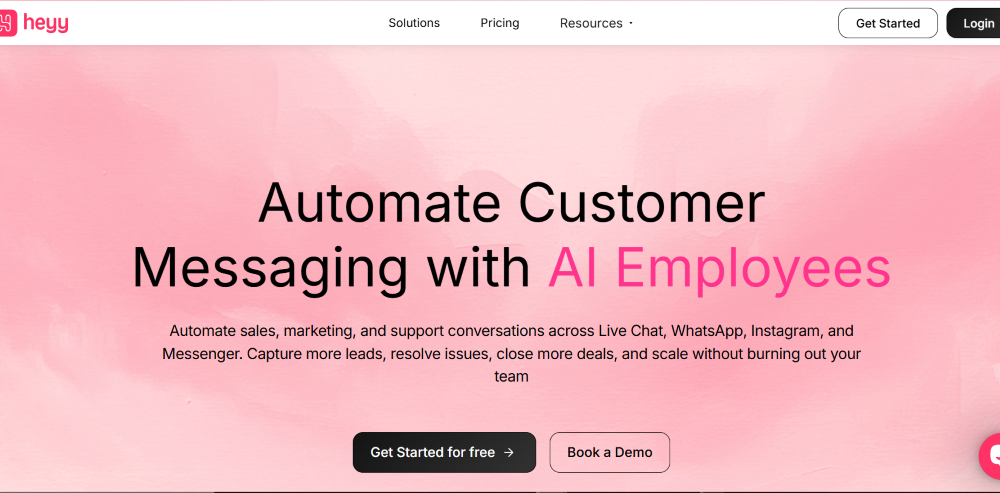
Heyy handles that gap. One inbox connects WhatsApp, Instagram DMs, Facebook Messenger, and website chat simultaneously. The AI is trained on the practice's specific services, appointment availability, policies, and FAQs. It handles appointment booking through a conversational flow, sends automated 24-hour and 2-hour reminders via WhatsApp (where open rates exceed 95%), and escalates anything requiring clinical judgment to a human immediately.
For practices where cosmetic, wellness, or elective procedures are a significant revenue line, the Instagram DM to appointment conversion flow is particularly valuable. A patient who sees a procedure on Instagram, sends a DM with a question, and receives an immediate, accurate, branded response converts at a dramatically higher rate than one who sends an inquiry and waits until the next business day.
Primary communication use: Appointment booking, automated reminders, post-visit follow-up, after-hours FAQ handling.
Best for: Independent practices, specialist clinics, cosmetic providers, and wellness businesses where WhatsApp and Instagram are primary patient communication channels.
Key result: Practices using automated WhatsApp reminder sequences report no-show rates dropping from 15–20% to under 8%, and after-hours booking capturing 30–40% of total monthly appointments that would previously have been missed.
Clinical boundary: Heyy handles administrative communication. Any clinical question triggers an immediate escalation to the human team.
Pricing: Free to start. Paid plans scale with usage, not patient count.
2. Ada Health — Best for AI Symptom Assessment Before a Clinical Encounter
Ada is one of the most clinically validated symptom checkers available. A patient describes their symptoms through a conversational interface. Ada uses a medical knowledge base built with clinical oversight to ask structured follow-up questions and produce an assessment of possible causes ranked by likelihood, along with a recommendation for the appropriate level of care.
The distinction that makes Ada credible in a category full of questionable health AI is its clinical validation. Ada combined with human physician oversight achieves a 97% safe advice rate, according to Kommunicate's 2026 healthcare chatbot review. That is not a stat about AI replacing physicians. It is a stat about AI reducing the volume of unnecessary emergency visits and directing patients to the right care level before a clinical encounter happens.
Primary communication use: Pre-clinical symptom triage, care level recommendation, patient education about their condition before they see a provider.
Best for: Health systems, insurance providers, and employer wellness programs wanting to reduce unnecessary ER visits and direct patients to appropriate care.
Key result: Reduces unnecessary emergency department visits by guiding patients toward the correct care pathway. Used by health systems across Europe and North America.
Clinical boundary: Ada does not diagnose. It assesses symptoms and recommends a care pathway. Every output includes a clear recommendation to seek professional medical advice.
3. Woebot — Best for Mental Health Support and CBT-Based Patient Communication
Woebot is a mental health chatbot built on cognitive behavioral therapy (CBT) principles and developed in collaboration with Stanford University. It engages users in therapeutic conversation, mood tracking, and evidence-based techniques for managing anxiety, depression, and stress.
The patient communication angle is specific: Woebot lowers the barrier to initiating mental health support. A patient who would not call a clinic to schedule a first therapy appointment may engage with Woebot at 11pm on a difficult night. That engagement creates a data trail and a relationship that can bridge to formal clinical care.
Woebot users report a 24% reduction in overall work impairment, per Kommunicate's healthcare data. Employers deploying it as part of wellness programs report measurable reductions in employee burnout indicators.
Primary communication use: Ongoing mental health support conversations, mood tracking, CBT exercises, crisis detection with escalation to human resources.
Best for: Mental health practices, employer wellness programs, and health systems wanting scalable first-line mental health engagement.
Key result: 24% reduction in work impairment among users, with sustained engagement over multi-week programs.
Clinical boundary: Woebot is not a therapist. It is not a substitute for clinical mental health treatment. It is a structured support tool between sessions and a first step for patients who have not yet initiated formal care.
4. Notable Health — Best for Pre-Visit Intake Automation and Administrative Load Reduction
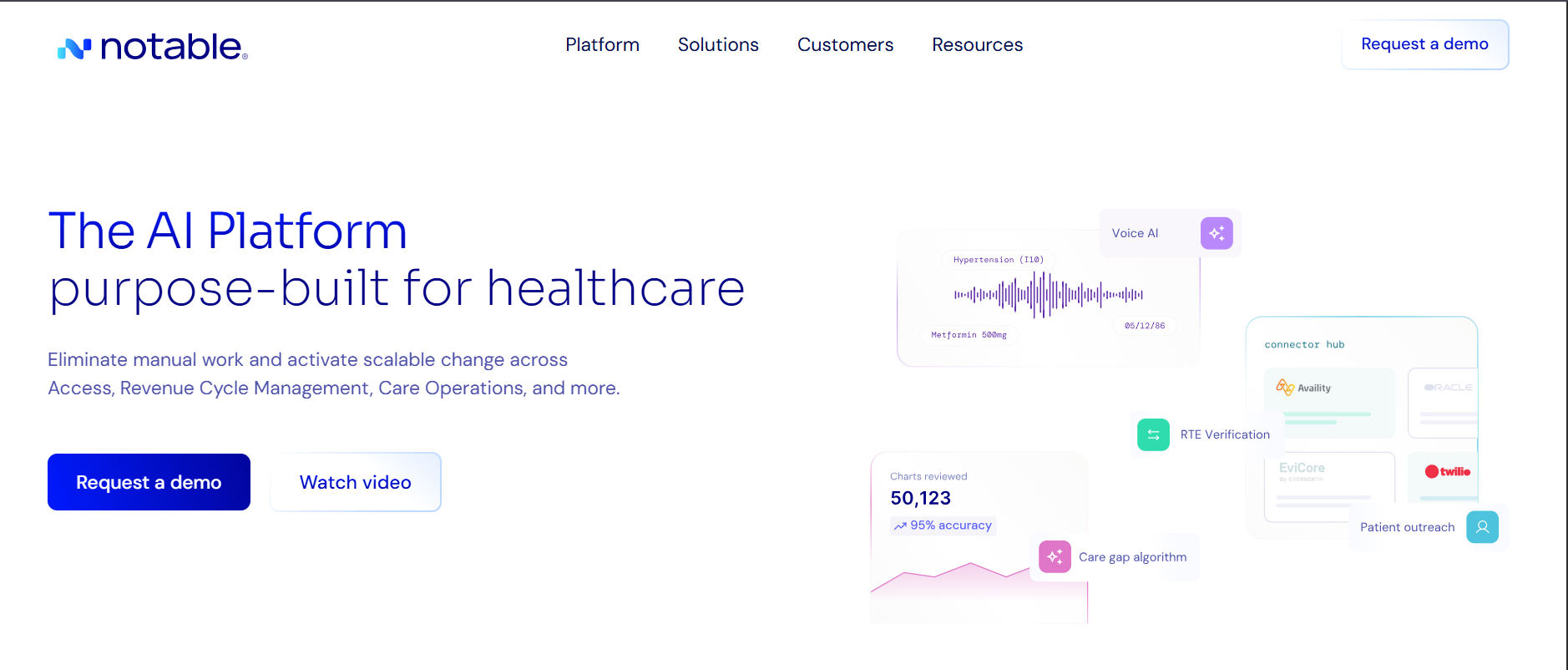
Notable Health is an AI-powered automation platform built specifically for healthcare administrative workflows. It handles pre-visit intake, insurance verification, prior authorizations, referral management, and patient outreach through a conversational interface that works across SMS, web, and patient portal channels. For healthcare organizations looking to build custom digital solutions around patient communication, AI, and mobile experiences, an Australian software development company such as Appello Software can help design and develop tailored healthcare applications.
The patient communication problem Notable solves is the intake process. In most practices, new patients complete intake forms on a clipboard in the waiting room, often arriving without documentation, creating delays that ripple through the entire appointment schedule. Notable replaces that process with automated pre-visit conversations: patients receive a text message before their appointment, complete their intake conversationally, and arrive with all necessary information already in the system.
Notable Health achieves up to 80% reduction in front-desk administrative time for the health systems that deploy it, according to Kommunicate's 2026 healthcare chatbot review. That reduction comes from automating the intake, insurance, and pre-authorization workflows that consume the majority of front-desk hours every day.
Primary communication use: Pre-visit patient intake, insurance verification, pre-authorization outreach, automated appointment preparation.
Best for: Health systems, multi-specialty practices, and clinics where front-desk administrative burden is limiting patient throughput and staff capacity.
Key result: Up to 80% reduction in front-desk administrative time, with intake completed digitally before the patient arrives.
Clinical boundary: Notable automates administrative communication. All clinical content in patient records is managed by licensed practitioners through the connected EHR system.
5. Hyro — Best for Health Systems Needing EHR-Connected Scheduling at Scale
Hyro is a conversational AI platform purpose-built for healthcare, with native integration into major EHR Software including Healthray, Epic, Cerner, and Athenahealth. It handles appointment scheduling, patient FAQs, prescription refill requests, and general inquiry routing through a natural language interface that connects directly to the health system's live data.
The EHR integration is what separates Hyro from general-purpose chatbots in a healthcare context. When a patient asks about their next appointment through a Hyro-powered interface, the chatbot checks the actual EHR record and responds accurately. When they schedule an appointment, it writes directly to the system without a human intermediary.
Northwell Health deployed Hyro and cut call center volume by 50%, per Kommunicate's healthcare use case review. That is the outcome of removing high-frequency, low-complexity calls from a staffed call center and routing them to an AI that handles them faster and at any hour.
Primary communication use: EHR-connected appointment scheduling, patient record access, prescription refill routing, general FAQ deflection.
Best for: Large health systems and hospital groups with existing Epic, Cerner, or Athenahealth installations that need AI-powered patient communication at scale.
Key result: 50% reduction in call center volume at Northwell Health.
Clinical boundary: Hyro handles administrative communication and data retrieval. Clinical escalation follows the health system's established protocols.
6. Sensely — Best for Chronic Disease Management and Post-Discharge Follow-Up
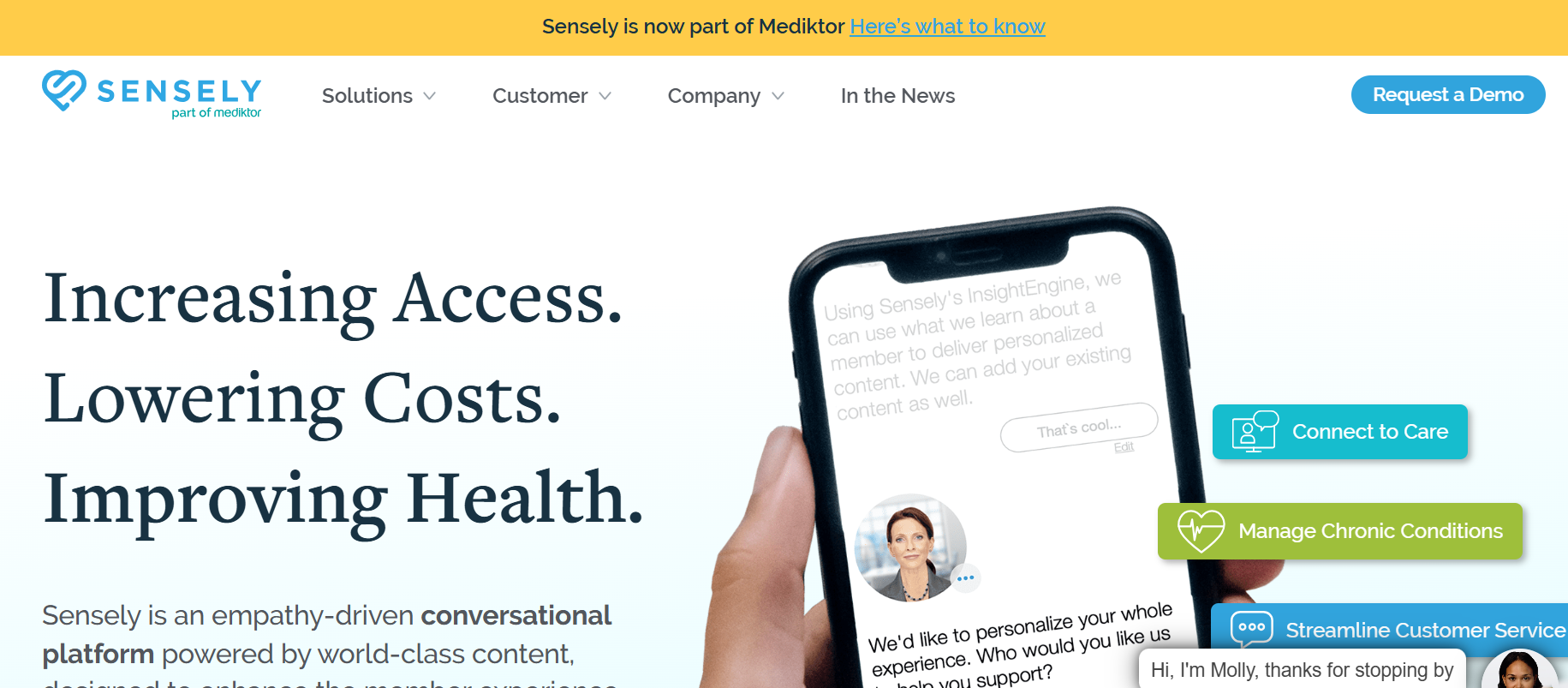
Sensely's virtual nurse, Molly, is a voice and chat-based AI assistant designed for ongoing patient monitoring. Molly checks in with patients daily, asks structured questions about their symptoms and medication adherence, and alerts the clinical team when responses suggest deterioration or non-compliance.
In chronic disease management, the communication gap between appointments is where patient health most frequently declines. Conditions like diabetes, heart failure, COPD, and post-surgical recovery all require consistent monitoring that clinic visits cannot provide weekly. Sensely fills that communication gap with a virtual touchpoint that is accessible, non-judgmental, and clinically structured.
Sensely's virtual nurse Molly achieves a 94% daily check-in completion rate, which is higher than any other patient engagement modality in the chronic care monitoring category.
Primary communication use: Daily patient check-ins, medication adherence monitoring, symptom tracking, post-discharge follow-up.
Best for: Practices and health systems managing patients with chronic conditions, post-surgical patients, and any population requiring structured follow-up between clinical visits.
Key result: 94% daily check-in completion rate, with alerts to clinical teams when responses suggest escalation is needed.
Clinical boundary: Sensely collects and reports. Clinical decisions based on the data it collects are made by licensed practitioners.
7. Florence — Best for Medication Management Communication
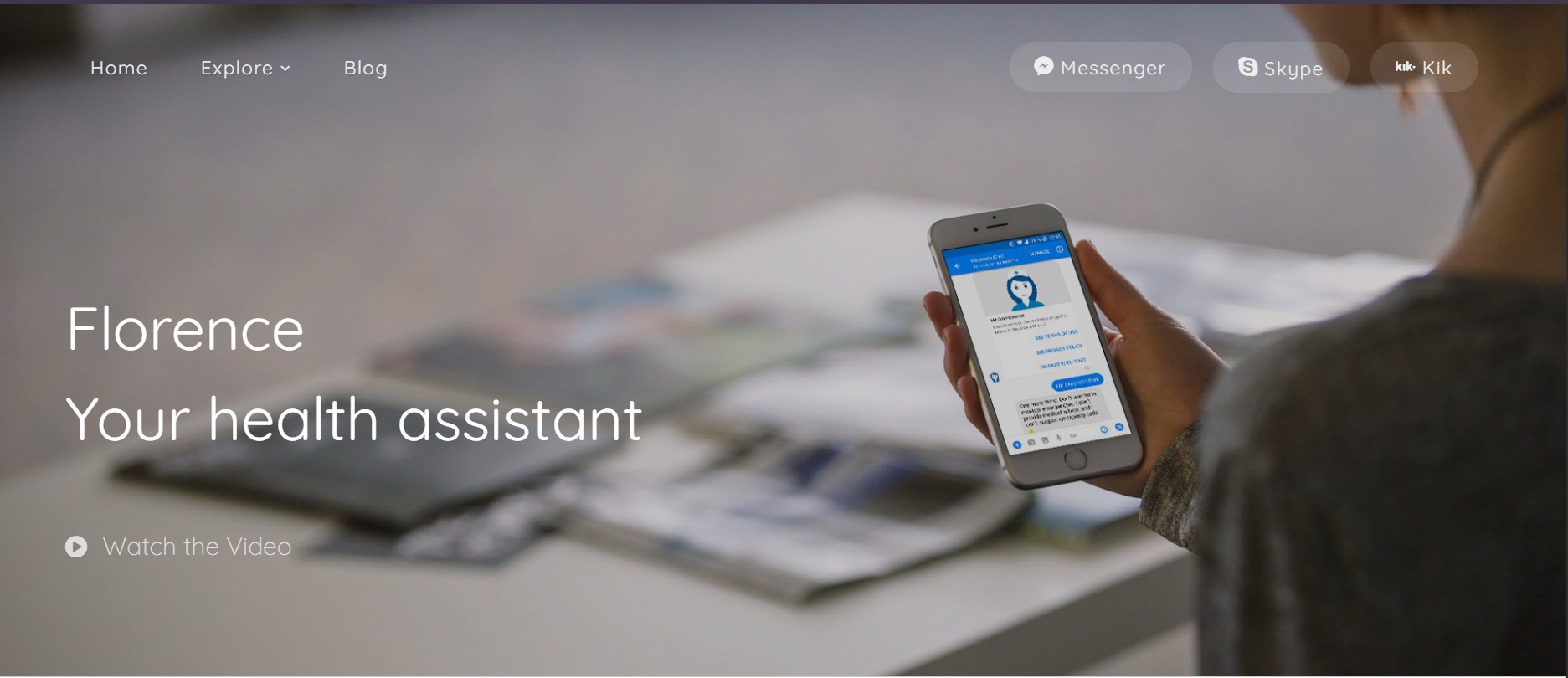
Florence is a medication management chatbot designed for patient-facing use via WhatsApp and SMS. It sends reminders when medications are due, tracks whether the patient has taken them, and provides basic information about the medication and its purpose. Patients interact conversationally: "Did you take your morning medication?" rather than a push notification they can ignore.
The medication adherence problem is enormous and underaddressed. Non-adherence to medication costs the US healthcare system approximately $528 billion annually, according to the Annals of Internal Medicine, resulting in avoidable hospitalizations, disease progression, and preventable deaths. A chatbot that builds daily conversational check-ins into the patient's existing WhatsApp routine removes the friction that causes missed doses.
Primary communication use: Medication reminders, adherence tracking, basic medication education, follow-up prompts for missed doses.
Best for: Practices managing patients on complex medication regimens, post-discharge care, and any clinical context where medication adherence directly affects outcomes.
Key result: Significant improvements in medication adherence among patients using the conversational reminder model versus standard push notifications or email.
Clinical boundary: Florence is a reminder and tracking tool. It does not provide medical advice about medication changes or side effects beyond general information.
8. Wysa — Best for Clinically Validated Emotional Support and Mental Health Triage
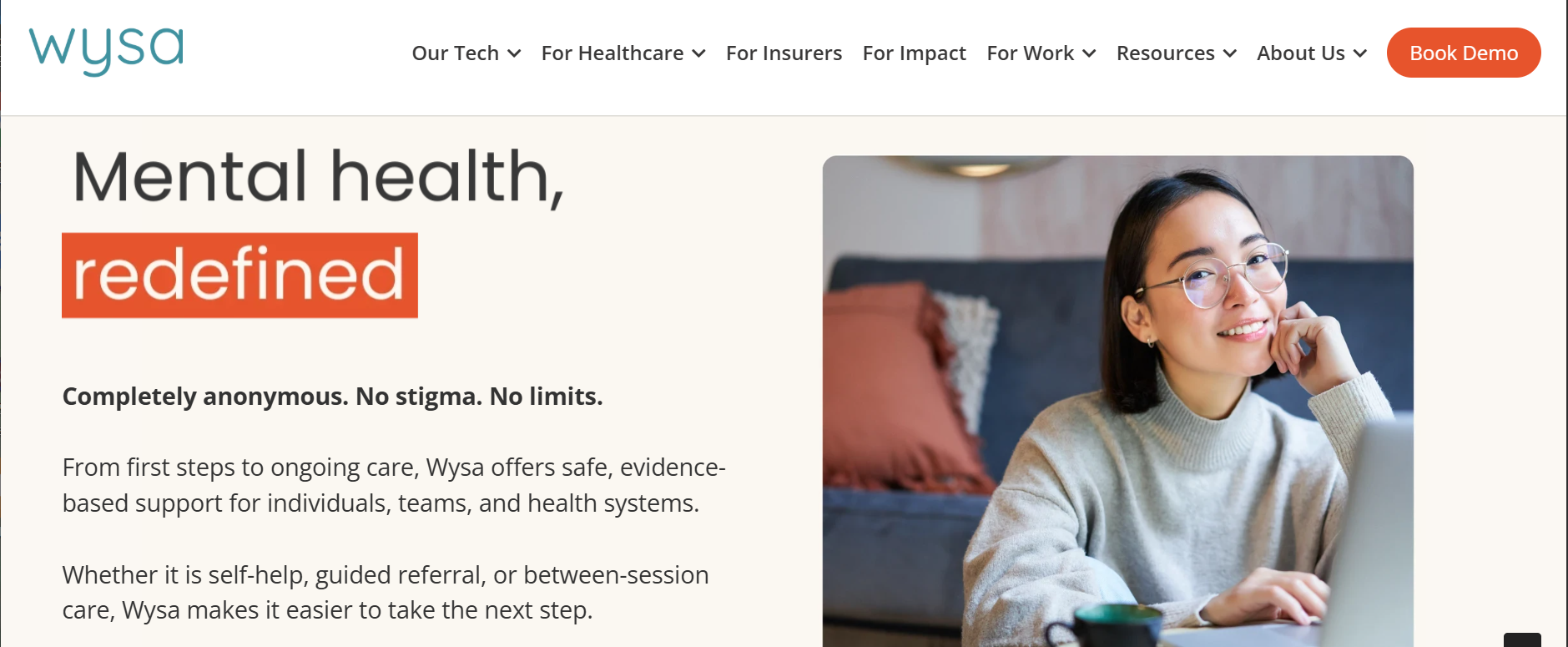
Wysa is an AI-powered emotional support chatbot used by health systems, employers, and individuals for mental health engagement. Like Woebot, it applies evidence-based techniques from CBT, dialectical behavior therapy, and mindfulness. Unlike general wellness apps, Wysa is clinically validated: its outputs have been evaluated in peer-reviewed research for safety and efficacy.
The patient communication role Wysa plays is in the space between needing support and accessing formal clinical care. That space is large: more than 50% of people who need mental health support do not seek it, according to the World Health Organization, largely due to stigma, access barriers, and cost. Wysa creates an always-available, private, non-judgmental first contact that moves patients toward care rather than away from it.
Primary communication use: Ongoing emotional support conversations, mood tracking, mental health triage, escalation to human clinicians when risk indicators are detected.
Best for: Health systems building mental health pathways, employers with EAP programs, and insurers wanting to improve mental health access without proportionally scaling therapist headcount.
Key result: Clinically validated reductions in anxiety and depression symptom scores across peer-reviewed research studies.
Clinical boundary: Wysa detects risk indicators and escalates immediately. It is not a replacement for clinical mental health treatment.
9. Buoy Health — Best for Patient Care Navigation and ER Diversion
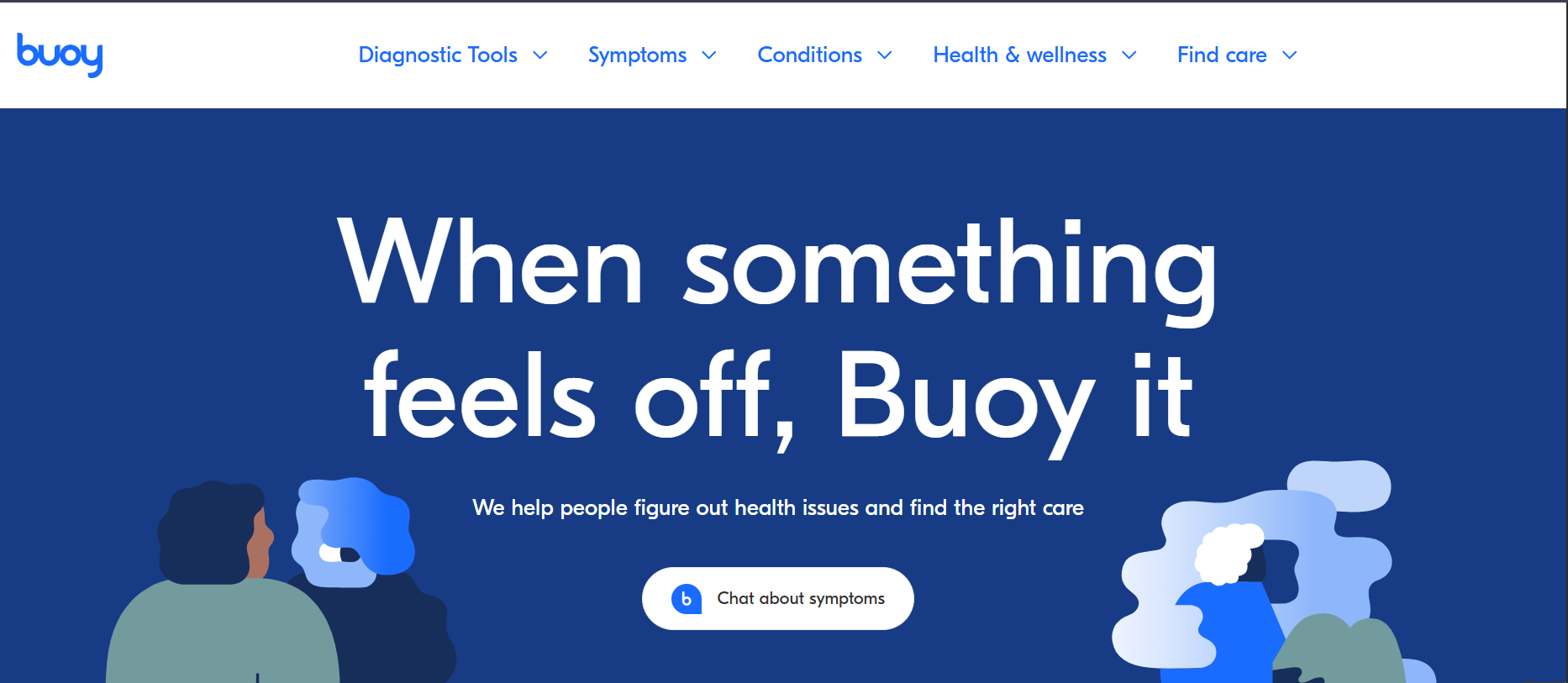
Buoy Health is an AI symptom checker and care navigation tool that guides patients toward the right care setting based on their symptoms. It asks structured questions, assesses severity, and recommends whether the patient should seek emergency care, urgent care, a primary care appointment, telehealth, or self-care.
The care navigation function addresses a real problem in healthcare systems: patients going to emergency departments for conditions that could be handled in primary care settings, and patients staying home with conditions that require immediate attention. Unnecessary ER visits cost the US healthcare system approximately $32 billion annually, according to Health Affairs. Buoy's patient communication role is directing the right patients to the right setting at the right time.
Primary communication use: Symptom-based care pathway guidance, ER diversion, patient education about appropriate care levels.
Best for: Health systems wanting to reduce unnecessary emergency department utilization and insurers wanting to direct members toward cost-appropriate care.
Key result: Measurable reduction in unnecessary emergency department visits when deployed as a first-contact patient communication tool.
Clinical boundary: Buoy navigates to care. It does not diagnose or treat. Every assessment ends with a recommendation to seek professional medical evaluation.
10. HealthTap — Best for 24/7 Virtual Primary Care Access
HealthTap combines AI-powered health guidance with access to a network of licensed physicians available for virtual consultation. The chatbot handles initial symptom collection and triage. When the patient needs to speak with a doctor, the platform connects them to a physician within minutes rather than days.
The patient communication gap HealthTap addresses is the delay between a health concern and professional guidance. In most markets, a primary care appointment takes days to weeks to arrange. A patient with a new health concern who cannot access a physician quickly either goes to the emergency department, uses unreliable online resources, or waits and hopes. HealthTap provides physician-accessible guidance in the window between those options.
Primary communication use: AI-powered health information, virtual consultation with licensed physicians, prescription refill support, lab result explanation.
Best for: Patients without immediate access to primary care, employers offering virtual care benefits, and health systems extending reach beyond clinic hours.
Key result: 24/7 access to physician-level healthcare guidance, reducing the gap between a health concern arising and a qualified response being received.
Clinical boundary: HealthTap connects patients with licensed physicians for all clinical decisions. The AI layer handles intake and information gathering.
How to Choose the Right Healthcare Chatbot for Your Practice
By Practice Size and Type
Independent practices and specialist clinics with social media presence: Heyy is the most practical starting point. No EHR integration required to go live. WhatsApp and Instagram covered natively. Deployment in hours, not weeks. The AI handles administrative communication while your clinical team handles everything requiring medical judgment.
Large health systems with EHR infrastructure: Hyro or Babylon Health. Both offer the EHR integration depth that large-scale operations require. Hyro specifically for scheduling and administrative communication. Babylon for first-line triage and virtual care pathways.
Mental health practices or practices with significant mental health patient volumes: Woebot or Wysa. Both are clinically validated for the mental health communication context and both handle the sensitivity and risk detection requirements that general-purpose chatbots do not.
Practices managing chronic disease populations: Sensely for post-discharge and ongoing monitoring. Florence for medication adherence. Both address the communication gap between clinical visits that is where chronic disease management most often breaks down.
Practices focused on patient education and ER diversion: Ada Health or Buoy Health. Both guide patients toward appropriate care before the clinical encounter, reducing unnecessary visits and improving care pathway efficiency.
The Non-Negotiable Compliance Requirements
Every healthcare chatbot handling patient data in the United States must operate under a signed Business Associate Agreement. The platform must demonstrate HIPAA-compliant architecture: encrypted data transmission, access controls, audit logs, and defined data retention policies.
For practices operating in the EU, GDPR applies. For practices in other markets, equivalent local frameworks govern patient data. The compliance requirement is not optional and should be the first question asked of any vendor in the evaluation process. When reviewing AI medical chatbots for your practice, ask specifically whether the vendor has a signed BAA template ready and whether their platform has passed a HIPAA compliance audit. The medical chatbot examples in this guide all operate within established compliance frameworks appropriate to their deployment context.
The tools that handle administrative communication only (appointment booking, reminders, general FAQs without any patient health data) have a lower compliance burden than tools that handle symptom data, health records, or clinical information. Configure the scope of your chatbot's function to match the compliance level you are prepared to maintain.
So, If your practice communicates with patients on WhatsApp, Instagram, or through your website and you are still managing those conversations manually, Heyy closes that gap today. The AI handles appointment booking, sends automated reminders, answers FAQs, and escalates clinical questions to your team immediately. No EHR integration required to start. Try it free and handle your first patient inquiry with AI before the end of the week.
FAQs
Are healthcare chatbots safe for patient communication?
Healthcare chatbots are safe for administrative patient communication: appointment booking, reminders, general practice information, and FAQ handling. For clinical communication, specifically anything involving symptom assessment, triage, or health advice, the chatbot must operate within defined clinical boundaries and escalate to a licensed practitioner whenever medical judgment is required. The tools covered in this guide all operate within those boundaries. See AI customer service in healthcare for a broader overview of how AI is safely deployed in clinical contexts.
Do healthcare chatbots replace clinical staff?
No, and this framing is counterproductive. Healthcare chatbots handle the administrative and communication layer: the tasks that currently consume clinical staff time without requiring clinical expertise. Appointment scheduling, reminder sequences, FAQ responses, post-visit follow-up messages, and intake form collection are all examples. The clinical staff time recovered from these tasks goes toward the work that genuinely requires a trained clinician.
How does HIPAA compliance work for healthcare chatbots?
Any chatbot that handles Protected Health Information (PHI) — patient names, health conditions, appointment details, or any information that could identify a patient and their health status — requires a Business Associate Agreement with the vendor. The platform must use encrypted data transmission, enforce access controls, maintain audit logs, and follow defined data retention policies. Platforms designed specifically for healthcare, like Hyro and Sensely, build HIPAA compliance into their architecture. General-purpose platforms require additional configuration and a BAA before they can legally handle PHI.
Can a healthcare chatbot handle mental health communication?
Specialized tools like Woebot and Wysa are purpose-built for mental health communication with clinical validation and built-in risk detection. General-purpose chatbots should not handle mental health communication without equivalent safeguards: crisis detection protocols, escalation pathways to clinical resources, and careful monitoring of conversation content. The clinical stakes in mental health communication are higher than in most other healthcare contexts. Use tools that were designed for it.
How quickly can a healthcare chatbot be deployed?
Administrative communication tools like Heyy can be deployed within one to two days for practices that do not require EHR integration. Full implementations with EHR connectivity, clinical triage workflows, and compliance configuration typically take two to four weeks. The timeline is extended by the compliance documentation process, not the technical setup. Have your BAA process underway before technical deployment begins.
What is the ROI of a healthcare chatbot for patient communication?
The ROI calculation runs across three lines. No-show reduction: bringing a 15% no-show rate to 7% at 25 appointments per day at $180 average value recovers approximately $324 per day, or $81,000 per year. Administrative time recovery: reducing admin staff time by 30% at a two-person admin team earning $40,000 each recovers $24,000 in annual labor that can be redirected to higher-value work. After-hours booking capture: capturing 30% of appointment demand that arrives outside business hours adds meaningful new monthly revenue that was previously entirely missed. Combined, most independent practices see full ROI within three to six months of proper deployment.
More blog posts to read

Ready to Automate Support
Across Every Channel?
.svg)
.avif)