.svg)
15 AI Project Ideas That Use Chatbots to Solve Real Business Problems

Most AI project idea lists are written for developers who want to build impressive portfolios. This one is not.
This is for business owners, operations managers, and founders who have a specific problem they need solved and want to know whether a chatbot can solve it. The framing is different from what you will find in most posts on this topic. Each idea below starts with a business problem that is costing someone money right now. The chatbot project is the solution to that problem. The outcome is a measurable business result, not a portfolio piece.
The global chatbot market is growing at 23.3% annually, projected to reach $27.3 billion by 2030. The businesses driving that growth are not building AI for novelty. They are building it because specific problems are costing them specific amounts of money, and an AI chatbot is the most cost-effective fix available.
Here are 15 of those problems and exactly what to build to solve them. These are the most actionable AI project ideas chatbots business problems generate across industries in 2026.
What Makes a Good AI Chatbot Project
Before the list, one framework.
A chatbot project worth building has three characteristics. First, it solves a problem that is repetitive. If the same question, the same process, or the same friction point appears more than twenty times a week, a chatbot can handle it. Second, it solves a problem where speed matters. If a delayed response costs you a lead, a sale, or a customer, a chatbot's 24/7 instant availability is a direct revenue lever. Third, the problem is bounded. A chatbot that tries to do everything does nothing well. The best AI chatbot project ideas are narrow, specific, and deeply useful within that scope.
Every idea on this list meets all three criteria.
Why These AI Projects Deliver Real Business Value
They Work While You Sleep
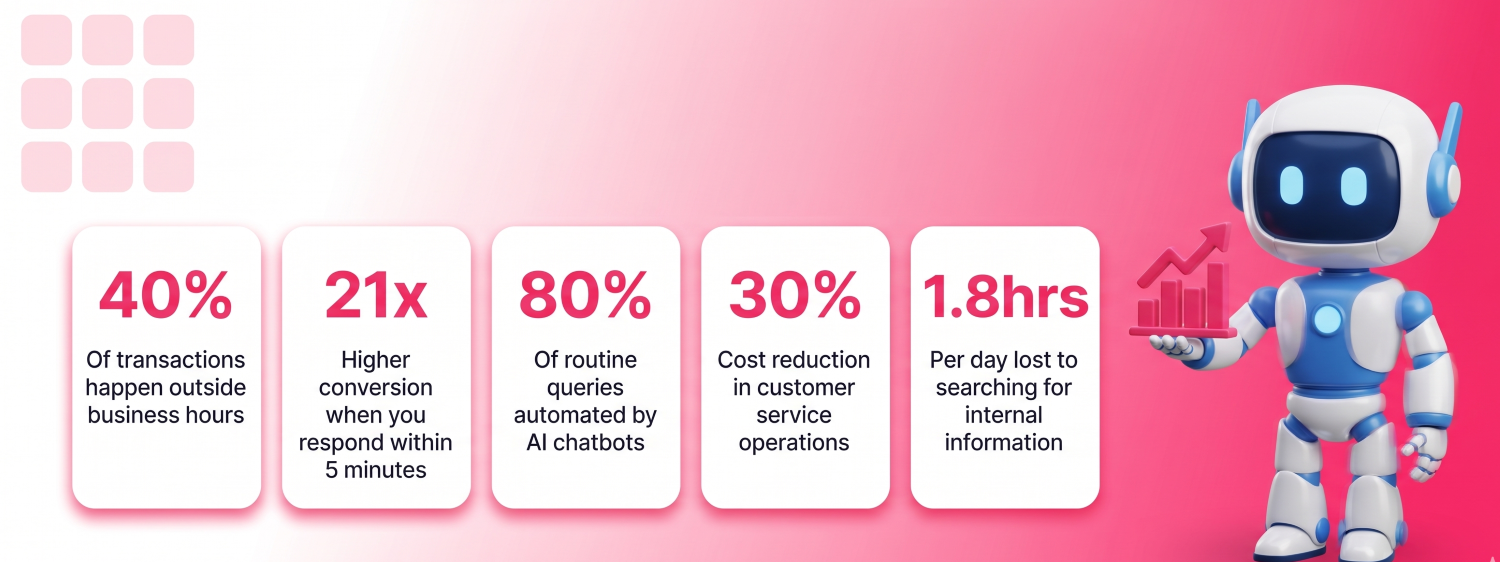
40% of online transactions happen outside standard business hours, according to Tidio's e-commerce data. Every chatbot project on this list creates a version of your business that is responsive and operational at 2am, on weekends, and across time zones without a human being present.
They Convert Faster Than Any Other Touchpoint
Leads contacted within 5 minutes of showing interest are 21 times more likely to convert than those reached after 30 minutes, according to Harvard Business Review. A chatbot that responds instantly to a lead inquiry on WhatsApp or your website is not a convenience feature. It is a conversion rate tool.
They Eliminate the Cost of Repetition
The average customer support agent spends 40 to 50% of their working day answering questions they have answered before, according to IBM. That is not a people problem. It is a systems problem. A chatbot trained on your product knowledge handles every repeat question automatically, freeing your human team for the work that actually requires judgment.
They Scale Without Proportional Cost
A human support team that handles 100 conversations per day requires 5x the headcount to handle 500. A chatbot that handles 100 conversations per day handles 500, or 5,000, with no additional cost. The marginal cost of an additional conversation is effectively zero. That economics shift is the reason businesses using AI chatbots report 30% cost reductions in customer service operations, according to IBM.
They Generate Data You Currently Cannot See
Every chatbot conversation is a data point. What are customers asking that your FAQ page does not address? Where in the buying process do people hesitate? What objections appear most frequently before a purchase? Manual support conversations generate none of this systematically. A deployed chatbot generates all of it, and that data improves your marketing, your product, and your operations. This is one of the most undervalued returns from AI project ideas chatbots business problems surface: the data layer that was previously invisible.
AI Projects Quick Glance Table
The 15 AI Chatbot Project Ideas
Project 1: 24/7 Customer Support Bot
The problem it solves: Your support team is offline for 16 hours every day. Every customer question that arrives in that window either goes unanswered until the next morning or lands in an email queue that takes hours to clear. You are losing customers who needed an answer and got silence.
What the bot does: Handles the top 20 to 30 questions your customers ask most frequently, across your website chat, WhatsApp, and Instagram DMs simultaneously. It answers product questions, explains policies, checks order status, and routes complex or emotional conversations to a human agent with full context attached.
Business impact: Businesses implementing AI customer support chatbots report handling up to 80% of routine queries without human involvement, according to IBM. For a team receiving 200 inquiries per day, that is 160 conversations handled automatically. Your human agents handle the 40 that actually require their judgment.
Complexity level: Low to medium. No custom coding required with modern no-code platforms.
Best channels: WhatsApp, Instagram DMs, website chat.
Relevant resource: Chatbot Automation: Benefits, Use Cases & Getting Started
Project 2: WhatsApp Lead Qualification Bot
The problem it solves: You are running Meta ads that send people into a WhatsApp conversation. The conversation starts. No one is there to respond. The lead goes cold in minutes. Or someone on your team is manually reading and replying to dozens of WhatsApp inquiries per day, wasting hours on leads that were never going to convert.
What the bot does: Fires immediately the moment someone messages your WhatsApp from an ad. It collects the lead's name, budget, need, and timeline through a conversational flow that feels like a real exchange. Hot leads get routed to your sales team instantly. Cold leads get added to a nurture sequence. Unqualified inquiries get handled politely without consuming human time.
Business impact: Click-to-chat ads convert up to 3x more than link-to-website ads when the conversation is handled immediately. A WhatsApp lead qualification bot closes the gap between ad click and human response at the exact moment conversion probability is highest.
Complexity level: Low. Build once with a no-code platform. Adjust qualification questions as you learn what signals predict conversion.
Best channels: WhatsApp (primary), Instagram DMs.
Relevant resource: How to Use the ChatGPT API to Build a 24/7 WhatsApp Sales Agent
Project 3: Appointment Booking Bot
The problem it solves: Your booking process requires a human: someone answering phones, checking a calendar, confirming availability, and sending a confirmation. That process has gaps: after-hours leads, missed calls, double bookings, and the administrative overhead of managing rescheduling and reminders manually.
What the bot does: Checks your live calendar, presents available slots, collects the customer's details, confirms the booking, and sends a reminder sequence automatically. The entire booking process happens inside a chat conversation without a human involved. Rescheduling and cancellations work through the same channel.
Business impact: 42% of service bookings happen outside standard business hours. An automated booking bot captures that demand. Businesses implementing automated appointment scheduling report no-show rates dropping from 15 to 20% to under 8% through automated WhatsApp and SMS reminder sequences.
Complexity level: Low to medium. Requires calendar integration. Most no-code platforms support Google Calendar and Outlook natively.
Best channels: WhatsApp, website chat, Instagram DMs.
Project 4: E-Commerce Order and Returns Bot
The problem it solves: Order status is the single highest-volume inquiry category for e-commerce businesses. Your support team is answering "where is my order" thirty times a day. Each one takes two to three minutes to pull up, check, and respond. That is one to two hours of daily support time on a question that does not require a human to answer.
What the bot does: Connects to your order management system (Shopify, WooCommerce, or equivalent) and retrieves live order status, tracking information, and delivery estimates automatically. When a customer asks about their order, the bot answers with the specific, accurate, real-time information rather than a generic redirect to check their email. It also handles return and exchange requests through a structured flow.
Business impact: E-commerce businesses that automate order status inquiries report 40 to 60% reductions in support ticket volume, with no degradation in customer satisfaction scores. Your support team refocuses on the issues that actually require their judgment.
Complexity level: Medium. Requires API integration with your order management system. Available natively on Shopify with the right chatbot platform.
Best channels: Website chat, WhatsApp, Instagram DMs.
Project 5: Instagram DM Sales Conversion Bot
The problem it solves: Your Instagram posts generate comments and DMs from people who are interested in buying. Those DMs sit unread for hours. The people who sent them have already moved on. You spent money on content and paid followers but the sales process breaks at the point of contact.
What the bot does: Triggers automatically when someone DMs your business account, comments on a post, or responds to a story. It identifies their intent, answers their product question, presents pricing or options, and guides them toward a purchase or a booking. For businesses running promotions, it delivers the discount code or the booking link within seconds of the trigger without any human involvement.
Business impact: Instagram has over 2 billion monthly active users, with the platform reporting that 90% of users follow at least one business. Businesses with automated Instagram DM responses report 5x higher response rates and 3x higher conversion from DM inquiries compared to manual management, according to Meta business case studies.
Complexity level: Low. Deployable on Instagram with no-code platforms in under a day.
Best channels: Instagram DMs (primary), Facebook Messenger.
Project 6: Employee Onboarding and HR FAQ Bot
The problem it solves: Every new employee asks the same 15 to 20 questions in their first two weeks. Where do I submit expenses? What is the holiday policy? How do I access the VPN? How does performance review work? Your HR team answers all of these repeatedly, often interrupting deeper work to do so.
What the bot does: Stores your HR policies, onboarding checklists, benefit information, and procedural guides in a knowledge base. New employees ask questions in a Slack channel or a web interface. The bot answers instantly from the knowledge base. Complex or sensitive questions escalate to HR with the question context attached.
Business impact: HR teams report spending 40% of their time on routine, answerable questions that could be automated. An internal HR FAQ bot recovers that time for strategic work. New employees get faster answers and feel more supported during the most vulnerable period of their tenure.
Complexity level: Low to medium. Build on your existing HR documentation. Requires no external integrations for the core FAQ function.
Best channels: Slack, Microsoft Teams, internal web portal.
Project 7: Internal Knowledge Base Bot
The problem it solves: Your team has procedures, policies, SOPs, and product documentation spread across a shared drive, a Notion workspace, a Confluence, and three people's inboxes. When someone needs to know something, they either spend 20 minutes searching or ask a colleague who has to stop what they are doing to find the answer.
What the bot does: Ingests your existing documentation, regardless of format (PDFs, Google Docs, Notion pages, Confluence articles), and makes it searchable through a conversational interface. A team member types a question. The bot retrieves the relevant section from the correct document and summarizes it. It links to the source so they can verify.
Business impact: Knowledge workers spend 1.8 hours per day searching for information they need to do their jobs, according to McKinsey. A knowledge base bot cuts that search time by making retrieval conversational and immediate. For a 20-person team, recovering even one hour per person per day is 20 hours of daily productivity returned.
Complexity level: Medium. Requires document ingestion and embedding. Increasingly accessible through no-code platforms.
Best channels: Slack, Teams, internal portal.
Relevant resource: The Complete Guide to Chatbot Development Frameworks
Project 8: Real Estate Property Inquiry Bot
The problem it solves: Property listings generate inquiries from buyers and renters at all hours. Agents cannot respond to every inquiry immediately. Leads that do not receive a fast response convert to another agency's viewing. Agents spend hours scheduling viewings that the buyer cancels, having never been properly qualified.
What the bot does: Responds to property inquiries on WhatsApp, Instagram, and your website instantly. It identifies the property the lead is interested in, asks qualification questions (budget, timeline, location preference, buying or renting), presents available viewing slots from the agent's calendar, and confirms the booking. Unqualified leads are handled politely without consuming agent time.
Business impact: Real estate teams using automated inquiry bots report 40% more viewings booked per week with the same agent headcount. Response time drops from hours to under a minute. Lead quality at the viewing stage improves because the bot pre-qualifies before the agent is involved.
Complexity level: Low to medium. Requires calendar integration for viewing booking. No coding required on most platforms.
Best channels: WhatsApp, Instagram DMs, website chat.
Project 9: Restaurant Reservation and Menu Bot
The problem it solves: Your restaurant phone rings during service. Staff cannot answer it, or answer it poorly while managing the floor. Potential reservations are missed. Customers who want to check the menu or ask about allergens cannot get an answer without calling. Reviews mention difficulty reaching you.
What the bot does: Handles reservations through WhatsApp and Instagram without requiring a phone call. Checks table availability, confirms booking details, sends reminders before the reservation, and handles rescheduling. It also answers menu questions, allergen queries, and opening hours without any staff involvement.
Business impact: 70% of restaurant customers prefer making reservations digitally rather than by phone, according to OpenTable's industry data. A WhatsApp reservation bot captures bookings at the moment of intent, including the late-evening decisions that phone-based systems miss entirely.
Complexity level: Low. No POS or reservation system integration required for basic deployment.
Best channels: WhatsApp, Instagram DMs.
Project 10: SaaS Onboarding and Activation Bot
The problem it solves: Users sign up for your SaaS product and do not activate. They hit a setup step they do not understand, close the tab, and never come back. Your trial-to-paid conversion rate reflects this: people who got through onboarding convert at 3x the rate of those who did not.
What the bot does: Triggers on user behavior inside the product. A user who reaches step three of onboarding and stalls receives a proactive message offering help. A user who has not logged in for five days receives a re-engagement prompt. The bot answers setup questions in real time inside the product interface rather than making the user find your help docs.
Business impact: SaaS companies that implement in-product onboarding chatbots report 15 to 25% improvements in trial-to-paid conversion rates, according to Intercom's onboarding research. Activation is the single highest-impact metric in the SaaS funnel. A bot that keeps users moving through it pays for itself within the first conversion improvement.
Complexity level: Medium to high. Requires event-based triggers from your product analytics. Better suited to teams with some technical capability or a platform with native product integrations.
Best channels: In-product chat, email, WhatsApp for reactivation.
Project 11: Abandoned Cart Recovery Bot
The problem it solves: 69.8% of online shopping carts are abandoned before checkout, according to Baymard Institute's analysis of 50+ studies. Most of those abandonments are not decisions. They are distractions: the customer meant to come back and forgot. A timed follow-up message recovers a meaningful portion of that revenue.
What the bot does: Detects when a customer has added items to their cart and left without purchasing. After a configured interval (typically one to two hours), the bot sends a WhatsApp or SMS message referencing the specific items left behind, offering to answer any questions or providing a small incentive to complete the purchase.
Business impact: Cart recovery messages sent within one hour achieve open rates above 90% on WhatsApp and average recovery rates of 5 to 15% of abandoned carts, according to multiple e-commerce automation case studies. For a store processing $50,000 in monthly sales with a 70% abandonment rate, recovering 10% of abandoned carts adds $3,500 per month in recovered revenue.
Complexity level: Medium. Requires integration with your e-commerce platform to trigger on cart abandonment events.
Best channels: WhatsApp (primary for highest open rate), SMS, email as fallback.
Project 12: Multilingual Customer Support Bot
The problem it solves: Your customers speak more than one language and your support team does not. Non-English inquiries either wait for a translated response, get a generic English reply, or go unanswered entirely. You are invisible to a segment of your market that is actively trying to reach you.
What the bot does: Detects the customer's language automatically and responds fluently in that language from a single training source. You configure the knowledge base in your primary language. The AI handles the language layer across 40 to 100+ languages without separate configuration for each one.
Business impact: 75% of consumers are more likely to purchase from a business that communicates in their native language, according to CSA Research. Businesses that implement multilingual support report 20 to 30% improvements in conversion rates from non-English-speaking markets.
Complexity level: Low on platforms with native multilingual AI. Medium on platforms that require separate language configurations.
Best channels: WhatsApp, website chat, Instagram DMs.
Project 13: Post-Purchase Review and Feedback Collection Bot
The problem it solves: Your customers have good experiences and say nothing publicly about them. Your Google rating is 3.8 because the only people motivated to leave reviews without being asked are the ones who were unhappy. Your front desk asks people to leave reviews in person and it feels awkward. The reminder email gets ignored.
What the bot does: Sends a WhatsApp or SMS message to every customer two hours after a purchase, service, or appointment. The message is personal, short, and frictionless. It asks a simple rating question first. If the rating is positive, it presents a one-tap link to leave a Google review. If the rating is negative, it opens a private feedback flow so the issue is captured internally rather than landing publicly on Google.
Business impact: Businesses using automated post-visit SMS review requests report 3 to 5x higher review response rates than those relying on verbal requests or email. A single star improvement in Google rating has been shown to increase revenue by 5 to 9% in local service businesses, according to Harvard Business School research.
Complexity level: Low. No complex integrations required. Trigger on purchase or appointment completion.
Best channels: WhatsApp and SMS for highest open rates. Email as fallback.
Project 14: Event Registration and Attendee FAQ Bot
The problem it solves: You are running a conference, workshop, webinar, or community event. Registration questions flood your inbox: What is included? Is lunch provided? Where do I park? What is the cancellation policy? Your team answers each one manually while simultaneously managing every other aspect of event logistics.
What the bot does: Handles the registration flow conversationally, including payment if required. Answers every FAQ about the event from a trained knowledge base. Sends confirmation and reminder messages automatically. On the day, handles check-in queries, directional questions, and schedule questions without requiring staff to be on WhatsApp.
Business impact: Event organizers using chatbot registration and FAQ handling report 60 to 70% reductions in pre-event support email volume. Staff capacity is redirected from inbox management to the actual event experience. Attendee satisfaction scores improve because questions are answered instantly rather than in the next-business-day email batch.
Complexity level: Low to medium. Requires payment integration if handling registrations. FAQ handling alone is deployable in a day.
Best channels: WhatsApp, website chat, Instagram DMs for event discovery traffic.
Project 15: Invoice and Payment Follow-Up Bot
The problem it solves: You have outstanding invoices. Following up on them manually is time-consuming, occasionally awkward, and inconsistently executed. Some clients get chased, others do not. Cash flow suffers because the follow-up process depends on whether someone remembered to send the email.
What the bot does: Triggered by your accounting or invoicing system when an invoice reaches a defined number of days overdue, the bot sends a polite payment reminder via WhatsApp or SMS. The message includes the invoice amount, the due date, and a direct payment link. If the invoice remains unpaid after a second interval, a second message goes out. All communication is logged.
Business impact: Businesses automating payment reminders via SMS or WhatsApp report 40% faster invoice payment cycles compared to email-only follow-up, according to Xero's small business payment research. Late payment is one of the most consistent cash flow problems for small and mid-sized businesses. An automated follow-up system is the lowest-effort fix available.
Complexity level: Medium. Requires integration with your invoicing system (QuickBooks, Xero, Wave, FreshBooks, or similar).
Best channels: WhatsApp, SMS.
How to Choose Which Project to Build First
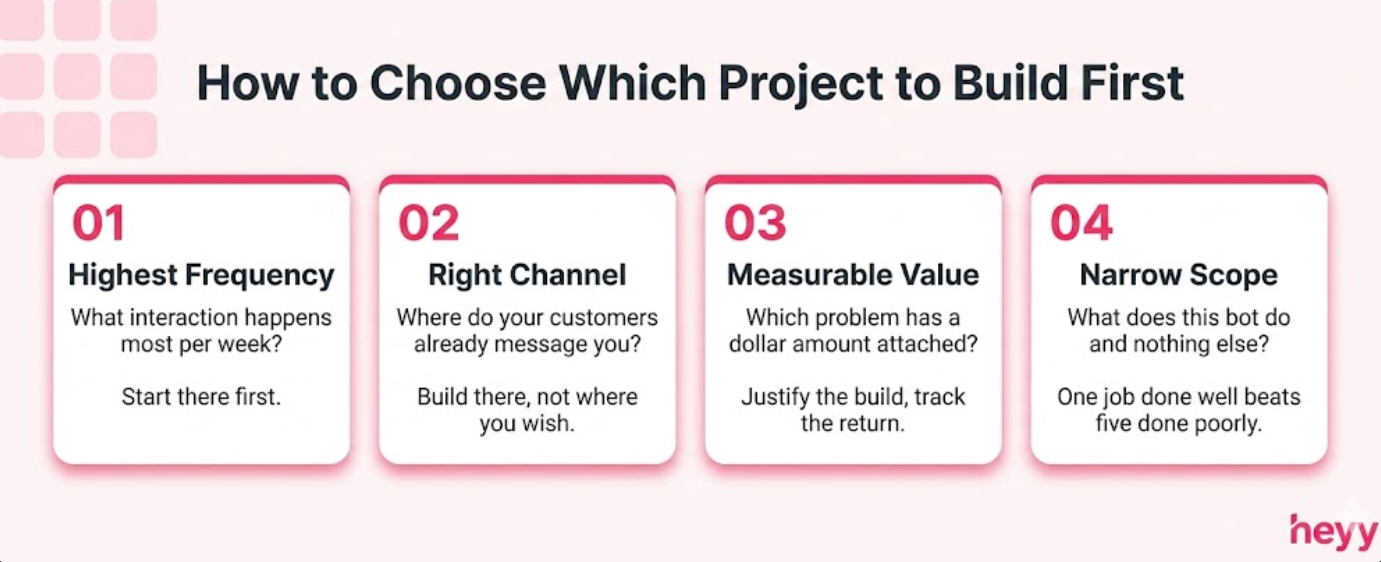
Every idea above is implementable. The question is sequence. The AI project ideas chatbots business problems generate most frequently are the ones to tackle first. Here is the filter that determines where to start.
Start with the highest-frequency problem: Count how many times per week the same interaction happens manually. The AI chatbot project ideas that automate the most frequently repeated interaction deliver the fastest ROI. For most businesses, that is customer support FAQs or order status checks.
Start with the channel where your customers already are: If your customers message you on WhatsApp, build a WhatsApp bot. If they come through Instagram, build there. Do not build a website chat bot for customers who never visit your website. Channel alignment determines whether the project gets used.
Start with the problem that has a measurable dollar value: Custom AI solutions for business problems with the clearest revenue attachment, like abandoned cart recovery, lead qualification, and appointment booking, are the ones you can justify fastest and build confidence around for the next one.
Do not try to build all fifteen at once: One well-configured chatbot that solves one specific problem delivers more business value than fifteen half-built bots that each do something poorly. The AI agents for small businesses that actually move metrics are the ones built with a narrow, specific scope and then optimized over time.
No-Code vs. Custom Build: When to Use Each
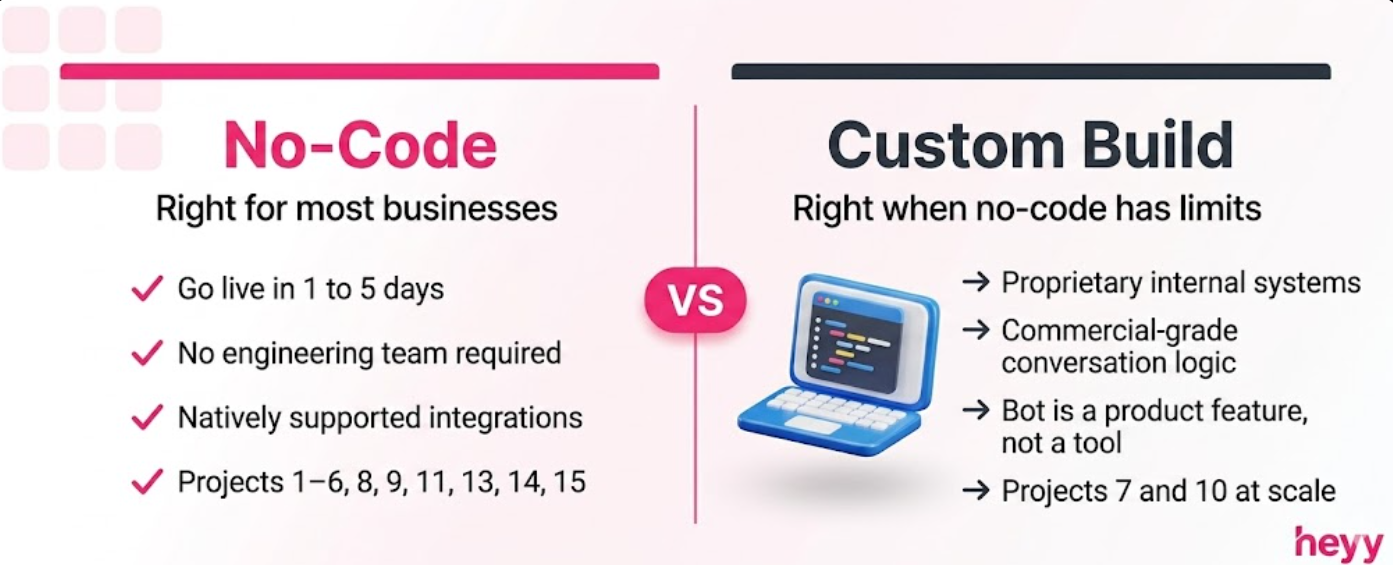
Most of the projects on this list are deployable with no-code platforms without writing a line of code. The choice between no-code and custom development is not about capability. It is about complexity and scale. Custom AI solutions for business problems that involve proprietary systems or commercial-grade conversation logic require the custom path. Everything else is a no-code decision.
Use a no-code platform when: You need to go live quickly. Your use case is clearly defined and bounded. Your team does not have engineering resources dedicated to the project. The integrations you need are natively supported. Projects 1 through 6, 8, 9, 11, 13, 14, and 15 all fall into this category for most businesses.
Build custom when: You need deep integration with a proprietary internal system. You have a use case that requires conversation logic that no-code platforms cannot accommodate. You are building a product where the chatbot is a commercial feature, not just an operational tool. Projects 7 and 10 may require custom development depending on your technical stack. See how to use the ChatGPT API to build a WhatsApp sales agent for a practical guide to the custom build path.
The most common mistake is defaulting to custom development for a problem that a no-code platform could solve in two days. The second most common mistake is using a no-code platform for a problem that genuinely requires custom logic and then being surprised when it breaks at the edges.
Common Mistakes When Implementing AI Chatbot Projects
Solving the wrong problem first. Building an elaborate internal knowledge base bot when your highest-volume problem is unanswered WhatsApp inquiries is a resource allocation error. Match the project to the problem with the highest current business cost.
Deploying without testing the failure cases. Every chatbot will eventually receive a question it cannot answer. What it does at that moment determines whether the customer experience is preserved or destroyed. Test every failure path before you go live.
Not defining success metrics before building. The most common reason AI chatbot projects get abandoned after three months is that nobody defined what success looked like before they started. Set a baseline, define the target, and measure monthly.
Building on a single channel when customers use multiple. A WhatsApp bot that cannot handle Instagram DMs leaves half your social traffic unserved. For customer-facing projects, omnichannel deployment from a single inbox is not a luxury. It is the standard that your customers expect.
Skipping the knowledge base. A chatbot without a well-structured, accurate knowledge base is a bot that makes things up. The training quality determines the response quality. Invest the time in building a clean, current knowledge base before deploying any of the projects on this list.
If you want to deploy any of these projects without building from scratch, Heyy handles the channel infrastructure for you. WhatsApp, Instagram, Facebook Messenger, and website chat all run through one inbox. The AI trains on your knowledge base and handles the conversations. You configure the logic. No engineering team required. Start free and have your first AI project live before the end of the week.
FAQs
Do I need coding skills to build any of these AI chatbot projects?
Most of the 15 projects on this list are buildable without any coding using modern no-code platforms. Projects like customer support bots, WhatsApp lead qualification, appointment booking, restaurant reservations, review collection, and event registration all deploy without writing code. Projects 7 (internal knowledge base) and 10 (SaaS onboarding) may require some technical configuration depending on your existing systems, but are still accessible via no-code tools for the core functionality. The ChatGPT API guide covers the custom build path for those who want more control.
How long does it take to build and deploy one of these projects?
A basic single-channel deployment for projects like FAQ handling, appointment booking, or lead qualification can be live in one to two days. A full deployment covering multiple channels, system integrations, and a tested escalation path typically takes one to two weeks. The testing phase is where most of the time should go.
What is the difference between an AI chatbot and a rule-based chatbot for these projects?
A rule-based chatbot follows a fixed script. It presents numbered menus and breaks the moment a customer phrases something outside the expected pattern. Custom AI solutions for business problems require genuine natural language understanding: the ability to handle context across a multi-turn conversation, adapt to how customers actually write, and recover gracefully when the conversation goes off-script. For customer-facing projects, the AI approach consistently produces higher completion rates and better customer satisfaction scores because real customers do not speak in menu selections.
Which of the 15 projects delivers the fastest ROI?
Abandoned cart recovery (Project 11), WhatsApp lead qualification (Project 2), and appointment booking (Project 3) typically deliver the fastest measurable ROI because the revenue impact is directly countable from day one. Every cart recovered, every lead qualified, and every appointment booked that would not have happened without the bot is attributable revenue with a clear calculation.
Can one chatbot handle multiple projects at once?
A single chatbot can be trained to handle multiple use cases, but the quality of each one depends on how clearly defined the scope is. A chatbot trained to do everything, handle support, qualify leads, book appointments, and answer FAQs simultaneously, often does all of them adequately rather than any of them excellently. The practical recommendation is to start with one well-configured project, optimize it until it performs reliably, and then expand the scope incrementally.
What channels should I prioritize for these projects?
Prioritize the channels your customers actually use. For most consumer-facing businesses, WhatsApp and Instagram DMs generate more customer-initiated contact than website chat alone. For B2B businesses, website chat and email remain primary. The projects that deliver the most value are the ones deployed where your customers already are, not where you wish they were.
More blog posts to read



Ready to Automate Support
Across Every Channel?
.svg)
.avif)