.svg)
8 AI Personalization Use Cases Driving Real Revenue in 2026

You have visited an online store before, bought a running shoe, and within 48 hours received a WhatsApp message about running socks that went with it perfectly. Not a generic promotion. Not a mass blast. A message that made you feel like the brand was paying attention.
That is AI personalization working at the level most businesses aspire to and few actually reach.
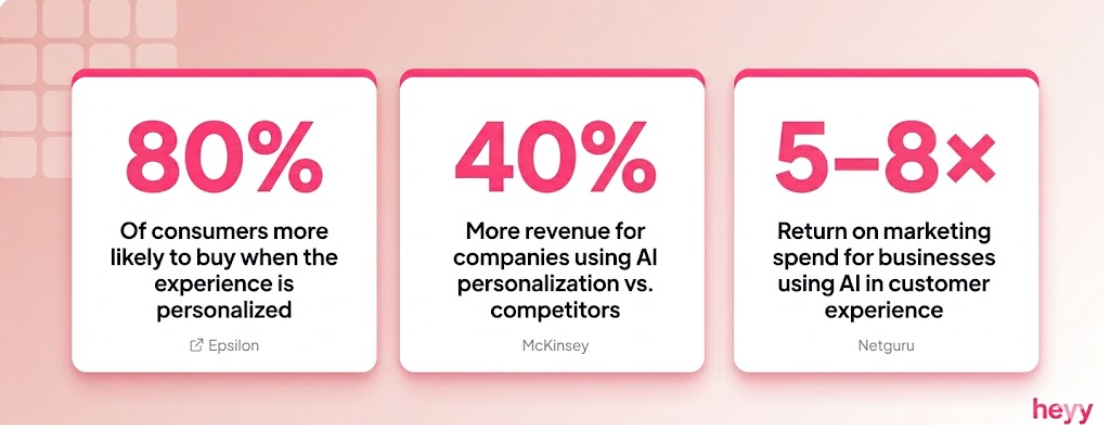
71% of consumers expect personalized interactions with brands, and 76% report frustration when that expectation is not met, according to research aggregated by Envive.ai. The gap between expectation and delivery is where revenue is lost. Companies that adopt AI personalization early generate 40% more revenue from personalization than their competitors, per Anchor Group's 2026 e-commerce statistics analysis.
This post covers 8 specific AI personalization use cases that are generating measurable revenue in 2026, with real numbers behind each one and a clear view of what it takes to implement them.
What Is AI Personalization?
AI personalization is the use of machine learning and behavioral data to deliver experiences, messages, product recommendations, and offers that are tailored to the specific individual receiving them, in real time, at scale.
It is not segmentation. Segmentation divides customers into groups and sends the same message to each group. AI personalization treats each customer as an individual, adapting the experience based on their specific behavior, purchase history, preferences, and context. The difference in outcome is substantial. Personalized recommendations drive up to 31% of e-commerce revenues in sessions where customers engage with them, per Envive.ai's personalization statistics.
The benefits of AI personalization in business fall into three categories. Revenue: higher conversion rates, larger average order values, more repeat purchases. Efficiency: marketing spend that targets the right customers rather than broadcasting to everyone. Retention: customers who feel known stay longer and buy more often.
Why AI Personalization Matters More in 2026
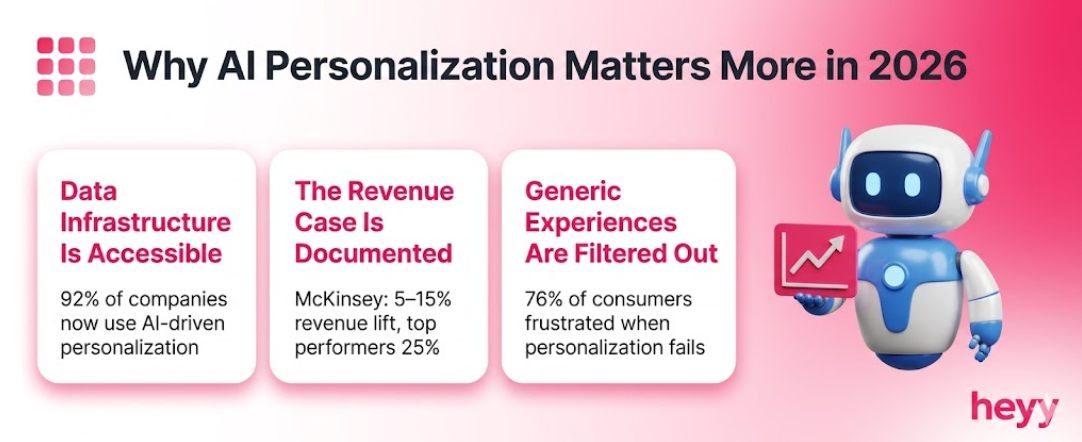
Three factors have elevated AI personalization from a competitive advantage to a baseline expectation.
The data infrastructure is now accessible. Personalization at scale once required enterprise budgets and dedicated data science teams. In 2026, the tools that power recommendation engines, behavioral triggers, and dynamic content are available to businesses of all sizes through SaaS platforms. 92% of companies now use AI-driven personalization in some form, per Ringly.io's 2026 e-commerce statistics compilation.
The revenue case is documented. McKinsey research shows personalization drives a 5 to 15% revenue lift, with top performers reaching 25%, per Triple Whale's AI e-commerce statistics. 82% of businesses that use AI to enhance customer experience report 5 to 8x return on marketing spend, according to Netguru's 2026 AI personalization analysis. These are not projections. They are reported outcomes from deployed systems.
Customer patience for generic experiences has evaporated. The customer who receives a mass promotional email and a personalized WhatsApp message on the same day has a lived basis for comparison. The personalized touchpoint feels like service. The mass email feels like noise. In 2026, noise is increasingly filtered out before it even reaches the inbox.
The Benefits of AI Personalization in Business: By the Numbers
Before the use cases, the macro-level proof:
80% of consumers are more likely to purchase from a brand that delivers personalized experiences, according to Epsilon's research cited by Ringly.io. 89% of marketers report positive ROI from personalization initiatives. AI-powered campaigns achieve 1.7x higher click-through rates compared to traditional approaches, per Netguru.
The benefits of AI personalization in business compound over time: the more customer data the system accumulates, the more accurate the personalization becomes, and the more accurate the personalization becomes, the more data the engaged customers generate. It is a flywheel, not a one-time lift.
8 AI Personalization Use Cases Driving Real Revenue
1. Product Recommendation Engines
The example everyone knows but few implement correctly:
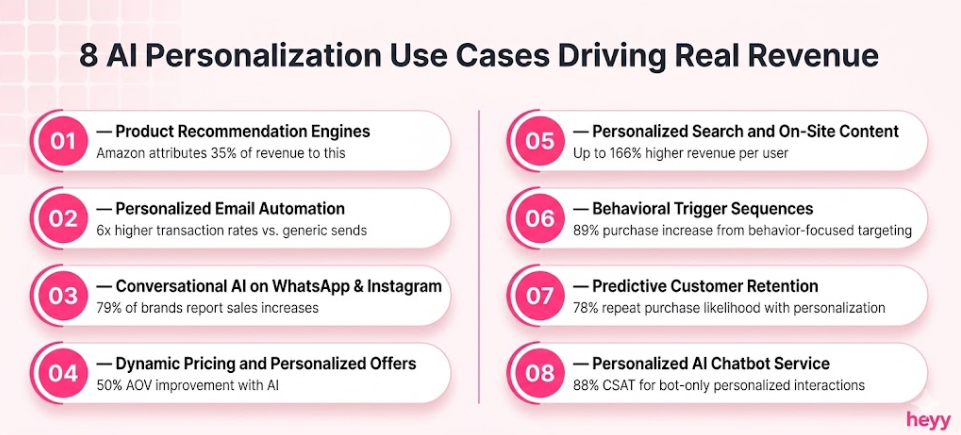
Amazon attributes 35% of its total revenue to its personalized recommendation engine. That is not a product feature. That is the company's second-largest revenue driver, after the products themselves.
The mechanism is straightforward: every click, purchase, time spent on a product page, and item added to cart trains a model that predicts what the customer is likely to want next. The "customers also bought" and "recommended for you" sections are that model's outputs.
For businesses without Amazon's data science team, the same logic applies at a smaller scale. A Shopify store connecting a product recommendation tool to their catalog and purchase history data generates "you might also like" suggestions that are based on real purchase patterns rather than manual curation. High-level customization through predicted product recommendations has been shown to increase average revenue per user by up to 166%, per EComposer's 2026 AI e-commerce analysis.
What you need to implement it: A product catalog, purchase history data, and a recommendation tool that connects to your e-commerce platform. Most modern Shopify and WooCommerce plugins include this. The differentiator is the quality of the behavioral data feeding the model.
2. Personalized Email and Marketing Automation
The channel with the highest documented revenue lift from personalization:
Personalized emails deliver 6x higher transaction rates than generic campaigns, per research compiled by Ringly.io from multiple sources. More dramatically: brands that segment and personalize their email campaigns have seen up to 760% increases in revenue from those campaigns compared to broadcast sends.
The AI personalization layer in email goes beyond "Hi [Name]." It determines which products to feature based on browsing history, which offer to present based on purchase frequency, which subject line to use based on past open behavior, and when to send based on the individual's historically highest-engagement time. Behavior-based email automation produces 320% more revenue than non-automated campaigns, per DMA research cited by Ringly.io.
What you need to implement it: Customer email data connected to behavioral signals (purchase history, browse data, click patterns). Tools like Klaviyo, ActiveCampaign, and Mailchimp's advanced tiers handle this. The AI layer improves with every email opened, clicked, ignored, or unsubscribed from.
3. Conversational AI Personalization on WhatsApp and Instagram
The use case most inspiration posts miss entirely:
Every other AI personalization example operates in contexts the customer has to seek out: they visit the website, they open the email, they use the app. WhatsApp and Instagram DM personalization meets the customer in the channel they are already in, at the moment they are already using it.
When a customer messages your business on WhatsApp asking about a product they viewed, the AI has access to their name, their previous purchase history, their current cart, and their expressed preferences from prior conversations. The response is not a generic FAQ. It is a conversation that sounds like it comes from someone who knows them.
67% of marketing and sales teams report revenue increases from AI in the past 12 months, per Triple Whale's 2026 AI e-commerce statistics, with conversational commerce identified as one of the highest-ROI applications. 79% of brands say AI-driven conversational commerce has increased their sales.
This is where platforms like Heyy create measurable differentiation. The AI is trained on your product catalog, your customer history, and your brand voice. When a customer messages on WhatsApp, the response references what they actually bought, what they actually browsed, and what they are actually likely to want next. The AI customer service guide covers how this personalization layer connects to the broader service experience.
What you need to implement it: A customer messaging platform that integrates WhatsApp and Instagram with your CRM and order data. The personalization quality is directly proportional to the richness of the customer data the AI can access during the conversation.
4. Dynamic Pricing and Personalized Offers
Where AI personalization intersects with revenue optimization:
Dynamic pricing is AI personalization applied to price rather than content. The same product is offered at different prices to different customers based on demand signals, customer lifetime value, competitive context, and purchase history.
At the enterprise level, hotels, airlines, and ride-sharing companies have operated dynamic pricing for years. In 2026, the same logic is accessible to mid-market e-commerce brands through tools that adjust promotional pricing based on customer data: a high-CLV customer at risk of churning receives a retention offer; a first-time visitor receives a new customer discount; a customer who has purchased three times at full price never sees a promotional offer that would train them to wait for one.
AI drives a 50% improvement in average order value through personalized recommendations and offers, per Anchor Group's 2026 e-commerce statistics. The mechanism is not random discounting. It is precision: the right offer, to the right customer, at the right moment.
What you need to implement it: Customer CLV data, purchase frequency data, and a pricing or promotions tool that can segment offers dynamically. The ethical constraint: personalized pricing must not discriminate on protected characteristics. The business constraint: price personalization should serve retention and conversion, not extract maximum price from price-insensitive customers.
5. Personalized Search and On-Site Content
The experience gap most e-commerce sites have not closed:
Two customers visit the same home page simultaneously. One has purchased women's athletic wear three times. The other has browsed men's casual shoes but never purchased. A generic home page shows them the same featured products.
An AI-personalized home page shows each customer the products most likely to convert for them specifically, based on their behavioral history. The same logic applies to site search: the results returned for "black shoes" are different for a customer who buys formal footwear than for one who buys sneakers.
AI-powered personalization achieves significantly higher conversion rates compared to rule-based approaches, and mobile apps with personalization show dramatically higher conversion rates than mobile web experiences, per Envive.ai's statistics. Predicted product recommendations can increase average revenue per user by as much as 166% when applied to high-traffic on-site moments.
What you need to implement it: Behavioral data from on-site activity (click paths, product page time, search queries) and a personalization platform that adapts content dynamically. Tools like Nosto, Barilliance, and Dynamic Yield specialize in this. Understanding customer data analytics is the foundation for making on-site personalization work well.
6. Behavioral Trigger Sequences and Re-engagement
Personalization that acts on intent signals, not schedules:
Standard marketing automation sends messages on a calendar. Behavioral trigger sequences send messages on intent. A customer who views a product three times without purchasing receives a message when the trigger threshold is crossed, not on a Tuesday morning because Tuesday is when the batch sends.
The AI personalization layer determines which trigger threshold is appropriate for which customer (a high-CLV customer gets more attempts before the brand concedes; a price-sensitive customer gets a discount trigger faster), which message to send (re-engagement, social proof, price drop notification, or low stock alert), and which channel to use for that specific customer.
Automated abandonment emails achieve 42% click-to-purchase rates when customers engage with them, per Envive.ai. 89% increase in purchases from behavior-focused personalization has been documented in behavioral targeting deployments. On WhatsApp specifically, where open rates exceed 95%, behavioral trigger sequences outperform email equivalents by a significant margin for customer-facing retail and service businesses.
What you need to implement it: Behavioral event tracking (page views, cart events, time on page), a trigger logic system, and channel connectivity for delivery. The CRM chatbot integration guide covers how to connect behavioral signals to the conversation layer where these triggers fire.
7. Predictive Customer Retention and Churn Prevention
Personalization applied before the problem is visible:
The customer who is about to churn has not yet cancelled. They have started opening emails less frequently. Their purchase interval has lengthened. Their support ticket sentiment has declined. Their NPS score fell two points at the last survey. Individually, each signal is ambiguous. Together, they are a prediction.
AI personalization in retention contexts identifies the combination of signals that precede churn in your specific customer base and triggers personalized outreach before the cancellation decision is made. The outreach is not a generic "we miss you" email. It is a message that references the specific product the customer has not reordered, asks whether the issue was resolved, or presents a personalized offer calibrated to their specific renewal economics.
Companies implementing AI-driven personalization earn 40% more revenue than organizations without personalization capabilities, with retention personalization identified as a primary driver of that gap. 78% repeat purchase likelihood with AI personalization versus significantly lower rates without it, per Anchor Group's 2026 data.
What you need to implement it: Historical behavioral data that spans the full customer lifecycle (not just acquisition), a churn prediction model or platform that identifies at-risk customers, and a personalized outreach mechanism that can act on the prediction. Most advanced CRMs include churn scoring features; the AI personalization layer is what makes the outreach specific rather than generic.
8. Personalized AI Chatbot Customer Service
Where personalization becomes a service standard, not a marketing tactic:
A customer contacts support about a delayed order. A generic chatbot asks for their order number and recites the tracking information. A personalized AI chatbot knows their order history, knows this is their third order, knows the last interaction was about a return, and opens with "Hi [Name], I can see your order for [specific item] is showing delayed — here's what's happening and what you can expect."
The personalization transforms a support interaction into a relationship signal. AI chatbots with access to customer data reduce support costs by up to 80% in optimized deployments while maintaining 88% customer satisfaction for bot-only interactions, per Ringly.io's 2026 statistics.
The data layer driving this experience is the CRM: purchase history, previous contact reasons, known preferences, and account status. When the AI chatbot has access to this data and is trained to reference it conversationally, the customer experience is measurably different from a transactional FAQ interaction.
The best AI chatbots for small businesses include personalization features that connect to CRM data, allowing even small teams to deliver this experience at scale.
The AI Personalization Tools Worth Knowing
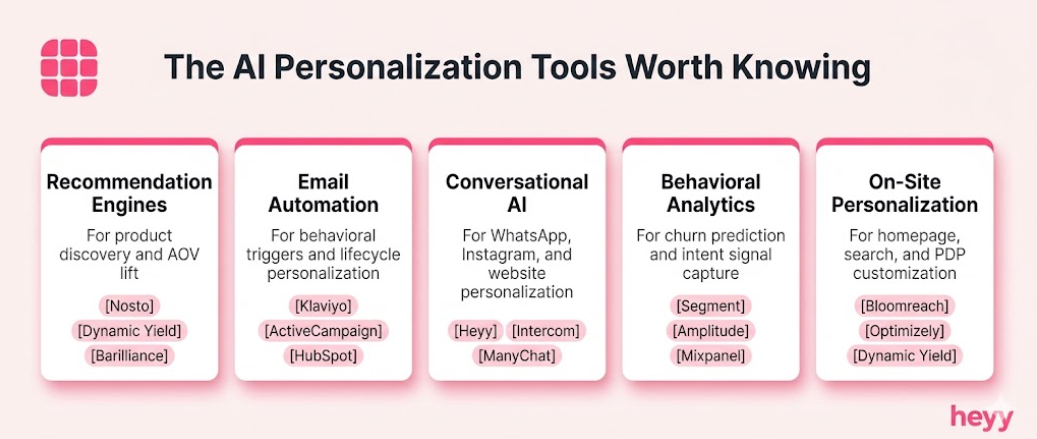
The AI personalization examples in this post span multiple tool categories. Different use cases require different tooling. The most widely deployed categories:
Recommendation engines: Nosto, Barilliance, Dynamic Yield, and Shopify's native recommendation features. All connect to product catalog and purchase data to generate personalized suggestions.
Email and marketing automation: Klaviyo for e-commerce, ActiveCampaign for SMBs, HubSpot for CRM-connected personalization. The differentiator is how deeply each tool connects to behavioral event data.
Conversational AI personalization tools: Platforms that connect AI chatbots to customer history and purchase data for WhatsApp, Instagram, and website chat. This is where AI personalization tools like Heyy operate, connecting the conversation layer to the CRM and order data layer so responses reflect what the AI actually knows about the customer.
Predictive analytics platforms: Segment, Amplitude, and Mixpanel surface the behavioral signals that feed both churn prediction and trigger-based personalization.
On-site personalization: Dynamic Yield, Bloomreach, and Optimizely for home page, search, and product page personalization based on individual behavioral history.
What Makes AI Personalization Fail
Most AI personalization posts focus on success stories. These are the failure patterns worth understanding before building.
Garbage data produces garbage personalization. A product recommendation built on three months of data for a new customer is speculative. A recommendation built on two years of purchase and browse history is accurate. The quality of personalization is proportional to the quality and completeness of the behavioral data feeding it.
Personalization without privacy destroys the relationship. There is a line between "we remembered your preference" and "we have been watching you very closely." Referencing a specific product a customer looked at once three months ago in an unsolicited message crosses that line for most customers. Personalization should feel like attentiveness, not surveillance.
Automation without personalization is just noise at scale. Sending a "personalized" message that uses the customer's first name but is otherwise identical to what every other customer received is not personalization. It is mass communication with a mail merge. AI personalization tools should adapt the substance of the message, not just the salutation.
The conversation layer is where AI personalization is most visible to the customer. When a WhatsApp message or Instagram DM references what they actually bought, what they actually asked about, and what they are actually likely to want next, personalization stops being a marketing tactic and starts being a service standard. Heyy connects your customer data to the conversational channels your customers already use, so every conversation reflects what the AI actually knows about the person it is talking to. Start free and see what personalized conversation looks like in your first week.
FAQs
What is AI personalization?
AI personalization is the use of machine learning to deliver experiences, messages, product recommendations, and offers tailored to each individual customer based on their specific behavior, purchase history, and preferences — in real time and at scale. It differs from segmentation in that it treats each customer as an individual rather than a group member. In 2026, AI personalization examples range from Amazon's recommendation engine to personalized WhatsApp conversations that reference a customer's specific order history.
What are the benefits of AI personalization in business?
The benefits of AI personalization in business are measurable across three dimensions. Revenue: McKinsey documents a 5 to 15% revenue lift for most deployments, with early adopters generating 40% more revenue than competitors without personalization. Efficiency: personalization improves marketing spend effectiveness by 10 to 30%, per McKinsey, by targeting the right customers rather than broadcasting to all. Retention: personalized experiences generate 78% repeat purchase likelihood versus significantly lower rates without personalization. The compound effect of all three makes personalization one of the highest-return investments available to growth-stage businesses.
What AI personalization tools should I start with?
The right starting point depends on your primary channel and primary use case. For email: Klaviyo (e-commerce) or ActiveCampaign (SMB). For product recommendations: Nosto or Dynamic Yield connected to your e-commerce platform. For conversational personalization on WhatsApp and Instagram: a platform that connects your customer history to the chat layer. For behavioral analytics and churn prediction: Segment or Amplitude. The CRM chatbot integration guide covers how to connect your customer data to your conversation channels for the most impactful personalization layer.
How do I measure whether AI personalization is working?
Five metrics tell the complete story. Conversion rate from personalized interactions versus non-personalized ones. Average order value for customers receiving personalized recommendations versus control groups. Email open and click rates for personalized versus broadcast sends. Churn rate for customers in AI-triggered retention sequences versus control groups. Customer lifetime value over 12 months for customers in personalization programs versus those not in them. The customer data analytics guide covers how to build the measurement infrastructure that makes these comparisons meaningful.
What data do I need to start AI personalization?
Start with what you already have: purchase history, email engagement history, and on-site behavioral data (product views, search queries, cart events). This is the minimum input for product recommendations and email personalization. Add real-time behavioral data (time on page, scroll depth, click paths) for on-site personalization. Add customer service interaction history and satisfaction scores for retention personalization. The richer the data, the more accurate the personalization. The most important constraint: the data must be first-party (collected directly from your customers, with their knowledge and consent).
The conversation layer is where AI personalization is most visible to the customer. When a WhatsApp message or Instagram DM references what they actually bought, what they actually asked about, and what they are actually likely to want next, personalization stops being a marketing tactic and starts being a service standard. Heyy connects your customer data to the conversational channels your customers already use, so every conversation reflects what the AI actually knows about the person it is talking to. Start free and see what personalized conversation looks like in your first week.
More blog posts to read

Ready to Automate Support
Across Every Channel?
.svg)
.avif)