.svg)
Best AI UGC Video Generators for Brands That Don't Want to Hire Actors

If you've scrolled through Instagram or TikTok in the past six months, you've noticed something: the ads that actually make you stop scrolling don't look like ads at all. They look like someone talking to their phone in a bedroom, sharing a product they're excited about. That's user-generated content — UGC — and it's become the default format for performance marketing across nearly every consumer category.
The problem is that authentic-looking UGC is surprisingly expensive and time-consuming to produce at scale. You need to find creators, negotiate rates, brief them, wait for deliverables, request revisions, and hope the final output matches the energy you were going for. For a single video, that process might cost anywhere from $200 to $2,000 and take a week or more. Multiply that across a testing matrix of different hooks, angles, and audiences, and the budget spirals fast.
That's exactly why AI UGC video generators have gone from novelty to necessity for growth teams and solo entrepreneurs alike. These tools create realistic talking-head videos — complete with natural speech, facial expressions, and casual framing — without requiring a single human creator on camera.
What AI UGC Video Generators Actually Do
The concept is straightforward but the execution is technically impressive. An AI UGC video generator takes your script, pairs it with a digital avatar that looks and moves like a real person, and renders a video that mimics the informal, direct-to-camera style that defines UGC content.
The best tools go beyond a static talking head. They incorporate natural pauses, subtle head movements, eye contact shifts, and even hand gestures that make the output feel spontaneous rather than robotic. Platforms like VEED.IO, a leading AI video generator, further enhance these experiences with capabilities such as realistic AI lip sync. Some platforms let you choose from libraries of diverse avatars — different ages, ethnicities, settings — so you can match the presenter to your target demographic without casting calls.

Pollo AI has built a particularly capable AI UGC video generator that stands out for its combination of realism and speed. As part of Pollo AI's all-in-one video and image creation suite, the UGC generator lets you go from script to finished video in minutes rather than days. What impressed me most was how natural the avatar movements felt — the kind of micro-expressions and conversational rhythm that usually requires a real person in front of a camera. Pollo AI supports multiple creative applications and cutting-edge models within a single platform, which means you can generate your UGC video and then immediately edit, add effects, or create supplementary visual assets without switching tools.
For brands running performance marketing campaigns, this speed advantage is transformative. Instead of producing three creative variations per week, you can test thirty. That volume of iteration is what separates campaigns that find winning creative from those that burn budget guessing.
Tagshop AI
.png)
Tagshop AI is an AI UGC platform that helps you generate creator-style video ads just from a simple conversation with its AI Video Agent, without hiring or briefing an actual creator. This makes it a strong fit for brands that need a steady output of UGC-style video content across TikTok, Instagram Reels, and Facebook ads.
Worth considering if you're building a brand identity and can't afford off-brand content slipping through, even at the cost of speed. It's a better fit for mid-market and enterprise brands managing multi-channel content operations than for lean teams looking for quick turnaround on a single ad format.
Higgsfield AI Video Generator
.png)
Higgsfield AI Video Generator is a cinematic AI video platform that helps creators and brands produce high quality marketing videos from simple text or image prompts. With advanced camera motion controls and realistic animations, it enables users to create premium visual content without a traditional production team.
It is a strong choice for businesses that need a consistent flow of social media videos, product promotions, and branded campaigns across platforms like TikTok, Instagram Reels, YouTube Shorts, and Facebook. The platform's ability to maintain scene and character consistency also makes it suitable for multi clip storytelling and long term marketing projects.
Worth considering if you want greater creative control over AI generated videos and need professional looking content that stands out. It is particularly well suited for marketers, agencies, and brands producing high volume video campaigns, while creators looking for a full featured video editing suite may prefer a dedicated editing platform.
Who Benefits Most From AI-Generated UGC
Not every brand needs this technology equally, and understanding where it delivers the most value helps you decide whether it belongs in your workflow.
Direct-to-consumer e-commerce brands are the most obvious beneficiaries. If you're selling a skincare product, a kitchen gadget, or a fitness supplement, your ad creative needs constant refreshing. Audiences fatigue on the same face and the same hook within days. AI UGC generators let you rotate presenters and scripts at a pace that keeps your content fresh without scaling your creator roster.
SaaS companies and app developers are a growing segment of users. Product walkthroughs and feature announcements delivered in a casual, UGC-style format consistently outperform polished corporate videos in engagement metrics. The informal tone builds trust in a way that a branded motion-graphics explainer simply can't replicate.
Agencies managing multiple client accounts find enormous operational leverage here. Instead of coordinating creator shoots across different client briefs simultaneously, a small team can produce UGC-style content for an entire portfolio of brands in a single afternoon.
Solo entrepreneurs and small business owners who can't afford to hire creators at all now have access to a content format that was previously gated by budget. A local service business can produce testimonial-style videos for social media without ever asking a customer to sit in front of a camera.
Comparing the Top Platforms in This Space
The market has matured enough that meaningful differences exist between platforms, and the right choice depends heavily on your specific needs.
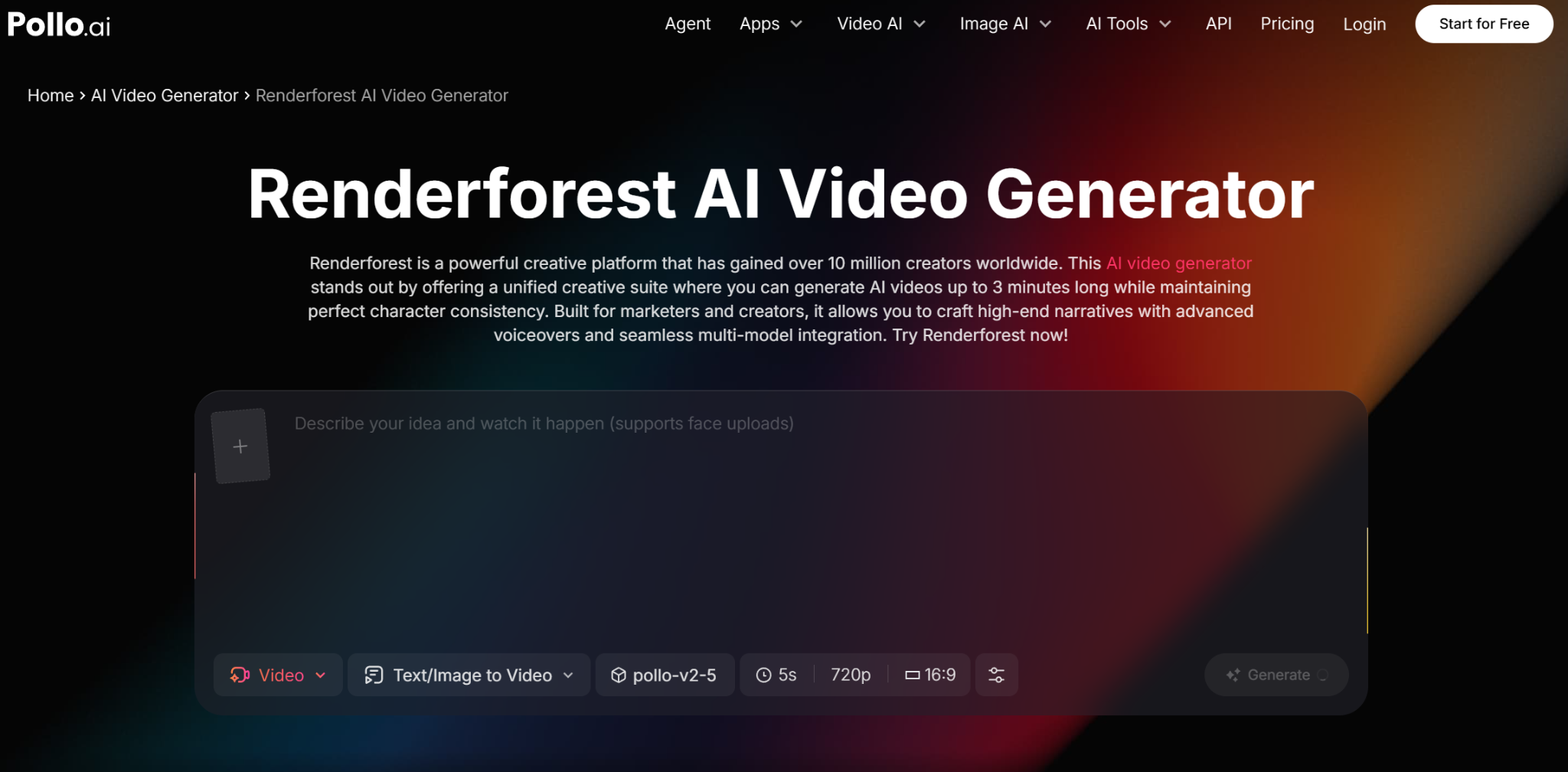
Renderforest approaches video creation from a broader toolkit perspective, offering templates for everything from logo animations to full marketing videos alongside its AI capabilities. It's a strong option for teams that need a versatile video creation platform covering multiple formats beyond just UGC — think brand intros, social media ads, and presentation videos. Pollo AI provides access to Renderforest's suite of tools, making it easy to explore whether its template-driven approach fits your workflow before committing to a production pipeline.
Synthesia has established itself as a leader in AI avatar videos for corporate and enterprise use cases. Its strength lies in multilingual support and a polished, professional aesthetic that works well for internal communications, training videos, and formal marketing content. It's less optimized for the raw, casual energy that defines true UGC, but excellent for professional talking-head content.
HeyGen offers a similar avatar-based approach with strong multilingual capabilities and a focus on marketing applications. It's particularly popular among teams producing localized ad content across multiple markets.
Where Pollo AI differentiates itself is in the integration of UGC video generation within a broader creative ecosystem. Rather than being a single-purpose tool, it sits within a platform that includes text-to-video generation, image creation, animation, and video editing capabilities. This means the UGC video you generate can be immediately enhanced with AI-generated b-roll, custom thumbnails, or additional visual effects — all without leaving the platform. For creators and marketers who need to produce complete content packages rather than isolated clips, that workflow consolidation saves significant time.
Tips for Getting the Most Out of AI UGC
The tool handles the production, but the strategy and scripting still determine whether your content performs. A few principles consistently separate high-performing AI UGC from forgettable output.
Write scripts the way people actually talk, not the way brands write copy. Read your script out loud before feeding it into any generator. If it sounds like a press release when spoken, it will look like a press release on screen — regardless of how realistic the avatar is. Use contractions, incomplete sentences, and conversational transitions. Start with a hook that sounds like the beginning of a story, not a value proposition.
Keep individual videos short and focused on a single message. The UGC format works because it feels spontaneous and personal. A ninety-second video covering four product benefits loses that energy. Better to produce four separate thirty-second videos, each built around one compelling point.
Test different avatars against the same script. The presenter's appearance, energy, and perceived demographic significantly impact performance, and you won't know which combination resonates until you test it. This is one area where AI UGC has a structural advantage over real creator content — swapping the presenter costs nothing and takes seconds.
Match your background and framing to the platform. A video destined for TikTok should feel different from one running as a Facebook ad. Casual bedroom or kitchen settings work for organic-style content, while a clean, well-lit background reads better in paid placements where viewers expect slightly higher production value.
What Comes Next for AI UGC
The current generation of tools produces content that's convincing enough for most advertising and marketing applications, but the gap between AI-generated and human-created UGC continues to narrow. Within the next year, expect to see real-time AI UGC generation — where you type a script and watch the finished video render in seconds rather than minutes — become standard across major platforms.
Personalization at the individual viewer level is another frontier. Imagine a product ad where the presenter's appearance, language, and even the specific benefits mentioned are dynamically tailored to each viewer's profile. The technical foundations for this already exist; the challenge is primarily one of platform integration and scale.
For anyone producing content today, the practical takeaway is that AI UGC generators have crossed the quality threshold where they deliver genuine business value. Platforms like Pollo AI have made the technology accessible enough that budget is no longer a barrier to producing the kind of authentic, high-converting video content that drives modern digital marketing. The brands and creators who adopt these tools early will build a meaningful advantage in content velocity — and in a landscape where creative testing speed directly correlates with performance, that advantage compounds quickly.
More blog posts to read

Ready to Automate Support
Across Every Channel?
.svg)
.avif)