.svg)

Chatbase gets one thing right: it is the fastest way to take a document, a URL, or a PDF and turn it into an AI chatbot. Paste your content, connect your website, and you have a working FAQ bot in under 30 minutes. For a proof of concept or a simple support bot with light traffic, that is exactly what it is built for.
The exits happen when the product grows past that.
I recommend Chatbase in one situation: when a team needs an AI FAQ bot on their website in under an hour and expects light traffic. When they come back three months later, the problems are usually the same ones. The bot stopped responding mid-conversation because the message credits ran out. A customer messaged on WhatsApp and got no answer because the bot does not live there. A $2,000 order inquiry got a wrong answer and no one on the team saw the conversation because there is no built-in team inbox.
Those are not edge cases. They are what happens when a tool built for speed hits real business volume.
The alternatives below solve these problems. Some are close Chatbase replacements. Some solve what Chatbase was never designed to handle.
Why Teams Leave Chatbase
Chatbase is honest about what it is: a tool for deploying an AI chatbot trained on your own data as quickly as possible. The limitations that send teams looking for alternatives are not hidden. They are structural.
Credit-based pricing at scale: Chatbase's Hobby plan at $32/month includes just 700 message credits. The Standard plan at $120/month gives 4,000 credits and the Pro plan at $400/month gives 15,000. Each AI response consumes multiple credits depending on the model used. When credits run out mid-month, the bot stops responding until the account recharges at $40 per 1,000 additional credits. The free plan gives only 50 credits and deletes the bot after 14 days of inactivity, making it a demo rather than a working deployment.
No native team inbox: When Chatbase cannot handle a conversation, it escalates to whatever external tool you have configured. There is no built-in inbox where your team sees incoming handoffs, picks up conversations, responds, and tracks resolution. For teams that need human-AI collaboration on customer queries, this requires a separate helpdesk tool, which adds cost and operational complexity.
Primarily single-channel deployment: Chatbase lives on your website widget. WhatsApp, Instagram, and other messaging channels require separate integrations that vary in reliability and are not natively managed within the platform.
Character limits on training data: Each plan caps how much content the bot can be trained on. Teams with large knowledge bases, extensive product catalogs, or multi-language documentation hit this ceiling and have to choose which knowledge to prioritize.
Chatbots handling routine support queries reduce agent workload by up to 80% of common ticket categories, per Marketing LTB's 2026 chatbot statistics. That deflection rate depends on the bot actually being available where customers contact you. A website-only bot misses every conversation that starts on WhatsApp, Instagram, or any other channel.
Quick Comparison: 8 Best Chatbase Alternatives
The 8 Best Chatbase Alternatives in 2026
1. Heyy: Best for Omnichannel AI Trained on Your Data
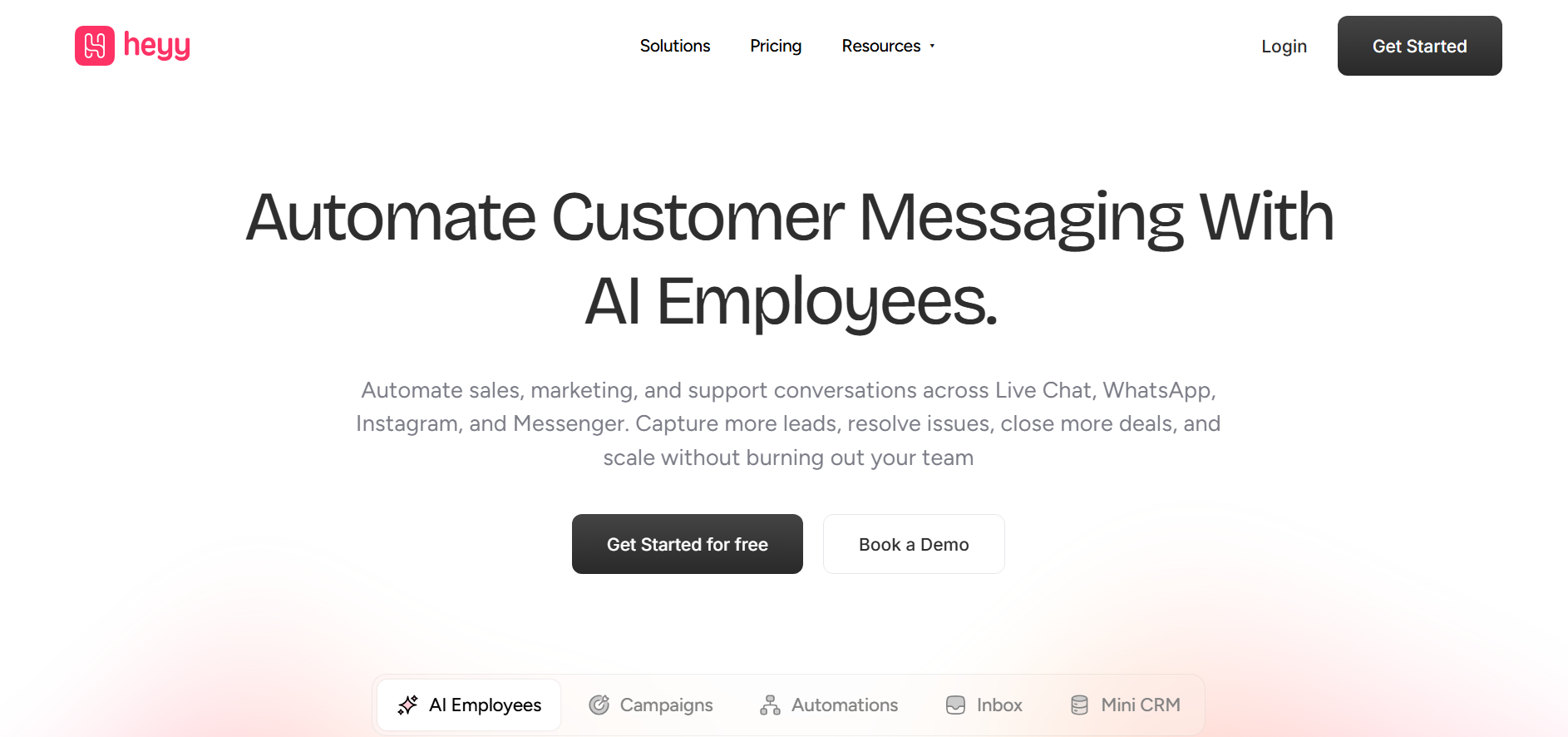
Best for: Businesses that need an AI chatbot trained on their own product data deployed across WhatsApp, Instagram, Facebook Messenger, and website chat simultaneously, with a team inbox for human handoff.
Chatbase trains on your data and deploys to your website. Heyy trains on your data and deploys to every channel where your customers actually are. That is the architectural difference.
Heyy's AI Employees are trained on your product catalog, FAQs, policies, and historical conversation data. Once trained, the same AI handles WhatsApp queries, Instagram DM responses, website chat questions, and Facebook Messenger conversations from a single configuration. A customer who messages on Instagram about a product gets the same accurate, on-brand response as a customer who messages on WhatsApp about the same product. No duplicate bot setups. No separate training for each channel.
The team inbox is native. When the AI reaches the edge of what it can handle, it escalates with full conversation context to a human agent. The agent sees the complete conversation history regardless of which channel it started on. No external helpdesk required for the handoff workflow.
For eCommerce brands on Shopify or WooCommerce, order-tracking queries resolve automatically. A customer sends "where is my order?" and the AI pulls live order data and responds accurately without human involvement.
The free plan is permanent and includes all four channels. This is not a 14-day trial. It is a working deployment that does not expire.
For teams evaluating knowledge base chatbot options more broadly, the best AI knowledge base chatbots guide covers the full category in detail.
Chatbase comparison verdict: Chatbase for a quick website FAQ bot with minimal traffic. Heyy when you need the same AI on WhatsApp and Instagram, a team inbox for escalations, and pricing that does not meter out mid-conversation.
Pricing: Free forever. Hobby $49/month. Pro $149/month. Ultra $499/month.
2. Botpress: Best Open-Source Chatbot Platform
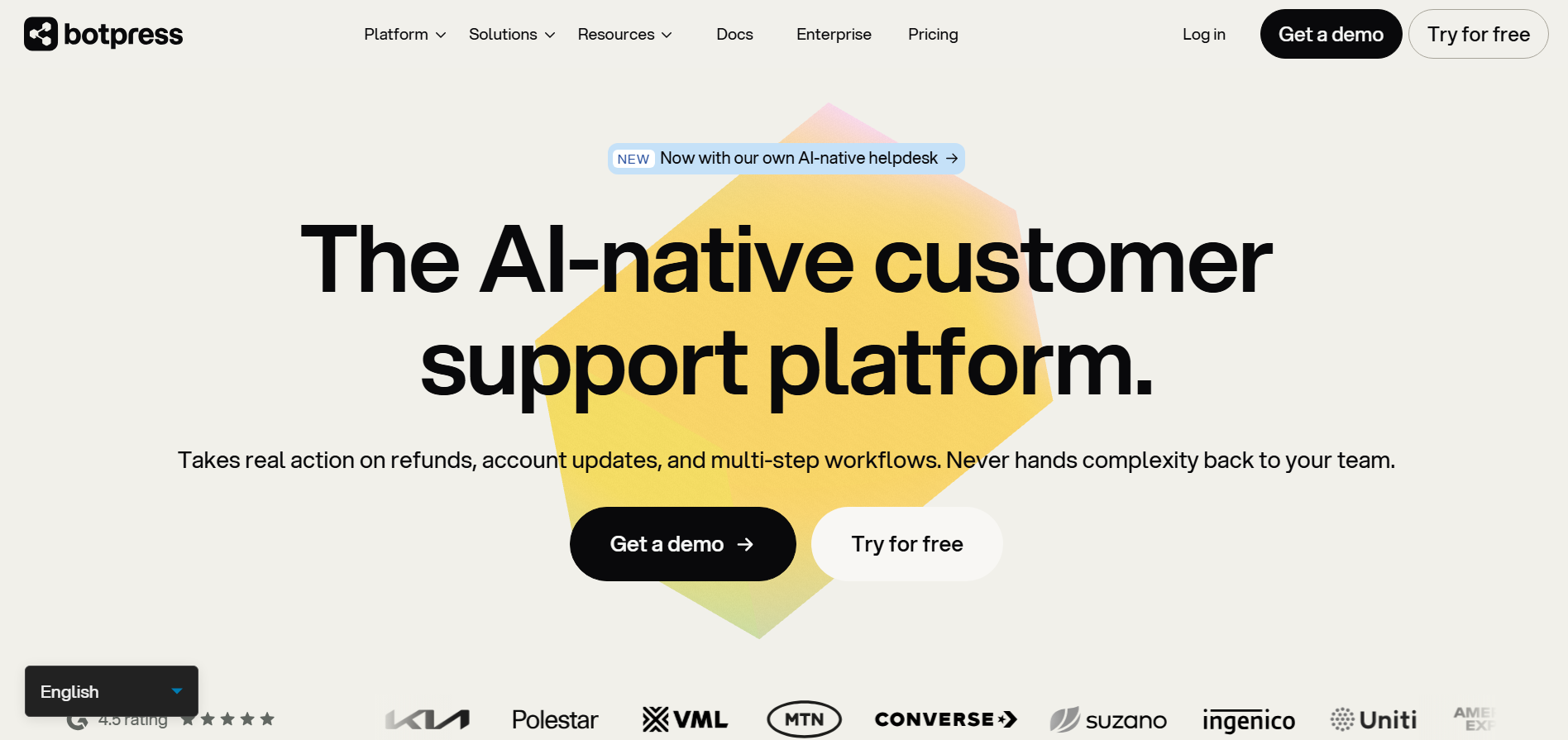
Best for: Developer-led teams who want complete control over conversation logic, custom AI integrations, and the ability to self-host or deploy to any channel through the API.
Botpress is one of the most capable open source chatbot platforms available and the most commonly considered alternative when teams outgrow Chatbase's no-code simplicity. The visual flow builder handles complex conditional branching. The knowledge base module lets you train on your own documents and URLs. The AI layer connects to OpenAI, Anthropic, and other model providers depending on what your use cases require.
What separates Botpress from Chatbase is depth and control. You can build conversation flows that Chatbase's single-chatbot model cannot support: multi-step qualification sequences, conditional routing based on user history, dynamic data retrieval from external APIs, and custom integrations with any system your team uses.
The free plan on Botpress cloud is genuinely functional for development and testing. The Plus plan at $189/month is where production deployments with advanced AI capabilities sit. Self-hosting removes the subscription cost entirely at the expense of infrastructure management and update maintenance.
The honest constraint: Botpress requires meaningful developer involvement to configure properly. Teams without engineering resources will find the learning curve steep compared to Chatbase's paste-and-publish simplicity.
Chatbase comparison verdict: Chatbase for non-technical teams needing a fast deployment. Botpress for technical teams needing production-grade conversation logic with full platform control.
Pricing: Free plan. Plus $189/month. Team $939/month. Enterprise custom.
3. Tidio: Best for eCommerce with Lyro AI
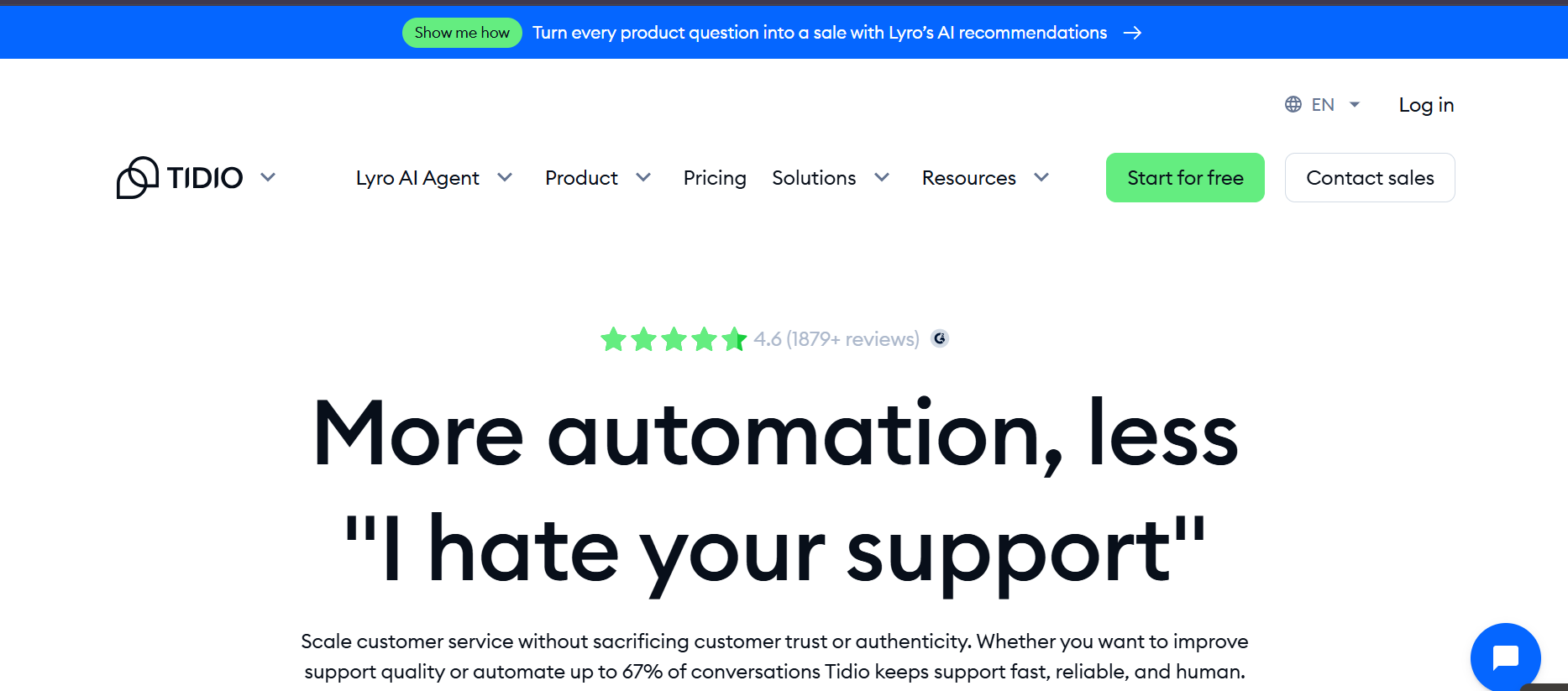
Best for: Small to mid-sized eCommerce businesses that need an AI chatbot trained on their knowledge base with native Shopify integration and live chat coverage.
Tidio's Lyro AI is trained on your knowledge base content and handles customer questions using that training autonomously. For an eCommerce business with a well-structured FAQ, Lyro resolves the repetitive support questions (order status, return policy, product availability) without human involvement. Tidio reports that Lyro resolves up to 70% of common customer questions without agent assistance.
What makes Tidio distinctly useful over Chatbase for eCommerce: the Shopify integration is native and bidirectional. Product information, order data, and customer records sync automatically. Lyro can answer order-specific questions using live store data, not just static FAQ content. That is a meaningful capability gap versus Chatbase, which requires manual document updates to keep the knowledge base current.
The free plan is limited to 50 Lyro conversations. Paid access starts at $24.17/month. Lyro AI is billed per conversation on top of the base subscription, so heavy usage volumes add to the headline price.
Chatbase comparison verdict: Chatbase for a quick website FAQ bot. Tidio for eCommerce businesses that need the chatbot integrated with their store data and a live chat layer when AI escalates.
Pricing: Free plan (limited). Starter $24.17/month. Growth from $49.17/month. Lyro AI billed per conversation.
4. CustomGPT.ai: Best for Enterprise Document-Heavy Knowledge Bases
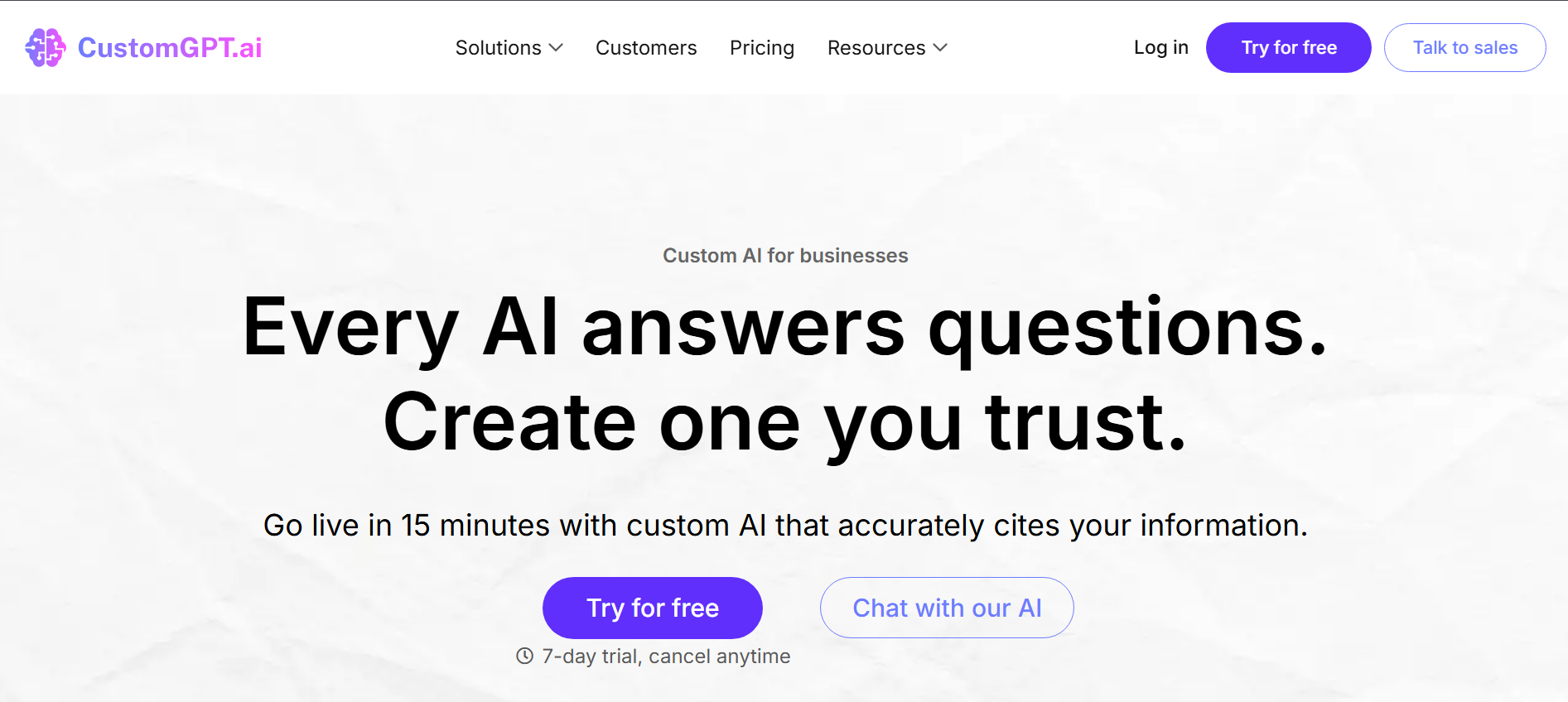
Best for: Enterprise teams with large, complex document libraries who need an AI chatbot trained on PDFs, internal documents, and proprietary content with white-label capability.
CustomGPT.ai is the closest Chatbase competitor for enterprise teams that need to train a chatbot on a large volume of proprietary documentation. It handles PDFs, DOC/DOCX, text files, URLs, and other content types. The character limits per plan are higher than Chatbase's, making it better suited for teams with extensive knowledge bases.
White-label branding is available without requiring the highest tier. Multiple knowledge bases per project make it viable for agencies managing separate client chatbots or companies with multiple product lines that need distinct bot personalities.
The honest limitation: CustomGPT.ai is US-hosted. For European businesses handling customer data, this creates GDPR compliance considerations that require DPA review and Standard Contractual Clauses. Chatbase has the same US-hosting issue, so this is not a differentiator between the two, but it is a consideration for any team moving from US-hosted infrastructure.
Chatbase comparison verdict: Chatbase for small teams needing a quick deployment. CustomGPT.ai for enterprises with larger document libraries and white-label requirements.
Pricing: Basic $99/month. Standard $449/month. Enterprise custom.
5. SiteGPT: Closest Chatbase Replacement With Cleaner Pricing
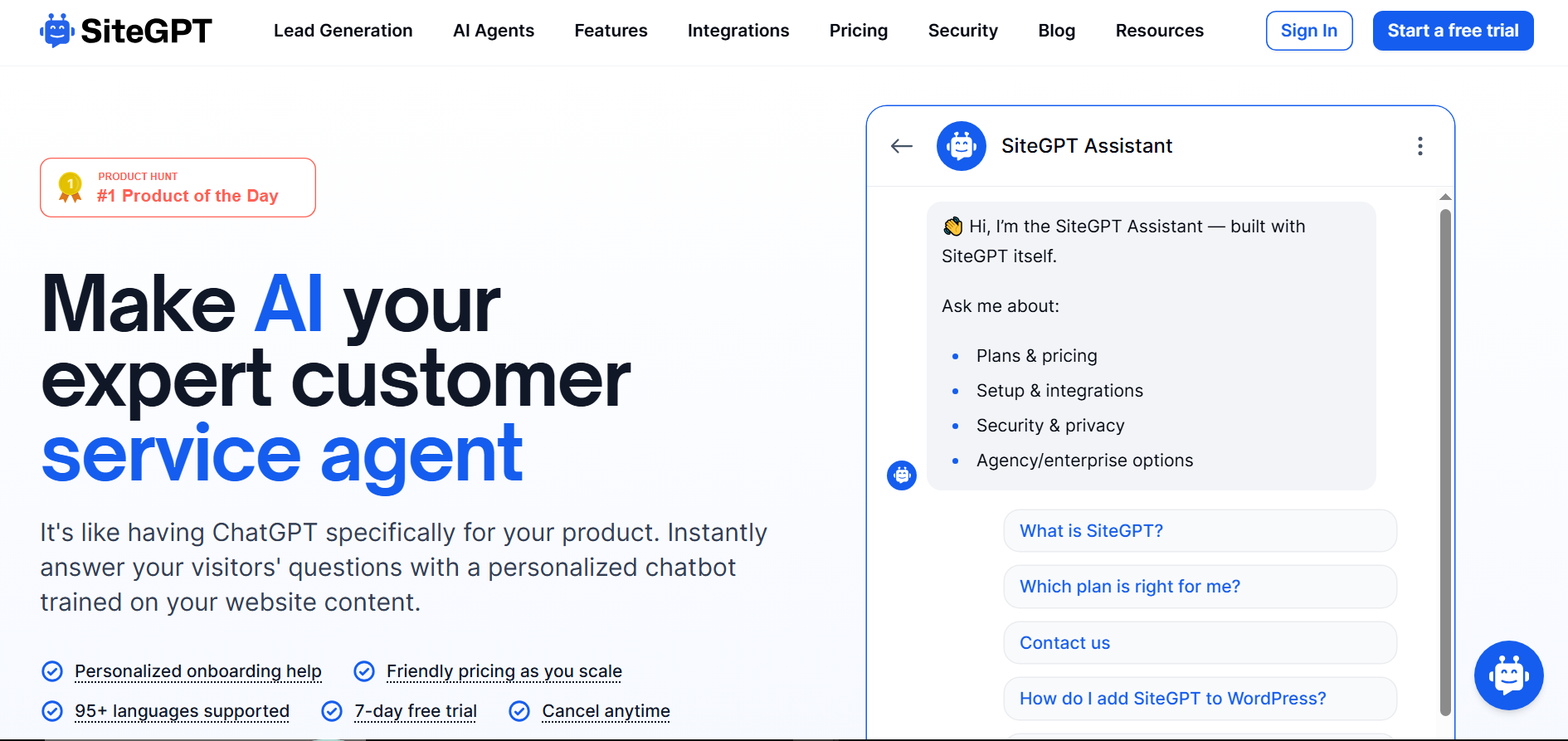
Best for: Teams looking for a direct Chatbase replacement that trains on website content and documents but with more transparent, less credit-dependent pricing.
SiteGPT is architecturally the closest alternative to Chatbase. You connect your website URL or upload documents, the platform crawls and trains on that content, and you deploy the chatbot to your site. The experience is similar. The pricing model is different.
Where Chatbase charges per message credit (which shrinks faster than advertised when using premium models), SiteGPT charges per plan tier with higher message allowances at each price point. For teams that found Chatbase's credits unpredictable, SiteGPT's pricing is easier to budget.
The trade-off: SiteGPT is narrower than Chatbase in its feature set. It does not have Chatbase's voice agent feature, its helpdesk module, or its breadth of native integrations. It is the right choice when your primary complaint with Chatbase is pricing unpredictability and your use case stays within website chatbot deployment.
Chatbase comparison verdict: Chatbase when you need its full feature set. SiteGPT when your primary need is a website-trained chatbot with more predictable per-plan pricing.
Pricing: Starter $59/month. Growth $129/month. Scale $429/month. Enterprise custom.
6. Voiceflow: Best Visual Conversation Design Plus AI
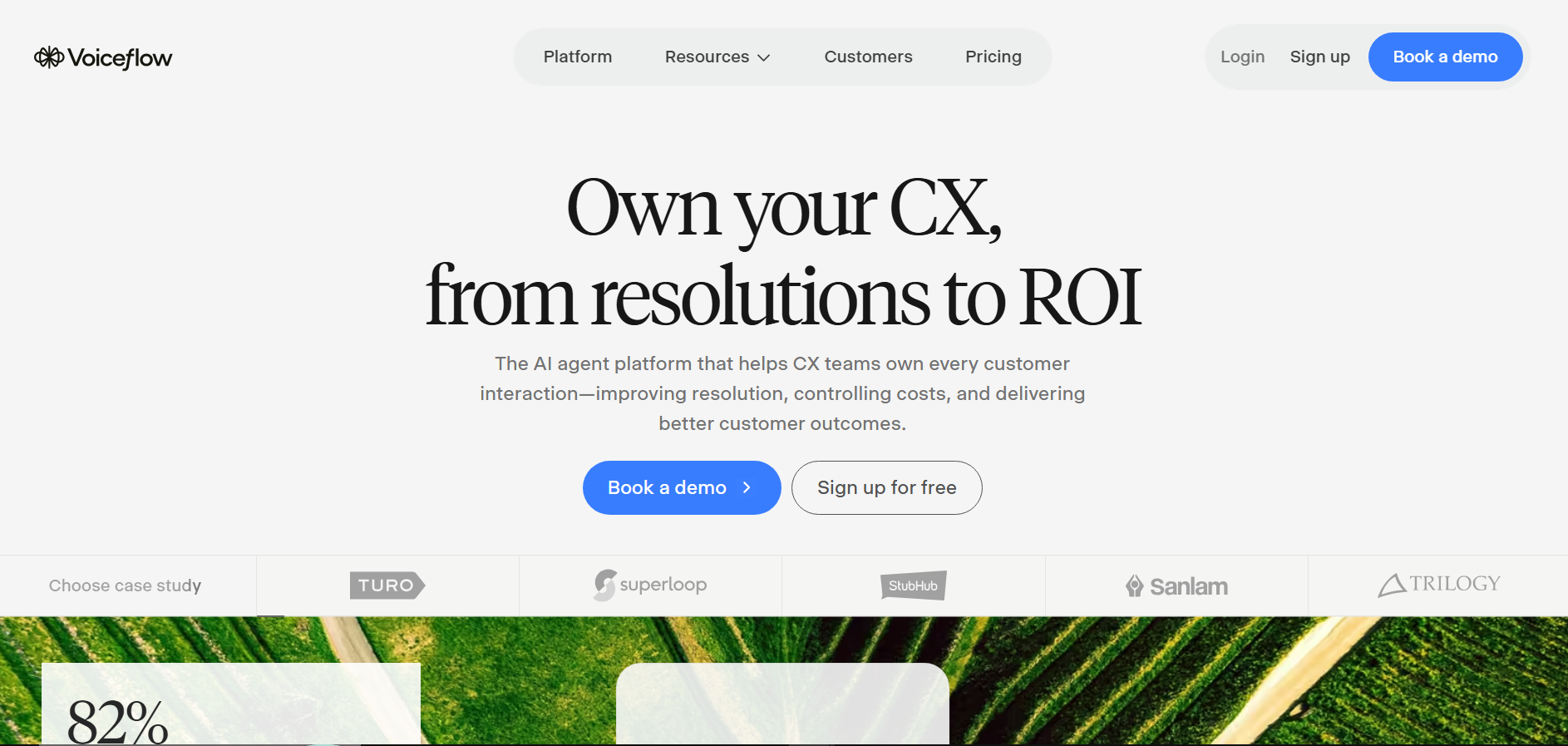
Best for: Product teams, designers, and agencies that need to design and prototype complex AI conversation flows with visual tooling before deploying to web, voice, or API.
Voiceflow sits at a different level of the market than Chatbase. Where Chatbase is designed to be operational in 30 minutes, Voiceflow is designed to be precise in conversation design. The visual canvas lets you map every conversation path, define fallbacks, integrate AI knowledge responses where appropriate, and collaborate with a team on the design before publishing.
For teams building sophisticated customer-facing AI experiences where conversation design quality matters as much as knowledge base accuracy, Voiceflow is the right tool. It is used heavily by UX teams, product teams, and agencies building branded AI assistants.
The honest limitation: Voiceflow has more setup overhead than Chatbase. It is not the right tool for a team that wants a working FAQ bot by end of day. It is the right tool for a team that wants a production-quality conversation architecture with version control, team collaboration, and deployment flexibility.
Chatbase comparison verdict: Chatbase for fast, undesigned deployment. Voiceflow when conversation design quality and team collaboration on the bot's architecture matter.
Pricing: Free plan, no card required.
7. Chatwoot: Best Free Open-Source Self-Hosted Option
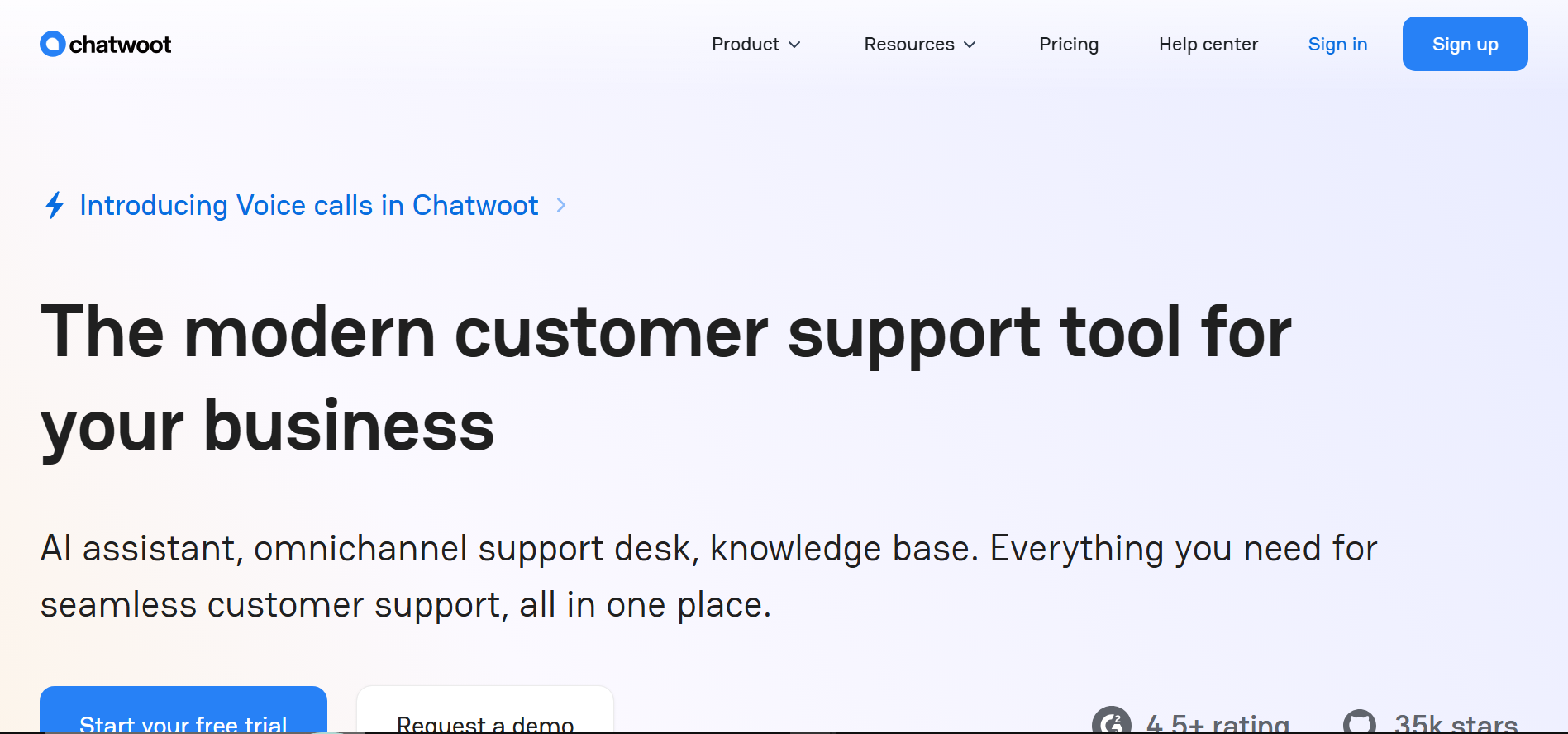
Best for: Developer teams wanting open-source infrastructure with full data sovereignty and the ability to add AI knowledge base functionality through integrations.
Chatwoot is one of the best free Chatbase alternatives for teams that prioritize data ownership over out-of-the-box AI capability. Self-hosted Chatwoot is free, MIT-licensed, and gives you full control over where your data lives. It covers WhatsApp, Instagram, Facebook Messenger, email, and website live chat in one unified inbox.
The AI knowledge base layer is not native in the same way Chatbase provides it. Teams connect Chatwoot to AI providers through integrations and APIs. This requires engineering effort but produces a fully custom AI assistant that runs entirely on your infrastructure with no per-message billing.
For EU-based businesses with GDPR requirements, self-hosted Chatwoot is one of the cleanest solutions: your data never leaves your servers, no US-hosted SaaS in the flow, and full audit trail control.
Chatbase comparison verdict: Chatbase for managed, quick-deployment AI chatbots. Chatwoot for developer teams wanting open-source infrastructure with team inbox capabilities where AI is added separately.
Pricing: Self-hosted free. Cloud free (2 agents), $19/agent/month Startups, $39/agent/month Business.
8. Rasa: Best for Full Custom Conversational AI Control
Best for: Engineering teams building production-grade conversational AI systems that require custom NLU models, on-premise deployment, and complete control over the AI architecture.
Rasa is an open source conversational AI framework, not a no-code tool. It is what teams choose when Chatbase's black-box GPT responses are not acceptable for their use case: financial services requiring explainable AI decisions, healthcare applications requiring deterministic conversation flows, or enterprise environments requiring on-premise deployment with no external API calls.
With Rasa, you define intents, entities, stories, and custom actions. The AI component can be extended with any model or training approach your team needs. The conversation logic is yours entirely, not a configuration option within someone else's system.
The learning curve is the highest on this list. Rasa requires Python knowledge, NLP familiarity, and production DevOps capability to deploy properly. It is not a weekend project. For teams with those resources and a use case that requires that level of control, it is the right answer. For the how to train your AI chatbot guide, the process is covered across both no-code and developer-first approaches.
Chatbase comparison verdict: Chatbase for quick, no-code AI chatbot deployment. Rasa for engineering teams that need full control over the conversational AI architecture, on-premise hosting, and custom NLU models.
Pricing: Open source free (self-hosted). Enterprise custom.
How to Choose the Right Chatbase Alternative
The choice maps to the specific Chatbase limitation you hit.
If credits are running out unpredictably: SiteGPT (more predictable plan pricing) or Heyy (flat subscription, unlimited conversations).
If you need WhatsApp or Instagram alongside your website: Heyy. It is the only option on this list that manages WhatsApp, Instagram, Facebook, and website chat from one AI configuration and one team inbox.
If you need open source chatbot platforms for data control: Botpress (cloud or self-hosted), Chatwoot (team inbox open source), or Rasa (full conversational AI control).
If you need a team inbox for human handoff: Heyy (native) or Chatwoot (native). Botpress and Tidio handle handoffs but require more configuration.
If you are on Shopify and need eCommerce AI: Tidio or Heyy. Both have native Shopify integrations with live order data access.
If you need enterprise white-label and large knowledge bases: CustomGPT.ai.
For a broader view of how AI chatbots compare across the chatbot building category, the best chatbot builders guide covers the full decision framework. And if your underlying goal is training an AI system on your own proprietary data, the how to train ChatGPT on your data guide covers the data preparation and training approaches that apply across platforms.
In conclusion, Chatbase is not the wrong tool. It is the right tool for a specific job: a fast, self-contained AI FAQ bot on a website. The moment that job expands to include WhatsApp replies, team handoffs, eCommerce data integration, or open-source infrastructure requirements, the right tool changes.
For brands where customer conversations happen on WhatsApp and Instagram as much as on the website, Heyy deploys the same AI trained on your data across all three simultaneously, with a team inbox that handles every escalation from a single dashboard. Start free and have your first AI-trained chatbot live across all your channels today.
FAQs
1. What are free Chatbase alternatives that actually work?
Heyy (free forever, full omnichannel AI), Botpress (free cloud plan, developer-first), Chatwoot (free self-hosted, open source), and Rasa (free open source) are the strongest free options. Chatbase's own free tier deletes the bot after 14 days of inactivity, which makes it less useful as a permanent free deployment.
2. Can I get an AI chatbot trained on my own data without paying per message?
Yes. Heyy's flat subscription pricing means unlimited conversations regardless of volume. Chatwoot and Rasa on self-hosted infrastructure have no per-message billing. SiteGPT charges per plan tier rather than per credit. If Chatbase's credit system is the primary pain point, all four of these remove it.
3. What is the easiest Chatbase alternative to set up?
SiteGPT and Heyy are the fastest. SiteGPT is the closest architectural replacement: paste your website URL, the platform trains on it, embed the widget. Heyy is similarly fast but adds WhatsApp and Instagram deployment in the same setup flow. Both are working deployments in under an hour.
4. Which Chatbase alternative is best for open source chatbot platforms?
Botpress for teams that want open source with a strong visual builder and cloud-managed option. Chatwoot for teams that want open source with a native multi-channel team inbox. Rasa for teams that want full NLP control and on-premise AI architecture. All three are MIT or Apache licensed.
5. How do I move my training data from Chatbase to another platform?
Export your source documents (PDFs, URLs, text files) from Chatbase. These are the same inputs you will upload to whichever platform you move to. The knowledge base retraining typically takes under an hour for platforms with similar document ingestion. Conversation history does not transfer, but your training data is portable because it is just your own content.
More blog posts to read

Ready to Automate Support
Across Every Channel?
.svg)
.avif)