.svg)
Best Chatbot Development Platforms for 2026


Let me tell you something that might sound controversial: I don't believe there's a single "best" chatbot development platform.
And before you close this tab thinking "great, another article that doesn't actually help," hear me out.
The reason there's no universal "best" platform is simple, they're dependent on your specific needs. A solo entrepreneur building their first chatbot has completely different requirements than an enterprise with developers on staff. A business getting most inquiries through Instagram DMs needs something fundamentally different than one handling complex B2B support tickets.
So when someone asks "what's the best chatbot development platform?" the only honest answer is: best for what?
That said, if you're here because you'd like to learn about the best chatbot development platforms for 2026, figure out which one actually matches your situation, and maybe discover options you hadn't considered, you're in the right place.
The chatbot market is growing at 23.3% annually and is projected to hit $27.3 billion by 2030, with 95% of customer interactions expected to be AI-powered by 2025. With that kind of growth, choosing the wrong platform now could cost you serious time and money later.
Let me walk you through the top chatbot development platforms for 2026, what makes each one worth considering, and most importantly, how to figure out which one is actually right for your business.
Criteria For Choosing A Chatbot Development Platform
Before we get into specific platforms, let me tell you what to look for based on your situation.
For Non-Technical Teams: You need drag-and-drop builders, pre-built templates, and setup that takes hours (not weeks). If setting up requires reading developer documentation, it's not for you.
For Technical Teams: You want API access, webhook capabilities, custom integrations, and the ability to build exactly what you envision without platform limitations holding you back.
For Multi-Channel Businesses: Your customers contact you everywhere, website, Instagram, WhatsApp, Facebook Messenger. You need one platform managing all these channels, not five different tools.
For Budget-Conscious Start ups: Transparent pricing that won't suddenly triple when you scale matters more than having every possible feature. You need something that grows with you affordably.
For Enterprises: Security, compliance, scalability, and integration with existing systems trump ease of setup. You need something that can handle massive volume without breaking, especially when working with regulated environments that rely on tools like aws compliance tools for data governance and security.
With that context, let's look at the platforms actually worth considering for 2026.
Top Chatbot Development Platforms for 2026
Heyy.io: Best for Multi-Channel Business Communication
Let me start with Heyy.io because it solves something most other platforms don't: unified multi-channel automation.
The problem it solves: Your customers don't just contact you through your website. They DM you on Instagram at midnight, message you on WhatsApp during lunch, hit you up on Facebook Messenger, and email when they're at their desk. Managing these separately is honestly a nightmare and that's where leads fall through the cracks.
What makes Heyy.io different:
True Multi-Channel Unification: Instead of treating each channel as a separate platform, Heyy.io brings website chat, Instagram DMs, WhatsApp messages, Facebook Messenger, and email into one unified inbox with intelligent automation across every platform. One chatbot flow works everywhere.
No-Code Conversation Builder: The visual flowchart interface means you can build sophisticated chatbot conversations without writing a single line of code. If you can draw a flowchart, you can build automation.
Smart Lead Qualification: The platform automatically categorizes leads based on their responses. Hot prospects get flagged for immediate follow-up. Browsers get added to nurture sequences. VIP customers get priority routing.
Seamless Human Handoff: When the chatbot encounters something it can't handle or detects a frustrated customer, it smoothly transfers to a human agent with full conversation context.
Built-In CRM: Customer data, conversation history, and interaction tracking are built-in. You're not constantly switching between your chatbot platform and your CRM trying to piece together customer journeys.
Why businesses choose it: You're getting a complete conversational commerce platform that works wherever your customers are. This matters in 2026 because over 1.4 billion people actively use messaging apps with chatbot access, and they're not all on your website.
Best for: E-commerce businesses, service providers active on social media, agencies managing multiple clients, any business where Instagram and WhatsApp are significant customer touchpoints.
Pricing: Free. Hobby $49/month. Pro $149/month. Ultra $499/month.
SendPulse: Best for Combining Chatbots with Email and SMS Marketing
Most chatbot tools treat the bot as the whole product. SendPulse treats chatbots as one channel inside a bigger marketing engine, letting chatbot flows for Instagram, WhatsApp, Messenger, Telegram, Viber, and TikTok live alongside email and SMS in one account.
Key features:
- No-code visual flow builder with triggers, quick replies, and ready-made templates
- AI-assisted flow generation, auto-replies, and voice transcription
- Built-in CRM, contact tags, and in-chat payments
- Chatbot data feeds directly into email/SMS segmentation
- Official WhatsApp API provider, a must for WhatsApp marketing
Why businesses choose it: Teams stop losing leads in tool-switching gaps. A customer's WhatsApp message can segment them for an email campaign on the same platform."
Best for: Scaling businesses and e-commerce brands that want chat automation that goes hand in hand with email/SMS, without enterprise pricing.
The trade-off: Less specialized than ManyChat for social-only marketing, and less customizable than Botpress for developers.
Pricing: Free plan (3 chatbots, 10,000 messages/month, 500 subscribers). Paid plans start around $10/month billed annually and scale with subscriber count.
Botpress: Best for Technical Teams Wanting Full Control
Botpress is where developers go when they need deep customization that no-code platforms can't provide.
What makes it powerful: It's open-source with both cloud and self-hosted options. You get complete control over conversation logic, integrations, data storage, and deployment. If you can code it, Botpress can do it.
Key features:
- Visual flow editor for non-technical team members
- Code-level customization for developers
- Multi-channel deployment (web, Messenger, WhatsApp, Telegram, Slack)
- Advanced NLU engine with intent recognition
- Self-hosting option for data privacy and compliance
- Extensive API for custom integrations
Why technical teams prefer it: You're not limited by what the platform offers out of the box. Need a custom integration with your legacy CRM? Build it. Want specific conversation logic that doesn't fit standard patterns? Code it. Have strict data residency requirements? Self-host it.
Best for: Companies with development resources, businesses with complex compliance requirements, teams building highly customized chatbot solutions, organizations needing self-hosted options.
The reality check: If you don't have developers, Botpress will feel overwhelming. It's incredibly powerful but not plug-and-play.
Pricing: Free for developers, commercial licenses start around $100/month depending on scale and features.
Tidio: Best for Small Businesses Getting Started
Tidio hits the perfect spot of being simple enough for beginners while still offering real AI capabilities through their Lyro assistant.
What makes it accessible: The platform combines live chat and AI chatbots in one clean interface. Setup is genuinely straightforward, you can have something working in under an hour without technical knowledge.
Key features:
- Lyro AI that learns from your website content
- Visual chatbot builder with drag-and-drop
- Live chat for human takeover when needed
- Pre-built templates for common scenarios
- Integration with popular e-commerce platforms
- Mobile apps for managing on the go
Why small teams like it: It doesn't overwhelm you with features you'll never use. The learning curve is gentle, customer support is responsive, and pricing makes sense for smaller businesses.
Best for: Startups, small online stores, service businesses with limited technical resources, anyone implementing their first chatbot.
The trade-off: It's not as powerful as Botpress for customization or as comprehensive as Heyy.io for multi-channel. But if you just need something simple that works, Tidio delivers.
Pricing: Free plan available for basic features, paid plans start around $29/month per operator.
ManyChat: Best for Social Media Marketing Automation
ManyChat is specifically built for businesses that live on Instagram, Facebook, and WhatsApp, not just as support channels but as active marketing and sales platforms.
What makes it specialized: ManyChat is laser-focused on messaging app marketing. It's designed for conversational marketing campaigns, not just support.
Key features:
- Deep Instagram and Facebook Messenger integration
- Visual flow builder for marketing sequences
- Broadcast messaging to subscribers
- E-commerce integrations for social selling
- Growth tools for building subscriber lists
- Analytics focused on marketing metrics
Why social-first businesses use it: If your business model relies heavily on Instagram DMs and Facebook Messenger for sales, ManyChat is purpose-built for that. It understands marketing automation in messaging apps better than general chatbot platforms.
Best for: E-commerce brands with strong social presence, influencers monetizing through DMs, businesses running Facebook/Instagram ad campaigns to messaging, social media managers handling multiple accounts.
The limitation: It's great for marketing automation on social but not designed for complex customer support or website chat. You're getting a specialized tool, not a general platform.
Pricing: Free plan for up to 1,000 contacts, paid plans start around $15/month.
Intercom: Best for Enterprise Customer Engagement
Intercom is a full customer communication ecosystem that includes AI chatbots as one component.
What makes it enterprise-grade: You're getting chatbots, live chat, help center, customer data platform, product tours, and team collaboration tools in one integrated suite. Everything works together effortlessly.
Key features:
- Fin AI chatbot powered by GPT-4
- Unified inbox across all channels
- Help center and knowledge base
- Customer segmentation and targeting
- Product tours for user onboarding
- Extensive integration ecosystem
- Advanced reporting and analytics
Why enterprises choose it: When you've outgrown simple chatbots and need a comprehensive customer engagement platform, Intercom provides that. The integration between components means data flows naturally and you're managing everything in one place.
Best for: SaaS companies, established businesses with significant customer communication needs, teams wanting to consolidate multiple tools, enterprises needing advanced features and support.
The consideration: It's expensive compared to standalone chatbot tools. You're paying for an entire platform, which only makes sense if you'll actually use most of it.
Pricing: Starts around $74/month but scales significantly with features and volume. Enterprise pricing is custom.
1mind: Best for Real-Time Product Expertise Across the Buyer Journey
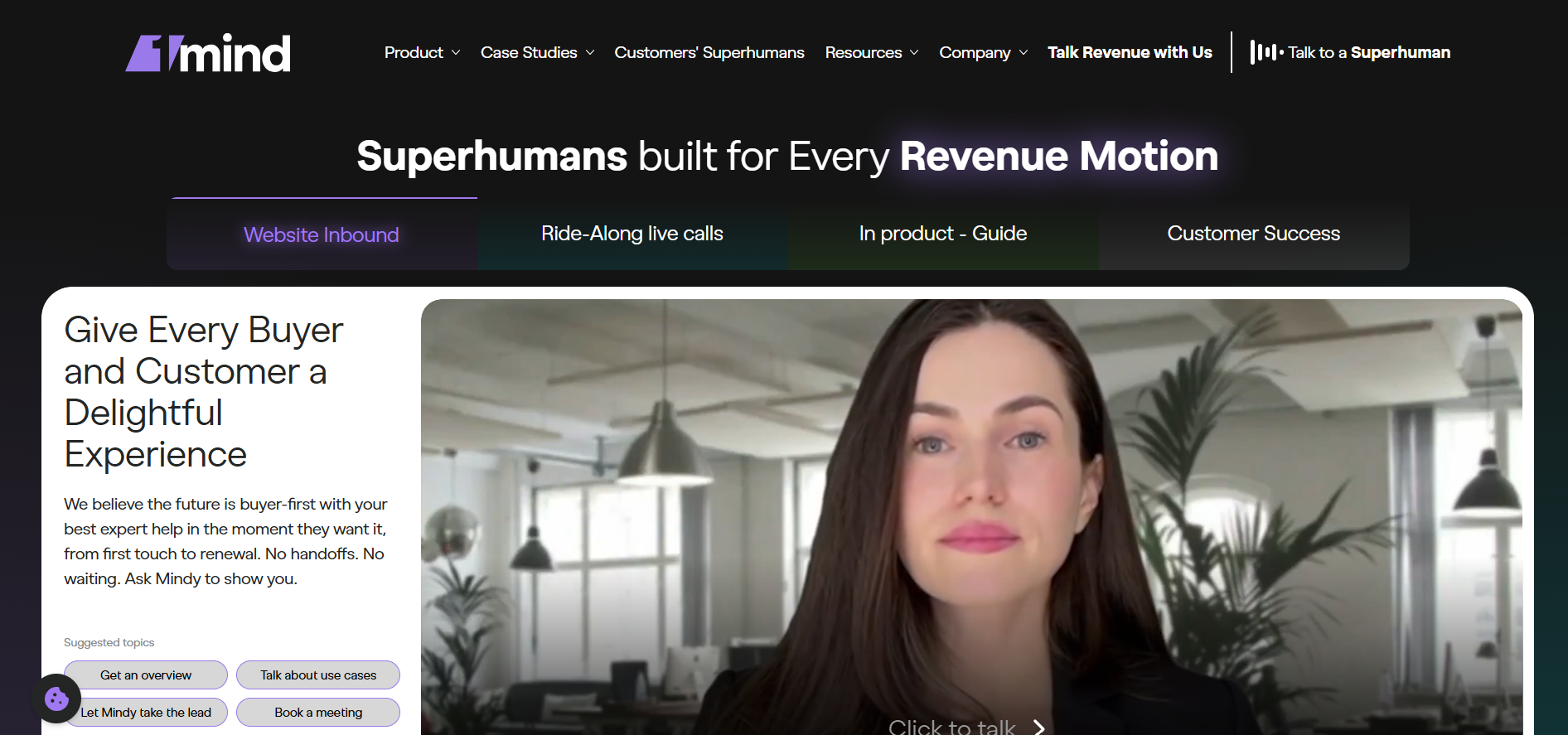
1mind uses AI-powered "Superhumans" to bring product expertise into revenue and customer conversations, from the first website visit through renewal.
What makes it different: Its Superhumans can engage and qualify website visitors, join live calls as active participants, answer technical questions, give demos, guide users inside the product, and support customers. These experiences share one Brain, so context can carry from sales into onboarding and customer success.
Best for: B2B teams that want consistent product expertise across website inbound, sales calls, in-product guidance, and customer success without relying on handoffs or waiting.
How to Choose The Platform For Your Needs
Okay, I've given you five strong options. Now how do you decide?
Step 1: Answer These Three Questions
Question 1: Where do most of your customer inquiries actually come from?
Track this for a week. Don't guess. If 70% of inquiries come through Instagram and you pick a platform that's primarily for website chat, you've made a strategic mistake.
Question 2: What's your team's actual technical capability?
Not what you wish it was. What it actually is right now. Can they read API documentation and build custom integrations? Or do they need visual builders and templates?
Question 3: What's your realistic budget including hidden costs?
Factor in monthly fees, per-conversation costs, setup time, training, integrations, and ongoing maintenance. A "$50/month" platform that requires $10,000 in setup isn't actually cheap.
Step 2: Map Your Decision to Your Answers
If most inquiries are multi-channel (Instagram + WhatsApp + Website): → Heyy.io
If you have developers and need deep customization: → Botpress
If you're a small team without technical resources: → Tidio
If you're marketing-heavy on Instagram/Facebook: → ManyChat
If you need a full customer engagement suite: → Intercom
Your answers literally tell you which platform to choose.
Step 3: Test Before Committing
Every platform mentioned offers free trials or free plans. Actually use them for at least a week. Don't just sign up and let the trial expire.
Build a basic chatbot. Send test conversations. Invite team members to try it. See if it actually fits your workflow or if you're fighting the platform constantly.
Common Mistakes When Choosing Chatbot Platforms
Let me save you from mistakes I've seen businesses make:
Mistake #1: Choosing Based on Feature Lists
More features doesn't mean better. It often just means more complexity you'll never use. Pick based on your actual needs, not hypothetical ones.
Mistake #2: Ignoring Integration Requirements
Does it connect to your CRM? Your help desk? Your e-commerce platform? Broken integrations create manual work that defeats the purpose of automation.
Mistake #3: Underestimating Setup Time
Even "easy" platforms require time to set up properly, train on your content, and integrate with your systems. Budget for this realistically.
Mistake #4: Forgetting About Maintenance
Chatbots need ongoing optimization. Customer questions change. Products change. Your chatbot needs regular updates or it becomes outdated and frustrating.
Mistake #5: Not Planning for Scale
What works at 100 conversations per day might break at 1,000. What costs $50/month at your current volume might jump to $500 as you grow. Plan for success.
Let me give you context on where this market is heading because it affects your platform choice.
According to market research, the chatbot market is projected to grow from $9.57 billion in 2025 to $11.80 billion in 2026, continuing its rapid ascent toward $27.30 billion by 2030.
AI is Getting Smarter: By 2027, 40% of generative AI solutions will be multimodal, meaning they'll process text, images, audio, and video simultaneously. Your chatbot will understand what customers show it, not just what they type.
Autonomous Agents are Emerging: We're moving beyond reactive chatbots to proactive AI agents that anticipate needs and take actions independently. By 2026, 40% of enterprise applications will feature task-specific AI agents.
Integration Depth Matters More: Standalone chatbots are losing value. Platforms that integrate deeply with your entire workflow, CRM, analytics, marketing automation, support systems are the ones worth betting on for 2026 and beyond.
So don't pick based on what's popular. Pick based on what solves your problems.
It's a New Month, Time to Try Something New for Your Business, Right?
Look, if you've read this far, you're clearly serious about implementing chatbot automation. You're trying to solve a real problem in your business.
And if that problem is managing customer conversations across multiple channels without losing your mind, try Heyy.io.
It's a new month. Fresh start. Perfect time to stop juggling separate tools for Instagram DMs, WhatsApp messages, Facebook Messenger, and your website chat. Perfect time to unify everything into one intelligent inbox with automation that actually works.
Start with a 14-day free trial. No credit card required. Connect your channels, Instagram, WhatsApp, Messenger, website. Build your first chatbot flow with the visual builder. See how it feels to never miss a lead again, regardless of which channel they use.
Because in 2026, 95% of customer interactions are expected to be AI-powered. Your competitors are already automating. Your customers already expect instant responses.
The question isn't whether to implement a chatbot. It's whether you'll choose the platform that actually fits how your customers want to communicate with you.
Make it a good month. Make it the month you finally automated your customer conversations properly.
Want to learn more about chatbot platforms? Check out our guides on website chatbots for customer support, and real estate chatbot tools.
More blog posts to read

Ready to Automate Support
Across Every Channel?
.svg)
.avif)