.svg)
The 6 Best Gupshup Alternatives for Scalable Business Messaging

If you have been in the WhatsApp business messaging space for a while, you have probably come across Gupshup. It is one of the oldest and largest WhatsApp API platforms in the world, with 45,000+ customers across 60+ countries, and for the right use case it genuinely delivers.
Here is what tends to happen though. Not everyone who ends up on Gupshup knew going in that it was an enterprise infrastructure tool. Some teams found it through a partner recommendation. Others picked it because it appeared on a comparison list. A few months in, they realized that every campaign update needed a developer, every billing question sat in a queue, and pricing changed without warning.
One Capterra reviewer said it plainly: "Even a simple query will take at least a week to resolve. Multiple emails exchanged asking silly questions, stretching the resolution time." Another added: "Sudden increase in price without any prior notice."
That is what this guide is about.
What Is Gupshup?
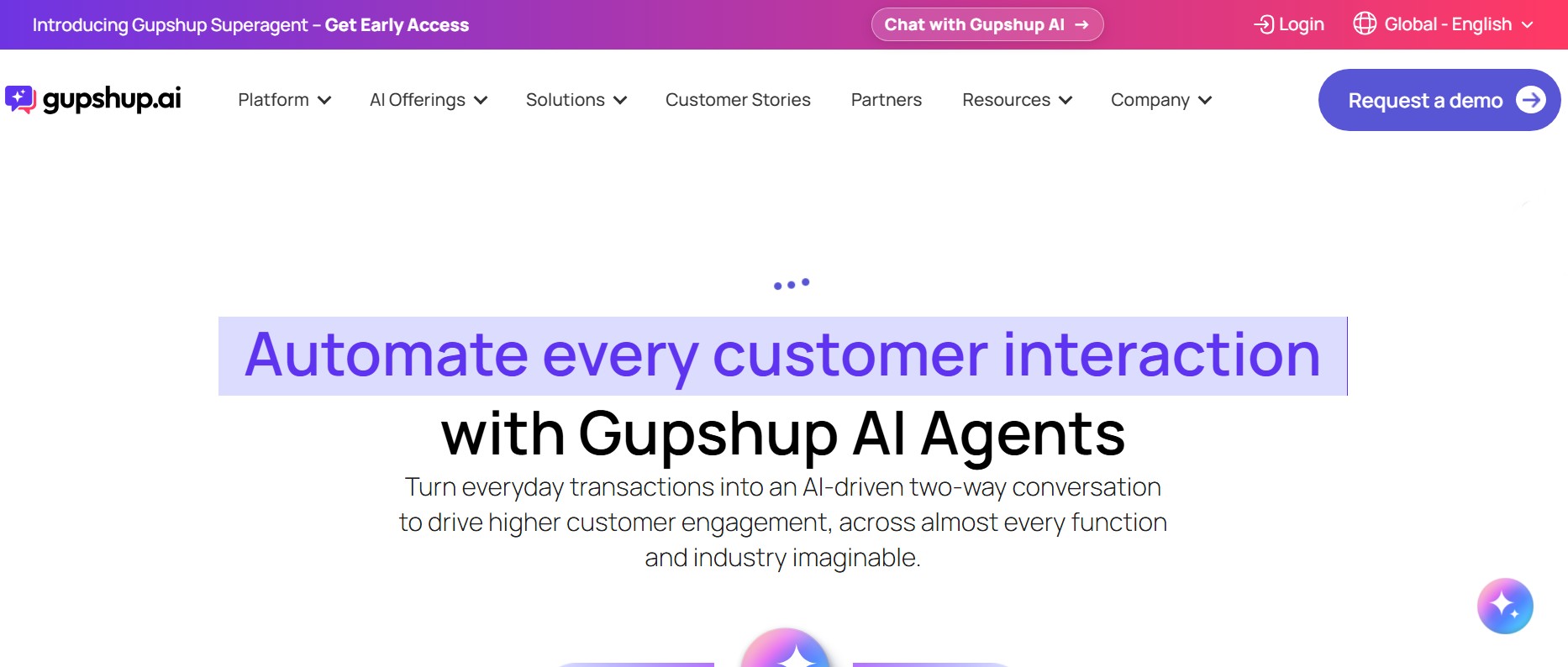
Gupshup is a conversational messaging platform that helps businesses communicate with their customers across multiple channels. Think of it as the infrastructure layer that sits between your business and the channels your customers use: WhatsApp, SMS, RCS (rich messaging on Android), Instagram, voice, and more.
At its core, Gupshup gives businesses access to the official WhatsApp Business API, which is what lets companies send messages to customers at scale without using the regular WhatsApp app. On top of that API access, Gupshup has built tools for creating chatbots, running marketing campaigns, and automating customer conversations using their own AI model called ACE LLM.
The platform is primarily used by large businesses and enterprises: banks, telecom companies, eCommerce platforms, and healthcare providers, mostly in India and across Southeast Asia. These teams typically have developers who connect Gupshup to their existing systems through its API, build their own conversation flows on top, and manage campaigns through a combination of Gupshup's dashboard and their own internal tooling.
What Gupshup does well at that scale is infrastructure reliability. It handles high message volumes, delivery rates are strong, and it supports the kind of complex, multi-channel setups that large enterprises need. The challenge for smaller or less technical teams is that the platform was designed with that enterprise setup in mind, which means the day-to-day experience requires more technical knowledge than most no-code alternatives.
What Gupshup does well:
- Official WhatsApp Business API access with strong delivery reliability at high volume
- Multi-channel coverage across WhatsApp, SMS, RCS, Instagram, and voice
- ACE LLM AI for automating conversations across channels
- Trusted by large enterprises in India and Southeast Asia with proven scale
- Supports complex integrations through a well-documented API
Where it falls short:
- Non-technical teams struggle with the interface for everyday tasks like campaign creation and template management
- Support response times are slow at lower tiers, with billing queries sometimes taking over a week to resolve
- Pricing is not self-serve or transparent, and fees have been raised without advance notice for some customers
- No native drag-and-drop flow builder for teams that want to build without developer help
- Added a 6% markup on certain WhatsApp Cloud API marketing messages from January 2026
Why Teams Look for Gupshup Alternatives
Gupshup's positioning as a developer-first API platform is both its strength and its exit trigger. The platform handles volume that most alternatives cannot. What it does not handle well is the team that needs to run campaigns, update templates, or resolve billing questions without opening a ticket and waiting.
The UX requires a developer mindset. Gupshup's campaign creation, flow management, and WhatsApp template workflows are built for technical users. Reviewers on GetApp describe the UX as "non-intuitive and painful," with campaign creation that "does not work smoothly" and requires multiple support touchpoints to complete. For non-technical marketing teams managing weekly campaigns, this is a real operational cost.
Pricing is enterprise-paced and not self-serve. Gupshup's pricing model involves Meta's per-message fees plus Gupshup's own platform fees, with a 6% markup added on certain WhatsApp Cloud API marketing messages from January 2026. Custom quotes are the standard engagement model, which means getting a clear number requires a sales conversation.
Support resolution times at non-enterprise tiers are slow. The billing and accounts team friction that reviewers describe is consistent: complex queries routed through email, slow response cycles, and resolution timelines measured in weeks rather than hours. For a growing business managing active campaigns, that turnaround is too slow to be useful.
No native no-code automation. Teams that want drag-and-drop journey builders, visual campaign editors, or Shopify-native order automation find that Gupshup requires either third-party tools or developer resources to build those workflows. Among WhatsApp Business API providers competing for SMB and mid-market business, that gap is significant. The Gupshup competitors that have captured this market segment all offer no-code tooling as a primary differentiator.
For a broader view of how WhatsApp automation platforms compare across pricing and feature sets, the best WhatsApp automation tools guide covers the full field.
Quick Comparison: 6 Best Gupshup Alternatives
The 6 Best Gupshup Alternatives in 2026
1. Heyy: Best No-Code Omnichannel AI With a Free Plan
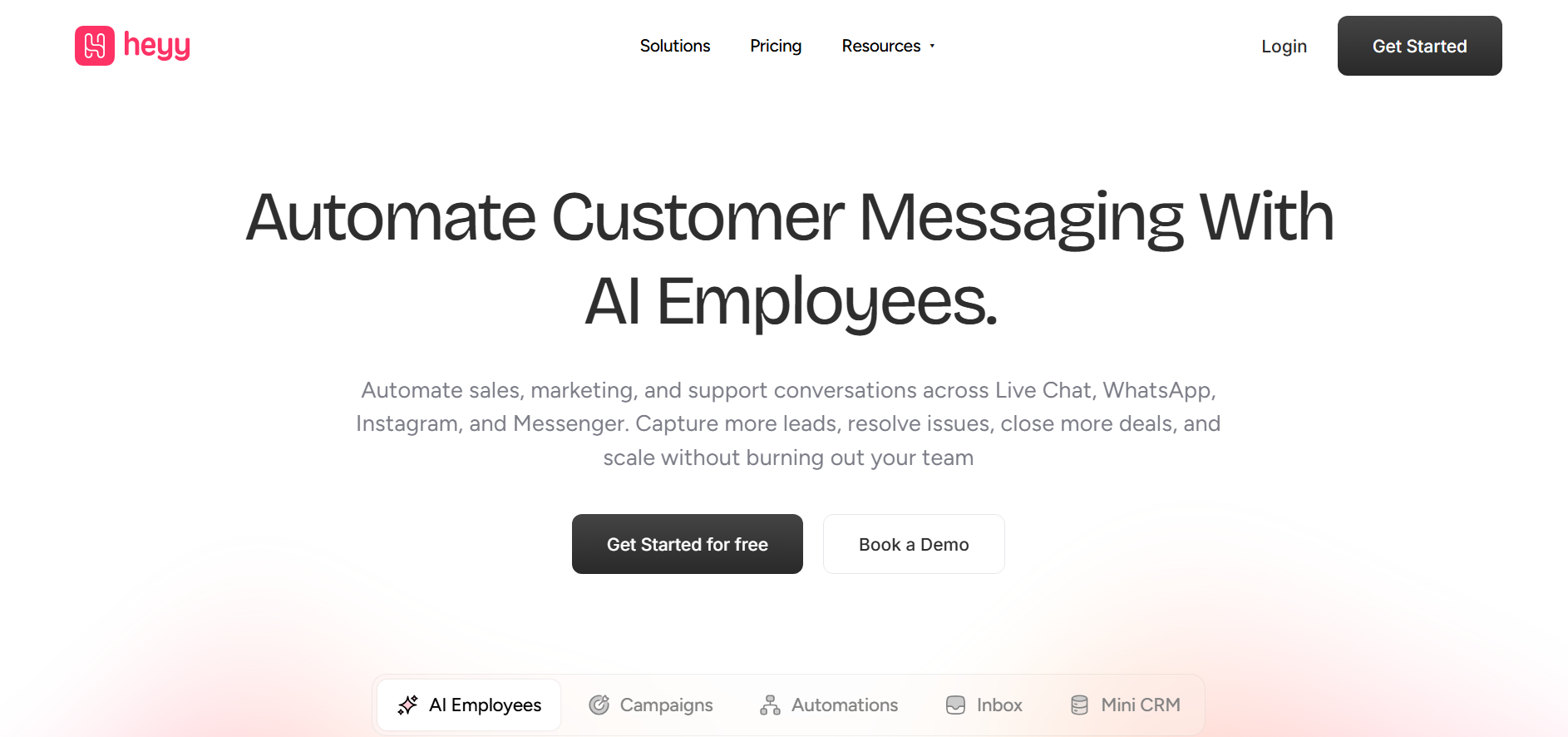
Best for: Consumer-facing businesses that need WhatsApp, Instagram, Facebook Messenger, and website chat handled by AI, without developer resources, per-message billing, or a custom enterprise quote.
The most direct contrast between Gupshup and Heyy is the team the platform is designed for. Gupshup assumes you have a developer available. Heyy assumes you do not. The entire setup, from connecting your WhatsApp number to deploying AI Employees across channels, is no-code and takes under an hour.
Heyy's AI Employees are trained on your product catalog, FAQs, and business policies. They handle customer queries across WhatsApp, Instagram DMs, Facebook Messenger, and website chat from a single configuration. When a customer messages on Instagram about a product and follows up on WhatsApp the next day, both appear in the same conversation thread with the same history. For teams managing multi-channel customer contact, that context preservation is one of the most practically useful features available.
Campaign broadcasts on Heyy are managed through a no-code interface. You set the audience, select or create your approved template, schedule the send, and the platform handles delivery and tracking. No developer needed. No ticket required to change the audience filter next week.
Pricing is flat by subscription tier with no per-message platform markup on top of Meta's fees. The free plan covers all four channels permanently, which makes it the most accessible entry point among Gupshup alternatives, especially for teams that want to test before committing.
Gupshup comparison verdict: Gupshup for enterprise-scale, developer-led deployments where raw messaging infrastructure and volume pricing matter most. Heyy for consumer-facing brands where AI automation, multi-channel coverage, and non-technical team access are the operational priorities.
Pricing: Free trial available. Hobby $49/month. Pro $149/month. Ultra $499/month.
2. WATI: Best WhatsApp Specialist for SMBs Exiting Gupshup

Best for: Small to mid-sized teams that need official WhatsApp Business API access with a team inbox, no-code campaign tools, and a significantly simpler setup process than Gupshup.
WATI is the most commonly considered WhatsApp-only alternative when teams outgrow Gupshup's complexity without needing its enterprise scope. The no-code flow builder handles FAQ automation, lead qualification sequences, and broadcast campaigns without developer involvement. The team inbox with auto-assignment eliminates the shared-WhatsApp-number chaos that many teams were trying to solve when they first came to Gupshup.
For teams that came to Gupshup specifically because they needed an official Meta BSP, WATI also carries that official status. The difference is the operational experience around the API: WATI wraps the API access in a no-code product layer that marketing and support teams can use independently.
The honest trade-off: WATI adds approximately 20% markup on Meta's per-message fees, similar to most BSP platforms. For teams that chose Gupshup partly for pricing transparency, this is worth factoring into the total cost comparison. For the top WATI alternatives guide, the full picture of what comes after WATI is covered there if you are evaluating the WhatsApp BSP market broadly.
Gupshup comparison verdict: Gupshup for enterprise volume and developer-first API access. WATI for SMBs that want official WhatsApp API with a team inbox and campaign tools their non-technical team can operate.
Pricing: Growth $49/month. Pro $99/month. Business $249/month. Annual billing available.
3. Respond.io: Best Omnichannel Messaging CRM
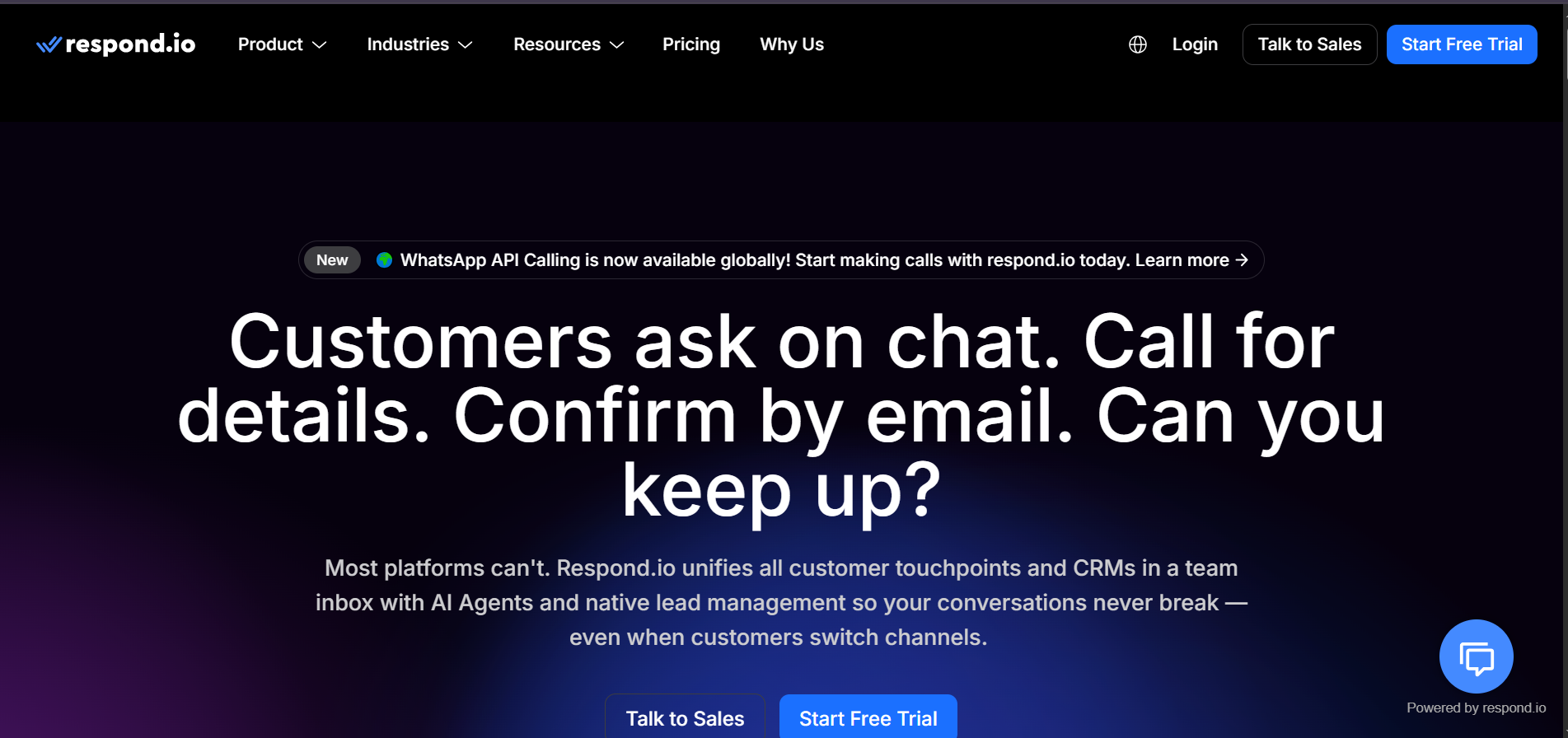
Best for: Mid-market teams that need 12+ messaging channels, AI Agents for automated conversation handling, and CRM integrations in one platform, at pricing more accessible than Gupshup's enterprise model.
Respond.io is the most feature-complete alternative for teams that need Gupshup-level omnichannel coverage with a more accessible pricing model and a no-code operational experience. It connects WhatsApp, Instagram, Facebook Messenger, Telegram, LINE, TikTok, email, SMS, and VoIP from one shared inbox, with AI Agents handling qualification, support routing, and escalation autonomously.
The AI Agents are workflow-driven and capable of multi-step reasoning. They can trigger CRM updates, send follow-up messages based on conditions, and route conversations based on contact history. For teams that found Gupshup limiting because of its API-first approach rather than its infrastructure reliability, Respond.io provides the equivalent channel breadth with significantly less developer dependency.
The pricing model to watch: Respond.io uses Monthly Active Contact billing. The Growth plan at $199/month includes 1,000 MACs, and costs grow as contact volume grows. For teams with stable contact lists, this is predictable. For teams with rapidly growing WhatsApp audiences, it compounds.
Gupshup comparison verdict: Gupshup for raw infrastructure and volume pricing at enterprise scale. Respond.io for mid-market teams needing omnichannel scope and AI Agents without building on a developer-first API.
Pricing: Starter $99/month. Growth $199/month. Advanced $349/month.
4. AiSensy: Best for High-Volume WhatsApp Campaigns Without Developer Setup

Best for: Marketing-led teams that need to run large-scale WhatsApp broadcast campaigns with audience segmentation, campaign analytics, and click-to-WhatsApp ad tracking, without the developer overhead Gupshup requires.
AiSensy is a useful Gupshup alternative specifically for the campaign use case. It has deployed WhatsApp automation for over 100,000 businesses and built its primary reputation on broadcast infrastructure. The campaign manager handles audience segmentation, message scheduling, rich media templates, and retargeting flows without requiring API calls or developer involvement for each campaign update.
One notable feature for teams comparing it to Gupshup on pricing: AiSensy passes through Meta's messaging fees without additional markup. For teams that were concerned about Gupshup's 6% markup on certain Cloud API marketing messages, AiSensy's pass-through model is a cleaner baseline.
The Google Ads integration for click-to-WhatsApp campaigns is one of the few available in the market, giving marketing teams direct attribution between ad spend and WhatsApp conversations without a third-party analytics layer.
The honest limitation: AiSensy is campaign-first by design. If your Gupshup use case is primarily inbound support, lead qualification, or customer lifecycle management, AiSensy's inbound conversation handling is thinner than Respond.io or Heyy. Use it for broadcast-heavy marketing motion. Pair it with a support tool if inbound coverage matters.
Gupshup comparison verdict: Gupshup for enterprise-grade API infrastructure. AiSensy for marketing teams running high-volume WhatsApp campaigns who need no-code campaign tools and no markup on Meta's fees.
Pricing: Free plan available. Basic ₹1,500/month($15). ₹3,200/month($33). Pro ₹9100/month($95). Enterprise custom.
5. Interakt: Best for Shopify eCommerce WhatsApp Automation

Best for: Shopify and WooCommerce brands that need WhatsApp automation purpose-built around eCommerce workflows, with abandoned cart recovery, order confirmations, and payment link generation as native features.
Interakt takes the narrowest scope on this list and is better for it. Every feature is built around eCommerce revenue workflows: abandoned cart recovery with product-specific messages and direct checkout links, order confirmation and shipping notifications, COD-to-prepaid conversion flows, and customer support routing with Shopify order data attached. The Shopify integration is bidirectional, meaning product catalog, order data, and customer records sync automatically without middleware.
For a Gupshup user whose primary WhatsApp use case is eCommerce automation, Interakt's tight Shopify integration removes the developer effort that Gupshup's API approach requires. Template management, audience segmentation, and campaign scheduling are all no-code. The pricing is subscription-based rather than per-message, which removes the billing complexity that frustrated many Gupshup reviewers.
The limitation is scope: Interakt is WhatsApp-only and optimized primarily for South and Southeast Asian eCommerce markets. Teams needing Instagram, website chat, or European GDPR-optimized infrastructure need a broader platform.
Gupshup comparison verdict: Gupshup for multi-channel enterprise deployments. Interakt for Shopify-first eCommerce brands where WhatsApp drives pre-purchase and post-purchase conversation and eCommerce workflows need to be native.
Pricing: Starter from $12/month. Growth from $55/month. Advanced from $69/month.
6. Bird: Best Enterprise BSP With Transparent Per-Message Pricing
Best for: Enterprise engineering teams at high message volume who need direct BSP infrastructure with transparent pricing, no platform-imposed campaign caps, and complete API control without Gupshup's billing complexity.
Bird occupies the same tier as Gupshup in terms of audience and infrastructure capability, with two notable differences in 2026. Pricing is more transparent and self-serve. And the platform has invested more heavily in modern tooling and API documentation that engineering teams find easier to work with.
Like Gupshup, Bird is not a no-code platform. It is infrastructure. WhatsApp, email, SMS, push, and voice connect through one API layer with complete programmatic control over routing, templating, and analytics. For enterprise teams that need the infrastructure flexibility of Gupshup with cleaner billing documentation and a more modern developer experience, Bird is the most direct comparison.
The constraint is the same as Gupshup: non-technical teams should not be evaluating Bird. The entry point for meaningful use requires engineering resources. For teams where that is not the constraint, Bird is one of the right answers at scale. For teams evaluating the broader range of Gupshup competitors across different team sizes, the best customer messaging tools guide covers the decision framework across SMB and enterprise options.
Gupshup comparison verdict: Both are enterprise BSPs for developer-led teams. Bird wins on pricing transparency and modern developer tooling. Gupshup wins on volume discount depth for India and Southeast Asia specifically.
Pricing: Priced by volume. Not by seat.
How to Choose the Right Gupshup Alternative
The decision maps to the specific Gupshup pain point you are solving.
If developer dependency is the problem: Heyy, WATI, or AiSensy. All three are genuinely no-code. Non-technical teams run campaigns, manage templates, and update flows without a developer ticket.
If WhatsApp-only coverage is acceptable: WATI (team inbox focus), AiSensy (campaign focus), or Interakt (eCommerce focus). All three are WhatsApp specialists with better no-code tooling than Gupshup.
If you need omnichannel beyond WhatsApp: Heyy (WhatsApp + Instagram + Facebook + website in one AI inbox) or Respond.io (12+ channels with AI Agents and CRM integrations).
If you are a Shopify brand: Interakt for WhatsApp-only eCommerce automation, or Heyy for Shopify integration alongside Instagram and website chat.
If you are enterprise and need infrastructure-level API access: Bird. Same tier as Gupshup, more transparent pricing and a more modern developer experience.
For teams comparing social-first messaging tools specifically, the best ManyChat alternatives guide covers the Instagram and Facebook DM automation market as a separate category from WhatsApp API platforms.
To conclude, Gupshup is enterprise infrastructure built for enterprise teams. For the organizations it was designed for, it does the job. For teams that ended up on it without the developer resources, billing team patience, or message volumes to justify it, the alternatives above are a better match.
For brands where WhatsApp, Instagram, and website chat are the primary customer channels and where campaigns need to run without a developer on call, Heyy covers all three with no-code tooling, flat pricing, and a free plan that starts today. Start free and run your first campaign without opening a ticket.
FAQs
1. Is Gupshup actually a good platform?
For the right use case, yes. Enterprise-scale deployments in India and Southeast Asia, high-volume WhatsApp API access for developer teams, and multi-channel messaging at 100,000+ messages per month are where Gupshup performs well. The consistent user complaints are about support response times, billing transparency, and the UX for non-technical team members, not about delivery reliability or API quality.
2. What is the easiest Gupshup alternative to set up?
Heyy and AiSensy are the fastest. Both are no-code with guided onboarding that gets campaigns running without developer involvement. Heyy adds WhatsApp, Instagram, and website chat from the same setup flow. AiSensy focuses on WhatsApp campaign infrastructure. Both can have your first campaign live in under an hour.
3. Which Gupshup alternative has the best pricing transparency?
AiSensy (no markup on Meta's fees, published tier pricing) and Bird (usage-based with self-serve pricing page) are the most transparent. Gupshup's pricing model involves Meta's per-message fees plus platform fees plus a 6% markup on certain Cloud API marketing messages added in 2026, which requires careful calculation before committing to volume.
4. Can I keep my WhatsApp number when leaving Gupshup?
Yes. Your WhatsApp Business number is registered with Meta, not with Gupshup. Migrating to a new WhatsApp Business API provider means reconnecting the same number through Meta Business Manager. Approved templates carry over. Conversation history stays in Gupshup's database. Most migrations take 24 to 72 hours.
5. Which alternative is best for teams in India or Southeast Asia?
WATI and AiSensy both have strong market presence in India with pricing and support infrastructure aligned to that market. Interakt (backed by Haptik, a Reliance Jio company) is purpose-built for South and Southeast Asian eCommerce. Heyy is available globally with flat USD pricing. Bird is the enterprise alternative for India at scale.
More blog posts to read

Ready to Automate Support
Across Every Channel?
.svg)
.avif)