.svg)
Best ManyChat Alternatives in 2026 for Businesses

If you've been using ManyChat long enough, you know exactly when you've hit the ceiling.
It usually happens one of four ways: your flows start breaking because customers aren't following the script. Your contact list crosses 25,000 and the pricing suddenly becomes a lot. A client asks why their WhatsApp customers aren't getting the same experience as their Instagram followers. Or your team needs to actually collaborate on conversations and you realize maybe...ManyChat was never built for that.
We've watched this pattern repeat across hundreds of businesses. The platform is genuinely good at what it does. Instagram DM automation, Facebook Messenger flows, broadcast campaigns, ManyChat built its reputation doing those things well, and it still does them well. The problem is that "what it does" is increasingly narrower than "what businesses need."
In 2026, 62% of consumers prefer resolving issues through a chatbot rather than waiting for a human agent, and businesses running on two-channel, rule-based flows are leaving serious revenue on the table. The alternatives in this guide close that gap, AI-native conversations across the channels your customers frequently use, with pricing that grows with conversations rather than contact counts.
Here's everything worth knowing about each one.
The Best ManyChat Alternatives in 2026
How We Evaluated These Tools
This list is based on hands-on testing and direct use across the platforms, not aggregated review scores. Here's our evaluation criteria:
- AI vs rule-based: Does the bot actually understand what someone is saying, or does it match keywords to pre-written responses?
- Channel coverage: How many channels are natively supported, and how well does the platform handle cross-channel conversation history?
- Pricing transparency: What does the tool actually cost at 1,000, 10,000, and 25,000 contacts or conversations? We calculated realistic monthly bills, not headline numbers.
- Ease of setup: How long does it take a non-technical team to go from signup to live bot?
- Support and sales use cases: Does the platform serve both, or does it force a choice?
Tools were shortlisted based on the problems businesses most commonly hit when leaving ManyChat: channel limitations, pricing ceiling, AI capability, and team collaboration. Each tool on this list addresses at least two of those four.
What Is ManyChat and Why Are Businesses Looking for Alternatives?
ManyChat is a rule-based social messaging automation platform built for Facebook Messenger, Instagram, WhatsApp, and SMS. Its visual flow builder lets non-technical users design conversation sequences without code, and it dominates the Instagram DM marketing category for good reason.
But here’s the thing, the limitation is structural because ManyChat runs on decision trees. When a prospect says something outside the expected script, the bot breaks, sends a generic fallback, or drops the conversation, so it doesn’t really understand intent or resolve a support ticket. It doesn’t maintain context when a customer switches channels as well, and its contact-based pricing model means costs climb as your audience grows, regardless of whether those contacts ever convert.
Four situations consistently drive businesses to look for ManyChat competitors. Understanding which one applies to you narrows the field from dozens of alternatives to two or three worth evaluating seriously.
Outgrowing two channels: ManyChat is strong on Instagram and Messenger. Weak on website chat, weak on WhatsApp at scale, absent from TikTok, and not built for team support workflows.
Needing real AI, not decision trees: ManyChat flows are pre-written scripts. AI chatbot platforms understand what the customer is actually saying and respond accordingly, even when the question was not anticipated during setup.
Hitting the contact-based pricing wall: At 25,000+ contacts, ManyChat's Pro plan runs $300+/month. Most omnichannel chatbot solutions at that price point offer substantially more capability.
Wanting support, not just marketing: ManyChat has no unified customer history, no ticket management, no agent handoff with context. Businesses that need customer support alongside marketing automation need a different category of tool.
Quick Comparison: Best ManyChat Alternatives in 2026
The 10 Best ManyChat Alternatives in 2026
1. Heyy — Best ManyChat Alternative for Businesses That Sell Across Social and Web
Best for: Consumer businesses running WhatsApp, Instagram, and website chat simultaneously.
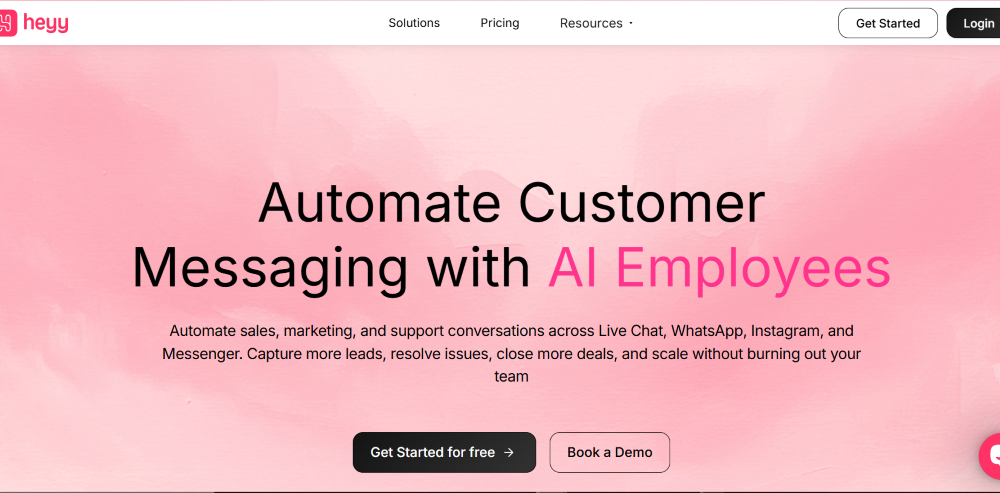
ManyChat gives you Instagram and Messenger. Heyy gives you Instagram, WhatsApp, Facebook Messenger, and website chat in one unified inbox, all powered by AI that is trained on your product catalog, policies, and tone — not pre-scripted flows.
The AI Employees concept is the core differentiator. Instead of a single generic bot, you configure role-specific agents: one handles customer support, one runs sales qualification, one manages order tracking. Each is trained separately and responds accordingly. The customer who messages your Instagram to ask about availability, follows up on WhatsApp about shipping, and checks out on your website appears as one customer with one conversation history, not three separate tickets.
For click-to-chat ads, Heyy closes the gap between ad click and qualified conversation in the same channel where the customer clicked — no landing page, no form, no friction. Setup takes around 15 minutes. The free plan is permanent, not a trial.
ManyChat comparison verdict: ManyChat is a better fit for high-volume Instagram DM broadcast campaigns. Heyy is a better fit for businesses that need AI-powered conversation handling across more than two channels, with support and sales running from the same inbox.
Pros: AI-native (not rule-based), free plan forever, 15-minute setup, unified cross-channel history, no-code AI Employees.
Cons: Newer platform with fewer third-party reviews than established tools. Less suited to pure Instagram broadcast marketing.
Pricing: Free. Hobby $49/month. Pro $149/month. Ultra $499/month.
2. Respond.io — Best Omnichannel Messaging CRM
Best for: Mid-to-large businesses managing customer conversations across WhatsApp, Instagram, TikTok, Facebook, Telegram, and SMS from one platform.
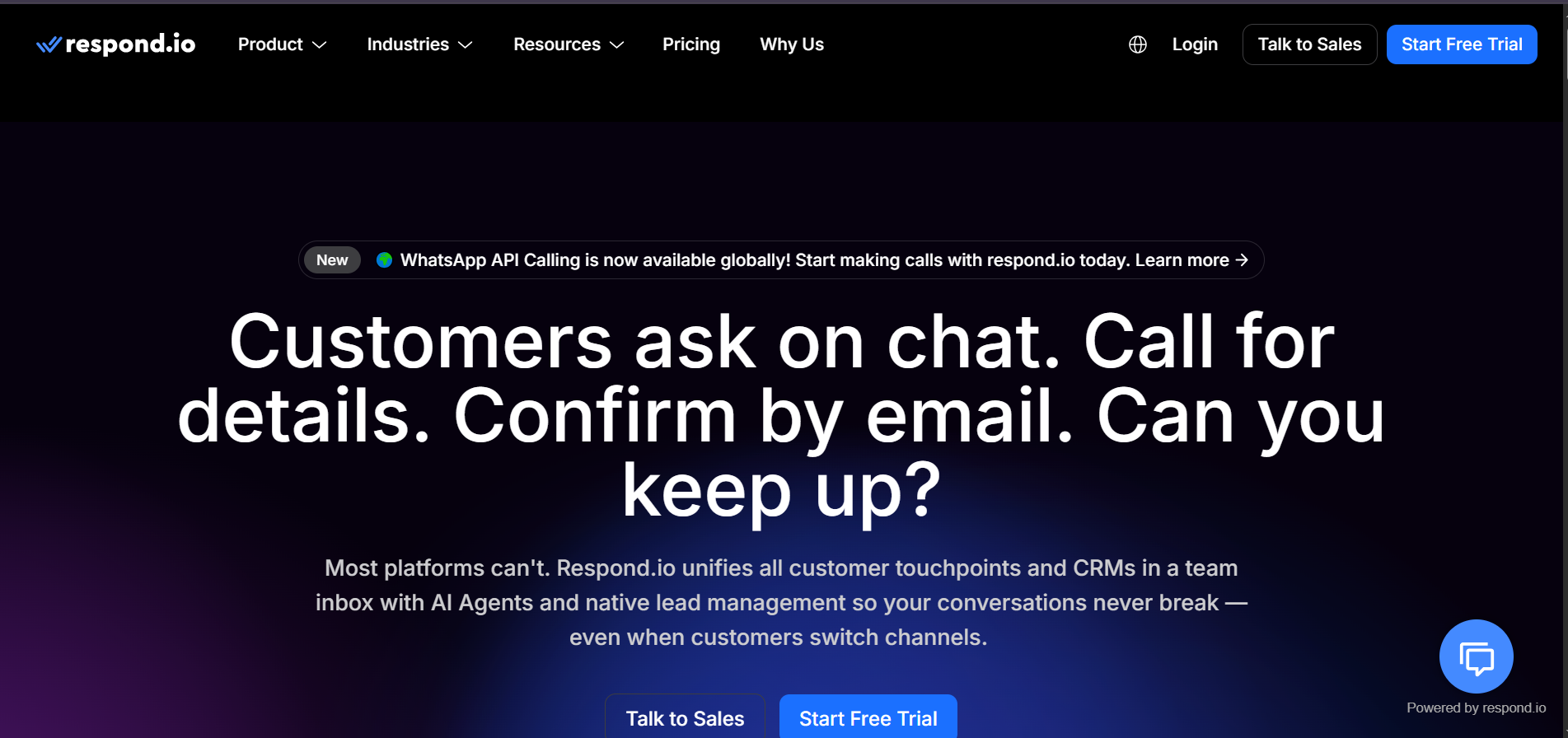
Respond.io is not a chatbot. It is a messaging CRM, the entire customer journey from first contact to closed deal, across every major messaging channel, with AI Agents running qualification and support on all of them simultaneously.
As an official Meta Business Solution Provider, Respond.io charges no BSP markup on WhatsApp messages beyond the subscription fee, a meaningful cost advantage at volume compared to platforms that charge a 15-20% markup on Meta fees. The lifecycle inbox view tracks prospects from first contact to conversion in one interface rather than across separate tools.
For businesses in Southeast Asia, MENA, and Latin America where WhatsApp, TikTok Shop, and Instagram drive the majority of customer contact, Respond.io is purpose-built infrastructure. The Growth plan ($159/month) is required to unlock AI Agents and automation; the Starter plan is live chat only. Detailed qualifying conversation is available in the customer messaging tools comparison.
ManyChat comparison verdict: ManyChat handles two channels with broadcast-focused flows. Respond.io handles 12+ channels with AI-powered customer lifecycle management.
Pros: Meta BSP with no markup, 12+ native channel integrations, AI Agents, lifecycle inbox, no-code automation builder.
Cons: AI features require the $1599/month Growth plan. Feature set may exceed SMB needs.
Pricing: Respond.io offers 4 plans: Starter ($79/mo), Growth ($159/mo), Advanced ($279/mo) & Enterprise. You only pay only for the contacts you talk to.
3. Chatfuel — Best Direct Social-First ManyChat Competitor
Best for: Businesses already using ManyChat for Instagram and Facebook Messenger who want a direct, lower-friction migration with stronger AI.
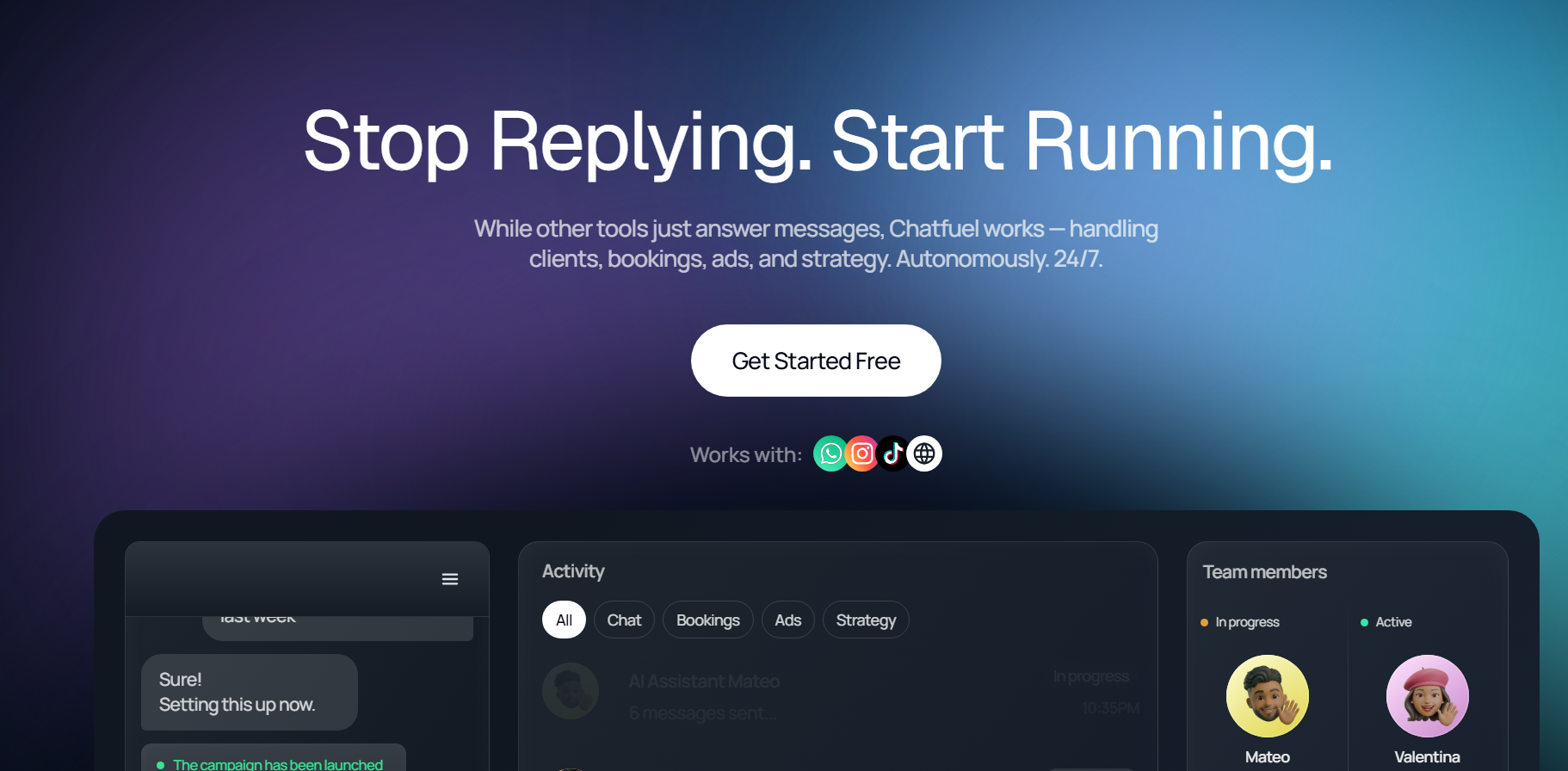
Chatfuel is the closest functional equivalent to ManyChat. It runs on Instagram, Facebook Messenger, and WhatsApp. The visual flow builder is familiar and the template library is extensive. And the pricing is generally lower than ManyChat at equivalent contact volumes because Chatfuel uses a conversation-based model rather than a contact-based model.
The key improvement over ManyChat is Fuely AI, Chatfuel's ChatGPT-powered AI assistant that handles open-ended questions rather than forcing customers into pre-written flows. A customer who asks something off-script gets a real answer rather than a fallback message. Abandoned cart recovery, product recommendations, and direct WhatsApp sales flows are all built in.
If you're also evaluating Instagram-specific automation, the Instagram automation tools comparison breaks down everything.
ManyChat comparison verdict: If ManyChat's pricing model is the primary pain point and you want to stay social-first, Chatfuel is the most direct path. If you need website chat or a unified support inbox, look at Heyy or Respond.io instead.
Pros: Conversation-based pricing (no contact bloat charges), Fuely AI for open-ended questions, click-to-chat ad integration, e-commerce templates.
Cons: Limited to social channels (no website chat), analytics are basic for complex flows, no native team inbox.
Pricing: Chatfuel Light/ Free, AI PRO/ $69/month.
4. Wati — Best WhatsApp Specialist

Best for: Businesses where WhatsApp is the primary customer communication channel and who want an official WhatsApp Business API platform with automation capabilities.
Wati is purpose-built for WhatsApp. Not Instagram, not Facebook, not website chat. WhatsApp. That focus produces a genuinely well-integrated experience for businesses that live and die by WhatsApp messaging: bulk broadcasts with analytics, no-code chatbot flows, a shared team inbox, and Astra AI Agents that handle queries across WhatsApp and voice without human input on the Pro plan.
Wati holds a 4.6/5 rating on G2 across 460+ reviews, with "ease of use" cited in 102 reviews as the primary positive. The no-code builder is genuinely accessible for non-technical teams, and broadcast campaigns are reliable at volume.
The pricing model requires honest budgeting. The Growth plan is $49/month (billed monthly) with 3 users hard-capped and 1,000 automation triggers. Those triggers run out quickly for any business with meaningful automation volume. Expect the actual monthly bill to run 30 to 50% above the listed subscription price once message markups, add-on triggers, and extra user seats are factored in. Shopify integration costs $4.99/month extra.
ManyChat comparison verdict: ManyChat is a better social marketing tool across multiple channels. Wati is a better WhatsApp operations tool for support and conversational commerce specifically on WhatsApp.
Pros: Official WhatsApp Business API, strong broadcast capabilities, 4.6/5 G2 rating, no-code builder, Astra AI Agents on Pro.
Cons: WhatsApp-only, pricing adds up with triggers and users, Shopify integration costs extra, no Instagram or website chat.
Pricing: Growth $49/month. Pro $99/month. Business $249/month. (All billed monthly; annual billing available at 25% discount.)
For a broader look at WhatsApp-specific platforms, the WhatsApp automation tools guide covers how Wati stacks up against Heyy, Respond.io, and others.
5. Tidio — Best for E-Commerce and Website-First Businesses
Best for: Shopify and WooCommerce stores wanting AI-powered support and lead qualification on their website, with social channels as secondary.
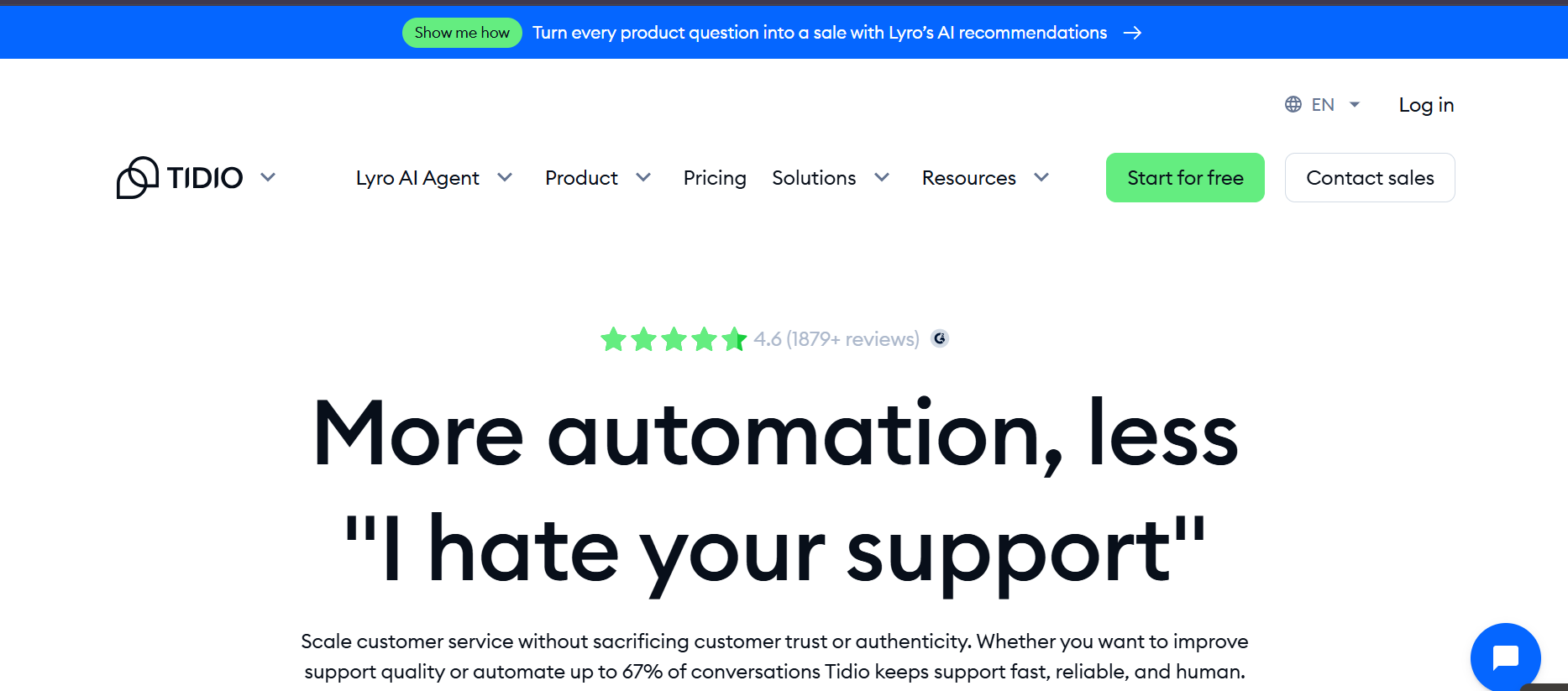
Tidio's Lyro AI resolves 67% of customer queries automatically, the highest independently published resolution rate of any platform on this list. For e-commerce businesses, the Shopify integration is genuinely native: agents can view customer carts, check order history, issue refunds, and look up shipping details without opening Shopify admin. Lyro handles all of this in natural language.
Where Tidio parts ways with ManyChat is in its channel priority. Tidio is website-first; social channels are secondary. If your customer contact happens primarily on WhatsApp and Instagram before the website visit, Tidio will not capture much of it. If your primary support surface is your website, Tidio is one of the strongest options available.
The Tidio vs Heyy comparison covers how these two tools serve different channel priorities in more detail.
ManyChat comparison verdict: ManyChat is stronger for social DM automation. Tidio is stronger for website support, Shopify integration, and AI-powered FAQ handling.
Pros: 67% Lyro AI resolution rate, native Shopify integration, clean live chat widget, 30+ templates, mobile app for agents.
Cons: Website-first (social DMs are secondary), Lyro AI is a separate add-on ($39/month on top of base plan), conversation limits can scale expensively.
Pricing: Free plan. Starter $29/month. Growth from $59/month. Lyro AI add-on from $39/month.
6. Landbot — Best No-Code Visual Flow Builder

Best for: Marketing and ops teams that want full control over conversation logic without writing code, particularly for WhatsApp-native lead gen flows.
Landbot's drag-and-drop visual builder is the strongest no-code chatbot builder for teams that want precision over speed. Conditional branching, score-based routing (hot leads to sales, cold leads to nurture), and CRM field mapping are all visual operations. WhatsApp is a native deployment target, not a bolt-on.
The key difference from ManyChat's flow builder: Landbot's flows are more granular and customizable. You can map exactly which answer routes to which outcome, which contact property gets written to your CRM, and which threshold routes to a human. ManyChat's flows are simpler to set up but less controllable at the edges.
The honest limitation: Landbot's AI layer is primarily rule-based. If a visitor goes off-script, the experience degrades. For well-defined qualification paths, it is not a material constraint.
ManyChat comparison verdict: Landbot offers more precise flow control and stronger WhatsApp-native performance. ManyChat offers more Instagram broadcast depth and larger template library.
Pros: No-code visual builder with genuine logic depth, WhatsApp native, score-based routing, CRM field mapping, free plan.
Cons: AI is rule-based (not truly conversational), no native team inbox or ticketing, website-focused for more complex scenarios.
Pricing: Free (100 chats/month). Starter $40/month. Pro $100/month. Business $400/month.
7. Kommo — Best Sales CRM With WhatsApp Chatbot
Best for: Sales-driven businesses that want WhatsApp and Instagram automation connected directly to a CRM pipeline without separate tools.
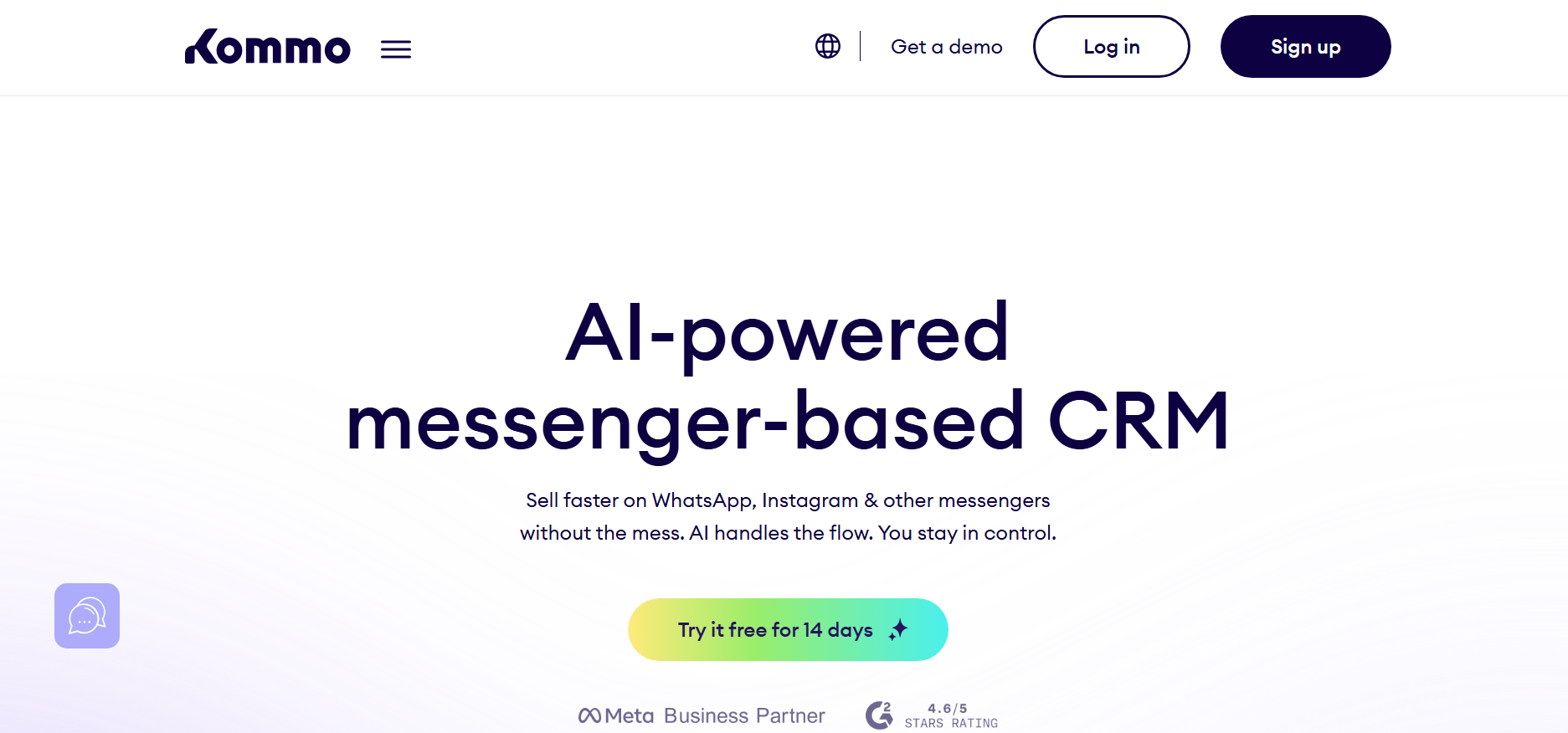
Kommo (formerly amoCRM) is the only tool on this list that approaches the chatbot problem from the CRM side rather than the messaging side. Its SalesBot feature builds automated conversation flows on WhatsApp, Instagram, and Facebook Messenger, with every interaction logged directly in the CRM pipeline as the conversation happens. No integration required.
For businesses where the primary use case is lead qualification and sales pipeline management — not broadcast marketing — Kommo does something ManyChat cannot: it connects a conversation to a deal. A WhatsApp message from a new prospect creates a CRM contact, triggers a qualification flow, and routes the lead to the right sales representative, all within the same interface.
Explore how AI agents for small businesses fit into this broader sales automation category.
ManyChat comparison verdict: ManyChat is a marketing-first tool. Kommo is a sales-first tool. If your need is broadcasting to audiences, ManyChat. If your need is qualifying and converting individual leads via WhatsApp, Kommo.
Pros: CRM-native (every conversation logged as a deal), WhatsApp + Instagram + FB + web chat, SalesBot with conditional logic, pipeline analytics, 14-day free trial.
Cons: Per-user pricing scales with team size, less suited for broadcast marketing campaigns, smaller app ecosystem than HubSpot or Intercom.
Pricing: Base $15/user/month. Advanced $25/user/month. Enterprise $45/user/month.
8. Intercom — Best Enterprise ManyChat Alternative
Best for: Mid-to-large businesses that need AI-powered customer support, product-led growth messaging, and marketing automation in one platform.
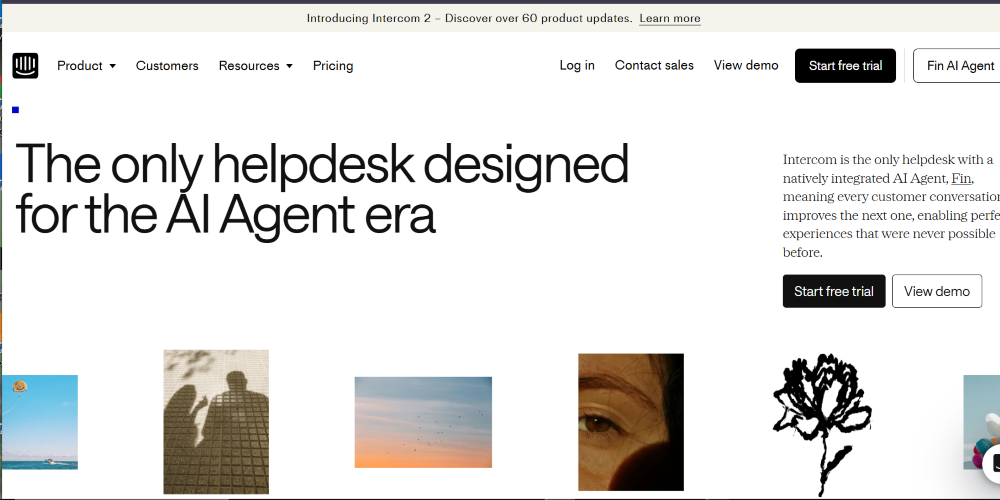
Intercom's Fin AI, powered by GPT-4, resolves approximately 67% of customer queries automatically by drawing from your help center content and past conversations. For businesses that need more than social DM automation — ticketing, CRM-connected responses, multi-store support, deep analytics — Intercom provides the infrastructure. 450+ integrations cover the full enterprise tech stack.
The pricing model requires careful budgeting. The $39/seat base fee gives platform access. The $0.99 per Fin-resolved conversation is the actual AI cost. During high-traffic periods, invoices can spike significantly. Three agents plus 2,000 Fin resolutions per month costs $2,087 in that month alone.
For a comparison of how AI chatbot platforms handle this kind of use case, see the best AI chatbots for small business guide.
ManyChat comparison verdict: ManyChat is for marketing automation on social channels. Intercom is for unified customer support, sales, and marketing at mid-to-large scale. Different tools for different problems.
Pros: Fin AI with 67% resolution rate, all channels consolidated, deep analytics, multi-store support, 450+ integrations.
Cons: Per-resolution pricing spikes at volume, overkill for SMBs, built for SaaS first.
Pricing: $39/seat/month. Fin AI at $0.99/resolved conversation.
9. Botpress — Best for Technical Teams Building Custom Chatbots
Best for: Engineering teams that need complete control over conversation logic, channel integrations, and data flows rather than off-the-shelf flows.
Botpress gives technical teams the full stack: a visual flow builder for standard workflows, an Agent Development Kit (ADK) for writing custom bot instructions, and a Shopify API integration covering products, orders, customers, and real-time events. The open-source architecture makes the conversation logic fully auditable, and the LLM costs are billed at provider rate with no markup.
Where ManyChat gives you templates and simplicity, Botpress gives you flexibility and scale. A bot built on Botpress can be deployed across any channel via API, connected to any proprietary system, and extended without rebuilding as requirements grow. The tradeoff is explicit: meaningful customization requires a developer.
ManyChat comparison verdict: ManyChat is for non-technical teams who want to move fast. Botpress is for technical teams who want to move precisely. They are not competing for the same buyer.
Pros: Open-source flexibility, Shopify API native, visual builder + code-level control, LLM costs at provider rate.
Cons: Requires developer involvement for anything beyond basic flows, usage-based pricing needs monitoring.
Pricing: Free plan. Plus $449/month. Team $939/month. Enterprise custom.
10. Trengo — Best Team Inbox + Chatbot for Growing Teams
Best for: Growing support and sales teams that want a shared inbox covering WhatsApp, Instagram, email, and live chat with automation and chatbots built in.
Trengo is the most team-focused tool on this list. Where ManyChat is primarily a marketing automation tool (one person or a small team setting up flows), Trengo is built for a support or sales team handling high-volume inbound from multiple channels collaboratively.
The chatbot (called Flowbot) handles FAQ deflection, lead qualification, and routing before conversations reach the team. The shared inbox gives every agent visibility into the full queue across all channels. WhatsApp, Instagram, Facebook Messenger, email, and live chat all land in one workspace. Internal notes, conversation assignment, and status tracking (open, pending, resolved) are all native.
ManyChat comparison verdict: ManyChat is for automated broadcast marketing with limited team collaboration. Trengo is for teams managing high-volume inbound support and sales conversations with automation layered on top.
Pros: Omnichannel team inbox, built-in Flowbot for automation, WhatsApp + Instagram + email + live chat, internal collaboration tools, analytics on team performance.
Cons: Chatbot is flow-based rather than AI-native, per-user pricing scales with team size, more support-focused than marketing-focused.
Pricing: Essential from $29/user/month. Boost from $49/user/month. Enterprise custom.
How to Choose the Right ManyChat Alternative
By primary use case
Social DM marketing (Instagram + Facebook broadcast campaigns): Chatfuel is the most direct ManyChat replacement. Lower pricing model, familiar flow builder, Fuely AI for open-ended questions.
WhatsApp-first customer communication: Wati for businesses where WhatsApp is the singular channel and team size is under 10. Respond.io for businesses where WhatsApp is primary but other messaging channels (Telegram, LINE, Viber) also matter.
Multi-channel sales and support (social + website): Heyy for businesses where WhatsApp and Instagram generate meaningful inbound alongside website chat. Tidio for businesses where the website is primary and social is secondary.
Sales pipeline and CRM: Kommo. The only tool on this list that treats every conversation as a CRM record from the first message.
Enterprise customer operations: Intercom for the highest AI resolution rate at scale with multi-store support. Botpress for technical teams that need fully custom conversation logic.
Team support operations: Trengo for growing support teams managing inbound from multiple channels collaboratively.
By ‘the real problem you're hitting’ with ManyChat
"My flows break when customers go off-script." The fix is AI, not better flows. Heyy, Intercom, Tidio, or Respond.io all use natural language AI rather than decision trees.
"My costs are scaling with contact count, not with actual usage." The fix is a conversation-based or flat pricing model. Chatfuel, Respond.io, and Heyy all price on conversations rather than stored contacts.
"I need website chat alongside my social channels." ManyChat does not solve this. Heyy, Tidio, or Respond.io do.
"I need my team to collaborate on customer conversations." ManyChat has no native shared inbox with assignment and status. Trengo, Respond.io, and Heyy do.
"I need WhatsApp at scale, not just Instagram and Messenger." Wati or Respond.io. Both are official WhatsApp Business API providers.
ManyChat earned its position in social commerce by solving a specific problem early and solving it well. The businesses outgrowing it in 2026 are not leaving because ManyChat failed. They are leaving because their customers are on more channels, expect smarter responses, and generate more support volume than a broadcast-focused flow builder was designed to handle.
The right alternative is the one that solves the specific bottleneck you have actually hit. If that bottleneck is channel coverage, AI quality, pricing predictability, or team collaboration, one of the ten tools above closes the gap. For businesses where WhatsApp and Instagram generate the most customer contact, Heyy handles both, adds website chat, runs AI trained on your actual business, and gives your team one inbox for all of it. Start free and handle your first AI conversation today.
If the response time is the underlying issue driving the switch, why slow support is killing your business is worth reading first, the problem is sometimes the tool, sometimes the process.
FAQs
1. Can I export my ManyChat contacts and flows before switching?
Yes. ManyChat allows you to export your subscriber list as a CSV from the Audience tab. Flows need to be recreated manually on the new platform; they don't port directly. Best practice is to run your new platform in parallel for 2–4 weeks before fully switching, so you can validate that automated flows work before turning off ManyChat.
2. Will my audience lose their conversation history when I switch?
Imported contacts won't carry conversation history from ManyChat; that data stays in ManyChat's system. What transfers is the contact list. Most platforms allow you to trigger a re-engagement message to your imported subscribers once they're in the new system.
3. Does switching platforms affect my Meta ad integrations?
It depends on the tool. If you're running click-to-Messenger or click-to-Instagram ads connected to ManyChat flows, those connections will need to be rebuilt in the new platform. Chatfuel and Heyy both support click-to-chat ad integrations natively. Expect 1–2 hours of reconnection work per active ad campaign.
4. Do ManyChat alternatives work with WhatsApp?
Most of the alternatives on this list support WhatsApp via the official WhatsApp Business API, including Heyy, Respond.io, Wati, Chatfuel, and Kommo. ManyChat's WhatsApp support is available but limited compared to its Instagram and Messenger capabilities. For businesses where WhatsApp is the primary channel, Wati or Heyy will outperform ManyChat meaningfully.
5. What's the cheapest ManyChat alternative?
Heyy's free plan includes AI-powered conversations across WhatsApp, Instagram, Messenger, and website chat, with no trial period and no contact limit on the free tier. Chatfuel starts at $69/month with Fuely AI included. Tidio's free plan includes limited Lyro AI. Of the three, Heyy is the only one where AI is available from day one without a paid upgrade.
More blog posts to read


Ready to Automate Support
Across Every Channel?
.svg)
.avif)