.svg)
7 Ways to Use Chatbots Across Your Marketing Funnel

Imagine a customer clicking your Facebook ad at 9:00 PM, and they land on your website and find a standard contact form. They type in their name and email, hit submit, and get a generic message like, "Thanks! We'll be in touch within 24 hours."
What do you think would happen next? Of course they’d immediately close the tab and head straight to a competitor whose chatbot answers their question in forty-five seconds and books them a demo for the very next morning.
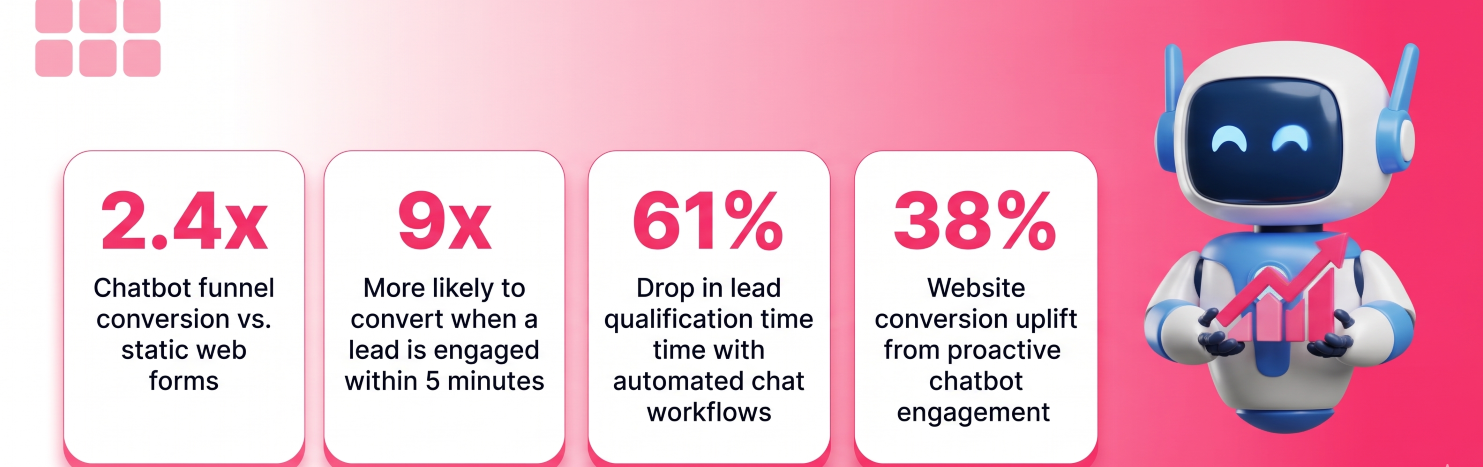
You paid for that click, but you lost the lead. It wasn't because your product was worse. It was simply because your funnel made them wait. The numbers back this up: chatbot-led funnels convert 2.4x higher than traditional static web forms, according to recent benchmark data.
The difference here isn't about product quality. It is entirely about speed and removing friction. A chatbot marketing funnel takes that passive, form-based model and replaces it with real-time conversation at every single stage. It generates interest at the top, qualifies and nurtures in the middle, and handles closing and retaining at the bottom. It removes the wait and the friction all at once.
This guide breaks down the 7 most effective ways to set up a chatbot marketing funnel. We have organized it by funnel stage, so you can easily spot your biggest conversion leak and fix that one first.
What Is a Chatbot Funnel?
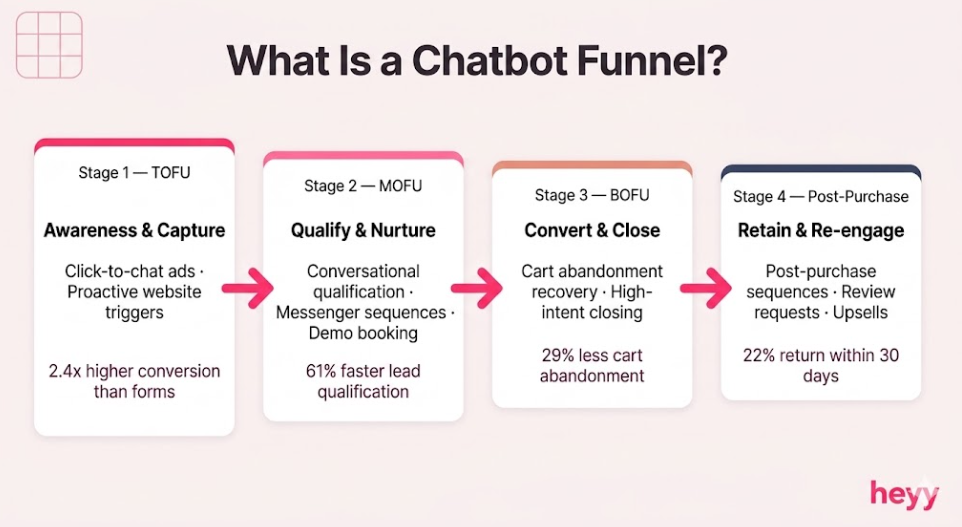
A chatbot funnel is a marketing and sales system that uses AI-powered conversational interfaces to move prospects through the buyer's journey at every stage, from first awareness through purchase and re-engagement, without requiring a human to be present at each step.
A traditional funnel is passive. It waits for the prospect to fill in a form, click a button, or reply to an email. A chatbot marketing funnel is active. It initiates conversations, asks qualifying questions, delivers relevant information, and presents the next step in the buying journey the moment the prospect shows intent.
The funnel stages where chatbots create the most impact:
Top of funnel (TOFU): Converting ad clicks and website visits into conversations rather than anonymous traffic.
Middle of funnel (MOFU): Qualifying leads, nurturing them with personalized information, and booking demos or appointments automatically.
Bottom of funnel (BOFU): Converting high-intent leads into buyers, recovering abandoned carts, and closing sales before the prospect disappears.
Post-purchase: Re-engaging customers, driving repeat purchases, and building the retention relationships that reduce churn.
Why Chatbot Funnels Outperform Traditional Funnels
The performance gap is structural, not coincidental.
Speed is the primary driver. Engaging a lead within 5 minutes of initial contact makes them 9x more likely to convert, according to lead generation research from Digital Applied. Traditional funnels respond within hours at best. A chatbot responds in seconds, at any hour, every time.
Conversation beats form. A static form that asks for name, company, email, and phone number before providing any value produces friction. A chatbot that asks "what brings you here today?" and builds a conversation from the response produces engagement. 64% of businesses report that AI chatbots have helped generate more qualified leads than their previous lead generation methods, per lead generation benchmark data from Blondish.
Channel reach extends beyond the website. Traditional funnels are website-centric. A chatbot funnel operates across WhatsApp, Instagram DMs, Facebook Messenger, and website chat simultaneously. Website conversions increase by up to 38% with proactive chatbots, per Marketing LTB's benchmark data, but the bigger opportunity is the leads who never reach the website at all.
Qualification happens in real time. By the time a sales representative receives a lead from a traditional form, they know the prospect's name and email. A chatbot funnel delivers structured qualification data: budget range, timeline, specific use case, decision-maker status. Lead qualification time drops by 61% with automated chat workflows, per Marketing LTB's 2026 data.
The Benefits of a Chatbot Marketing Funnel
Every Lead Gets an Immediate Response
No prospect waits 24 hours. No inquiry goes unanswered because it arrived on Friday afternoon. Every person who engages receives a response in seconds, regardless of when they reached out.
Your Best Performers Run 24/7 Without Burnout
Your best sales representative has a bad day sometimes. The chatbot does not. In 2026, AI-powered agents are projected to handle up to 95% of customer interactions delivering personalized support 24/7, according to AI lead generation statistics from Click Vision.
Qualified Leads Reach Sales With Full Context
Instead of a sales representative starting every call with "can you tell me a bit about your situation?", they start with a complete qualification profile the chatbot built during the initial conversation.
The Funnel Scales Without Proportional Headcount
Adding 1,000 new leads per month to a traditional funnel means hiring more people to respond. Adding 1,000 new leads per month to a chatbot funnel means the AI handles qualification, nurturing, and booking automatically. This is the core of how to use AI chatbots for lead generation at scale without a proportional increase in headcount.
7 Ways to Use Chatbots Across Your Marketing Funnel
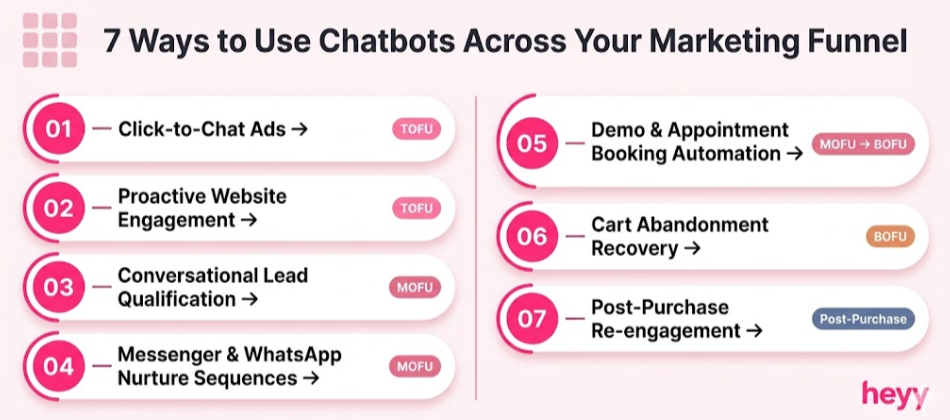
1. Click-to-Chat Ads (TOFU)
The opportunity: Your ad spend sends people to landing pages that wait passively for form submissions. Click-to-chat ads send people directly into a WhatsApp or Instagram DM conversation with your business instead.
How it works: In Meta Ads Manager, set the destination of your campaign to WhatsApp or Instagram Direct instead of a website URL. When someone taps the ad, a conversation opens instantly. Your chatbot responds, qualifies the lead, and presents the next step.
Why it converts better: The friction of navigating a landing page, reading the offer, finding the form, and submitting it disappears. The prospect is in the conversation before they have had time to get distracted. Click-to-chat ads for lead generation consistently outperform link-to-website ads by 2 to 3x on conversion rate, because the channel they open is one the prospect already uses and already trusts.
What to configure: A welcome message that acknowledges the specific ad clicked. "Hi, you just tapped our ad about [topic] — what would you like to know?" opens a conversation specific to the ad context rather than a generic greeting.
The metric to track: Cost per conversation initiated versus cost per landing page visit. In most campaigns, cost per initiated conversation is lower than cost per form submission from equivalent traffic.
2. Proactive Website Engagement (TOFU)
The opportunity: 61% of marketers say generating quality leads is their top challenge, per AI lead generation statistics from Click Vision. Most website visitors leave without making contact. Proactive chatbot engagement captures a portion of that silent majority before they exit.
How it works: Configure behavior-based chat triggers on your website. A visitor who has been on the pricing page for 20 seconds receives: "I noticed you're looking at pricing — do you have a specific budget in mind? I can suggest the right plan." A visitor who views three product pages gets a different message: "You've been looking at a few products — can I help you figure out which one fits your situation?"
Why it converts better: Generic popups interrupt. Relevant, behavior-triggered messages assist. Personalized experiences convert at 3 to 5x the rate of generic ones, according to marketing funnel strategy data from Rich Wood Marketing. A behavior-triggered chatbot message is the personalization a landing page cannot provide.
What to configure: Two to three distinct triggers tied to high-intent behaviors: pricing page visits over 15 seconds, multiple product page views in one session, return visits from the same user, and exit intent on checkout pages.
The metric to track: Conversation initiation rate from proactive triggers versus passive chat (widget clicks only). A well-tuned proactive setup generates 3 to 5x more conversations than a passive widget from the same traffic.
3. Conversational Lead Qualification (MOFU)
The opportunity: Static qualification forms gate content and demos behind a wall of fields that prospects abandon at 60 to 80% rates. Conversational qualification asks the same questions across a natural back-and-forth that feels like assistance rather than interrogation.
How it works: Replace your lead capture form with a chatbot that asks qualifying questions conversationally. "What's bringing you here today?" flows naturally into "What does that look like for your business currently?" which flows into "What's your timeline for making a change?" The same qualification data is captured. The experience is entirely different.
For the Facebook messenger chatbot marketing funnel specifically, this plays out as a Messenger lead ad that opens a chatbot conversation when clicked. The prospect answers qualification questions inside Facebook Messenger without leaving the platform, and structured responses are passed to your CRM automatically.
Why it converts better: Forrester projects 62% of B2B websites will deploy conversational AI lead capture by Q2 2027, up from 14% in early 2026, with chat-driven lead capture lifting qualified meeting bookings by 38% on the same traffic. The businesses building this infrastructure now are capturing qualified leads their competitors are losing to form abandonment.
What to configure: Five to seven qualifying questions maximum. Each question should build on the previous answer rather than following a fixed sequence. End with a clear next step: a booking link, a resource, or a direct connection to a relevant team member.
The metric to track: Form completion rate before chatbot versus conversation completion rate after. And qualified lead rate: what percentage of conversations produce a lead your sales team rates as sales-ready.
4. Messenger and WhatsApp Nurture Sequences (MOFU)
The opportunity: Email nurture sequences are increasingly filtered into promotions tabs and ignored. WhatsApp messages have a 98% open rate compared to email's 20% average. A Facebook messenger chatbot marketing funnel or WhatsApp nurture sequence reaches prospects in a channel they actually check.
How it works: When a prospect provides their WhatsApp number or opts into Messenger communication during qualification, they enter a timed nurture sequence. Day 1: a welcome message with the specific resource they requested. Day 3: a case study relevant to their stated use case. Day 7: a direct invitation to book a call or demo, with urgency framing tied to their stated timeline.
The chatbot delivers each message, handles replies conversationally, and escalates the prospect to a human team member when they express high intent or ask a question outside the bot's scope.
Why it converts better: Messenger and WhatsApp nurture sequences reach prospects in a conversational channel that feels personal rather than a broadcast channel that feels like marketing. A prospect who ignored three emails often replies to a WhatsApp message. The channel shift is the conversion mechanism.
What to configure: Three to five messages maximum. Each message should be short, single-topic, and end with a question or call to action that invites a response.
The metric to track: Open rate, reply rate, and progression rate — what percentage of prospects in the sequence move to the next funnel stage within 14 days.
5. Demo and Appointment Booking Automation (MOFU to BOFU)
The opportunity: A qualified lead who wants to book a demo should be able to do it in the same conversation. Every step between "I'm interested" and "your meeting is confirmed" is a drop-off risk.
How it works: Integrate your chatbot with your booking calendar. When a prospect expresses intent to see the product or speak with the team, the chatbot presents available slots directly in the conversation. The prospect picks a time. A confirmation is sent immediately. A reminder fires 24 hours before.
This works within the website chatbot, the Facebook messenger chatbot marketing funnel, and WhatsApp, covering the full channel spread where qualified prospects exist.
Why it converts better: The average time between a prospect expressing interest and a sales representative manually arranging a booking is 4 to 24 hours. In that window, the prospect cools, finds an alternative, or forgets the context of why they were interested. The chatbot automation framework closes that window to under 60 seconds.
What to configure: A booking trigger in the conversation flow that fires when specific intent signals appear: "I'd like to see a demo," "can I speak to someone?", "how do I get started?". Present the next 2 to 3 available slots rather than a full calendar to reduce decision friction.
The metric to track: Show rate for chatbot-booked meetings versus manually arranged meetings. Chatbot-booked meetings typically show higher show rates because frictionless booking selects for higher intent.
6. Cart Abandonment Recovery (BOFU)
The opportunity: A customer adds items to their cart and leaves without completing the purchase. Traditional recovery is an email 24 hours later with a coupon code. A chatbot sends a WhatsApp message within 60 minutes while purchase intent is still warm.
How it works: Connect your chatbot to your e-commerce platform. When a cart is abandoned by a customer whose WhatsApp number you have, an automated message fires within one hour: "Hey [Name], you left something behind — your [specific product name] is still in your cart. Can I help with anything before you decide?" The message references specific products and offers assistance rather than immediately discounting.
If the customer replies with a question, the chatbot answers it. If they express purchase intent, the chatbot guides them directly to checkout. If they say they are not ready, the chatbot sets a follow-up sequence.
Why it converts better: Chatbots reduce cart abandonment by up to 29%, per Marketing LTB's benchmark data. The mechanism is timing and channel. A 60-minute WhatsApp message reaches the prospect while they are still thinking about the purchase. A 24-hour email arrives after they have already bought from a competitor or forgotten the decision entirely.
What to configure: A 45 to 60 minute delay after abandonment before the first message. A question-based opening rather than an immediate discount offer. A two-message sequence maximum before pausing.
The metric to track: Recovery rate (percentage of abandoned carts that complete purchase within 48 hours of chatbot contact) and revenue recovered per month.
7. Post-Purchase Re-engagement and Retention (Post-Purchase)
The opportunity: The most underused stage of the chatbot marketing funnel is after the sale. 22% of bot-assisted customers return for a second purchase within 30 days versus a significantly lower baseline for customers who received no post-purchase engagement, per Marketing LTB's retention data.
How it works: A customer completes a purchase. The chatbot fires a post-purchase sequence via WhatsApp or SMS. Day 1: order confirmation with real-time tracking link. Day 3 post-delivery: a check-in message asking how they are finding the product. Day 7: a request for a review or testimonial. Day 21: a relevant product recommendation based on what they bought.
This sequence handles four distinct post-purchase touchpoints automatically. It generates social proof, surfaces product issues before they become returns, and presents the upsell at the moment the customer has experienced the product.
Why it converts better: Customers are most receptive to re-engagement in the 7 to 30 days after their first purchase, when satisfaction is high. Most businesses do not reach customers during this window at all. 47% of customers are willing to purchase directly via chatbot, per Marketing LTB's data, meaning the re-engagement sequence is also a direct sales channel.
What to configure: Integration between your chatbot and your order management system for real-time order status. A review request trigger timed to post-delivery. A product recommendation matched to the specific category of first purchase.
The metric to track: Repeat purchase rate within 30 and 60 days for chatbot-engaged customers versus non-engaged customers. Review generation rate from chatbot requests.
How to Measure Your Chatbot Funnel Performance
Conversation initiation rate. What percentage of relevant website visitors, ad clicks, or social media contacts start a chatbot conversation? This is the top-of-funnel metric.
Qualification completion rate. What percentage of initiated conversations produce a fully qualified lead with the structured data your sales team needs?
Conversion rate by funnel stage. What percentage of qualified leads book a demo? What percentage of demo bookings show up? What percentage of shows close?
Channel performance comparison. Are WhatsApp conversations converting differently than website chat? Are click-to-chat ad leads qualifying at a higher rate than organic website leads?
Revenue attributed to chatbot funnel. How to use AI chatbots for lead generation effectively is ultimately a revenue question. Track which deals originated through chatbot conversations and denominate the answer in dollars, not just percentages. The chatbot lead qualification guide covers what structured qualification data enables at the revenue attribution level.
The businesses winning on conversion in 2026 are not running more ads or writing better copy. They are responding faster, qualifying better, and following up in channels their customers actually use. The chatbot funnel is the infrastructure that makes all three happen automatically.
The place to start is whichever stage in this guide described the biggest gap in your current operation. Fix that one first, measure it, then build the next stage on top of a foundation that is already working.
If you want to run this across WhatsApp, Instagram, Facebook Messenger, and your website from one platform, Heyy is built for exactly that. Click-to-chat ads, qualification flows, booking automation, cart recovery, and post-purchase re-engagement are all configurable in one place. Start free and build your first chatbot funnel stage before the end of the week.
FAQs
What is a chatbot funnel?
A chatbot funnel is a marketing and sales system that uses AI-powered conversational chatbots to move prospects through each stage of the buyer's journey automatically. It replaces passive, form-based lead capture with active, conversational engagement at the top of the funnel, qualifies and nurtures leads in the middle, closes sales at the bottom, and drives re-engagement post-purchase. A chatbot funnel operates 24/7 across WhatsApp, Instagram, Facebook Messenger, and website chat simultaneously from a single configured system.
What is a Facebook Messenger chatbot marketing funnel?
A Facebook Messenger chatbot marketing funnel uses Meta's Messenger platform as the primary conversational channel for lead generation and nurture. It works by running Messenger lead ads that open a chatbot conversation when a prospect clicks, qualifying the lead through a conversational exchange inside Messenger, and nurturing them through a timed message sequence in the same channel. The advantage of the Facebook Messenger chatbot marketing funnel is that the prospect never leaves the platform they are already using, reducing friction at every step.
How does a chatbot marketing funnel differ from a traditional marketing funnel?
A traditional marketing funnel relies on passive conversion mechanisms: landing pages that wait for form submissions, emails that wait to be opened, sales representatives who respond during business hours. A chatbot marketing funnel actively initiates conversations at the moment of intent, qualifies leads in real time, books meetings automatically, and follows up across messaging channels with open rates far higher than email. The measurable difference is a 2.4x higher conversion rate for chatbot-led funnels versus static web forms.
How do I use AI chatbots for lead generation?
How to use AI chatbots for lead generation follows a four-step process. First, deploy an entry point that captures initial interest: a click-to-chat ad, a proactive website trigger, or a social DM response. Second, run a qualification conversation that asks the questions your sales team needs answered. Third, route qualified leads to the next step automatically: a booking link, a relevant resource, or a human team member. Fourth, follow up with unqualified or undecided leads through a timed nurture sequence in the same channel.
Which funnel stage should I deploy a chatbot to first?
Start at the stage with the highest volume and the biggest current gap. For most businesses, that is lead qualification at the point where prospects express interest. If your primary traffic source is paid social ads, start with click-to-chat ads and qualification together. If you have an existing customer base you are not currently re-engaging, start with the post-purchase retention sequence. Fix the biggest leak first.
What channels should a chatbot funnel cover?
At minimum: your website and the one social messaging channel where your customers are most active. For consumer-facing businesses in most markets, that is WhatsApp or Instagram DMs. For B2B businesses, website chat is primary. For businesses using Facebook advertising, Messenger. The most effective chatbot funnels cover two to three channels from one unified inbox so the same qualification history travels with the customer regardless of which channel they use. The best AI chatbots for small businesses covers specific platforms with this multi-channel coverage.
More blog posts to read

Ready to Automate Support
Across Every Channel?
.svg)
.avif)