.svg)
Chatbot Marketing: The Complete 2026 Guide

Think about the last time you added a new tool to your marketing stack. Most of them take weeks to set up, require constant monitoring, and eventually just become another line item on your monthly bill. Chatbot marketing is the exception, and the numbers make it hard to argue otherwise.
79% of companies report positive results from conversational marketing bots, citing improvements in customer loyalty, sales, and revenue. Chatbot-led funnels convert at 2.4 times the rate of static web forms. Chatbot marketing is one of the few areas where that pattern actually breaks. It’s less about adding another 'task' to your plate and more about finally offloading the ones that have been slowing you down.
So, those are not hypothetical projections. They are what businesses are seeing in live deployments right now. The reason it works is not complicated: chatbot marketing meets your audience in a real-time, two-way conversation instead of asking them to fill in a form, wait for a follow-up email, and hope they still remember why they visited your site three days later.
This guide covers everything you need to know to actually use chatbot marketing effectively: what it is, how it works, where to deploy it, which tools to consider, what to measure, and the mistakes that will quietly kill your results. AI chatbots are the number one channel companies plan to increase investment in for 2026. If you are not using them as a marketing channel yet, this is a good time to start.
What Is Chatbot Marketing?
Chatbot marketing is the use of automated, AI-powered chat conversations to attract, engage, qualify, and convert prospects and customers. Instead of relying on static landing pages, passive forms, and delayed email sequences, chatbot marketing makes your funnel interactive, responding to every visitor in real time and moving them toward a decision within the conversation itself.
The key distinction from traditional marketing automation is the medium. Email sequences are asynchronous and one-directional. Chatbots are live and two-way. A lead capture bot does not just collect an email address: it asks what the visitor is looking for, qualifies their intent, serves relevant content or offers, and hands a warm, pre-qualified lead to your sales team, all in the same session.
Chatbot marketing sits at the intersection of marketing automation, conversational marketing, and customer engagement strategy. When it is done well, it feels less like a tool and more like having a sales assistant available on every page of your website, inside every social media DM, and across every channel where your audience spends time, working around the clock without a team member typing a single response.
It is worth noting what chatbot marketing is not. It is not a pop-up that pesters visitors before they have read a word. It is not a rigid script that falls apart the moment someone asks a question that was not pre-programmed. And it is not a substitute for having a real product, a clear value proposition, and a customer who actually wants to hear from you. Chatbots amplify good marketing. They cannot create it from scratch.
What Chatbot Marketing Is Actually Trying to Do
Before getting into the how, it helps to be precise about the purpose. Chatbot marketing is not just about having a bot on your website. It is about making specific parts of your funnel faster, smarter, and more responsive than they would be if you relied on static content and delayed human follow-up.
The core jobs chatbot marketing is hired to do:
- Qualify leads in real time. Instead of waiting for a visitor to fill in a form and then having your sales team spend 20 minutes on a call figuring out if they are actually a fit, the chatbot asks the qualifying questions in the moment and segments the lead before it ever hits your CRM.
- Capture leads during off-hours. Your team is not online at 11pm but your chatbot is. One of the most consistent ROI drivers for chatbot marketing is the percentage of leads captured outside business hours that would otherwise have bounced.
- Reduce friction in the conversion path. Every additional step between a visitor's first interest and their first action is an opportunity for them to leave. Chatbots collapse those steps by handling questions, objections, and decisions within the conversation.
- Personalize at scale. A chatbot connected to your CRM knows returning customers. It can reference their history, serve relevant content, and adjust its tone and offer based on where they are in the customer lifecycle. That level of personalization would require a human sales team at enormous cost to replicate manually.
- Accelerate the sales cycle. Chatbot leads convert at three times the rate of traditional sign-up forms or email captures. The reason is speed and context: the chatbot captures intent at the moment of peak interest and responds immediately.
How to Use Chatbots in Marketing: The Main Channels and Plays
Chatbot marketing is not a single tactic. It is a set of deployment strategies across different channels and funnel stages. Here is how it works in practice across the most important ones.
Website Chat: Converting Visitors Who Are Already Interested
Your website has already done the hard work of getting a visitor there. A marketing chatbot's job is to make sure that visitor does not leave without taking action. Exit-intent bots trigger when a visitor shows signs of leaving. Proactive bots initiate a conversation after a visitor spends a certain amount of time on a specific page. Content recommendation bots suggest relevant resources based on what the visitor is browsing.
The most important play here is the lead capture bot on high-intent pages: pricing pages, product pages, demo request pages. Instead of a form with six fields, the chatbot has a conversation, gathers the same information naturally, and captures a lead who is warmer and more qualified than a form submission typically produces.
WhatsApp and Messenger: Marketing in the Channels People Actually Use
WhatsApp has over 2 billion active users. Facebook Messenger has over 1 billion. These are not platforms your audience uses sometimes: they are the places where they send messages to friends, family, and, increasingly, the brands they buy from. Running chatbot marketing on WhatsApp and Messenger means reaching customers where the conversation is already happening rather than asking them to come to you.
In markets where WhatsApp is the default way people communicate, it’s often the most direct line you have to your customers. It’s not just a messaging app; it’s where the actual relationship happens. Successfully navigating WhatsApp chatbot marketing usually comes down to knowing how to turn those casual pings into revenue without losing the conversational feel that makes the platform work in the first place.
Click-to-Chat Ads: Turning Ad Spend Into Conversations
The usual way of doing things involves a landing page, a form, and then a long wait for someone to actually follow up. Click-to-chat ads on platforms like Facebook and Instagram basically cut out the middleman. By dropping users straight into a conversation, you're getting rid of the page load times and the "we'll get back to you in two business days" lag.
It’s a much more direct way to handle click-to-chat ads for lead gen because it meets the customer exactly where their interest is highest, without the friction of a sign-up form. You’re essentially moving from "seeing an ad" to "having a conversation" in a single click, which makes the whole path to a sale feel significantly shorter.
Instagram DMs: Conversational Marketing on Social
Brands running giveaways, product launches, or content campaigns on Instagram are using chatbot automation to handle the DM volume that these campaigns generate. Comment-triggered DM automations send a chatbot sequence to everyone who comments a specific keyword on a post, turning a passive engagement action into an active conversation that qualifies interest and captures leads.
Post-Purchase Sequences: Marketing to Customers You Already Have
The most valuable leads in your database are the people who have already bought from you. Chatbot marketing sequences targeting existing customers for reorder reminders, complementary product recommendations, loyalty program enrolments, and review requests drive repeat revenue without acquiring a single new visitor.
Ready to run chatbot marketing on WhatsApp and Instagram?
Heyy connects to your chosen channels and goes live in 15 minutes, no developer and no credit card needed. Try it for free.
How to Build Chatbot Marketing Into Your Strategy: A Step-by-Step Approach
A chatbot sitting on your website without a strategy behind it is just a widget. Here is how to make it a meaningful part of your marketing operation.
Step 1: Pick One Funnel Problem to Solve First
Do not try to deploy chatbots everywhere at once. Look at your funnel and identify the biggest leak: is it visitors who land on your pricing page and leave without converting? Is it leads who come in through ads and go cold before a follow-up call? Is it customers who buy once and never come back? Start with the one problem that costs you the most revenue and deploy your first chatbot there. Learn what works, then expand.
Step 2: Map the Conversation Before Building It
Before you open any chatbot tool, write out the conversation you want to have with your visitor. What is the first thing the bot says? What are the two or three most likely responses? Where does each path lead? A chatbot conversation that has not been designed with real customer language in mind ends up sounding scripted and generic, which is the fastest way to lose the visitor you were trying to engage.
Step 3: Connect It to Your Real Data
A chatbot that cannot access your CRM, your product catalog, your order data, or your knowledge base is limited to generic responses. The value of chatbot marketing multiplies when the bot knows who it is talking to and can personalize accordingly. Make sure your chatbot integrates with the tools your marketing and sales team already use before you go live.
Step 4: Set Up Lead Routing and Notifications
Decide in advance what happens when the bot qualifies a lead. Does it book a meeting directly in a sales rep's calendar? Does it send an instant Slack notification? Does it create a contact in your CRM with the qualification data attached? The lead capture is only valuable if the handoff to your team is fast. The data shows that responding to a lead within five minutes increases conversion likelihood by nine times compared to a 10-minute response.
Step 5: Launch, Measure, and Iterate
Your first chatbot conversation will not be your best one. Launch it, watch where visitors drop off, read the transcripts of conversations that did not convert, and update the copy and flow accordingly. The businesses seeing the highest conversion lifts from chatbot marketing are the ones iterating on their conversations monthly, not the ones who set it up once and moved on.
Step 6: Expand Channels Based on Where Your Audience Is
Once your website setup is solid, the next logical step is to meet your customers where they’re already hanging out. If your audience lives on WhatsApp, that’s where you should be, too. If your Instagram DMs are constantly buzzing with the same five questions, that’s a clear signal to automate those responses. For ecommerce teams, seeing how different platforms handle this multi-channel approach can help you decide which tools actually fit your specific workflow and where your brand needs to show up next.
5 Chatbot Marketing Tools Worth Considering
There are dozens of platforms in this space. These five represent meaningfully different approaches, so you can see where the category breaks down before deciding which direction to go.
1. HubSpot Chatbot Builder
Best for: Marketing teams already using HubSpot for CRM and automation
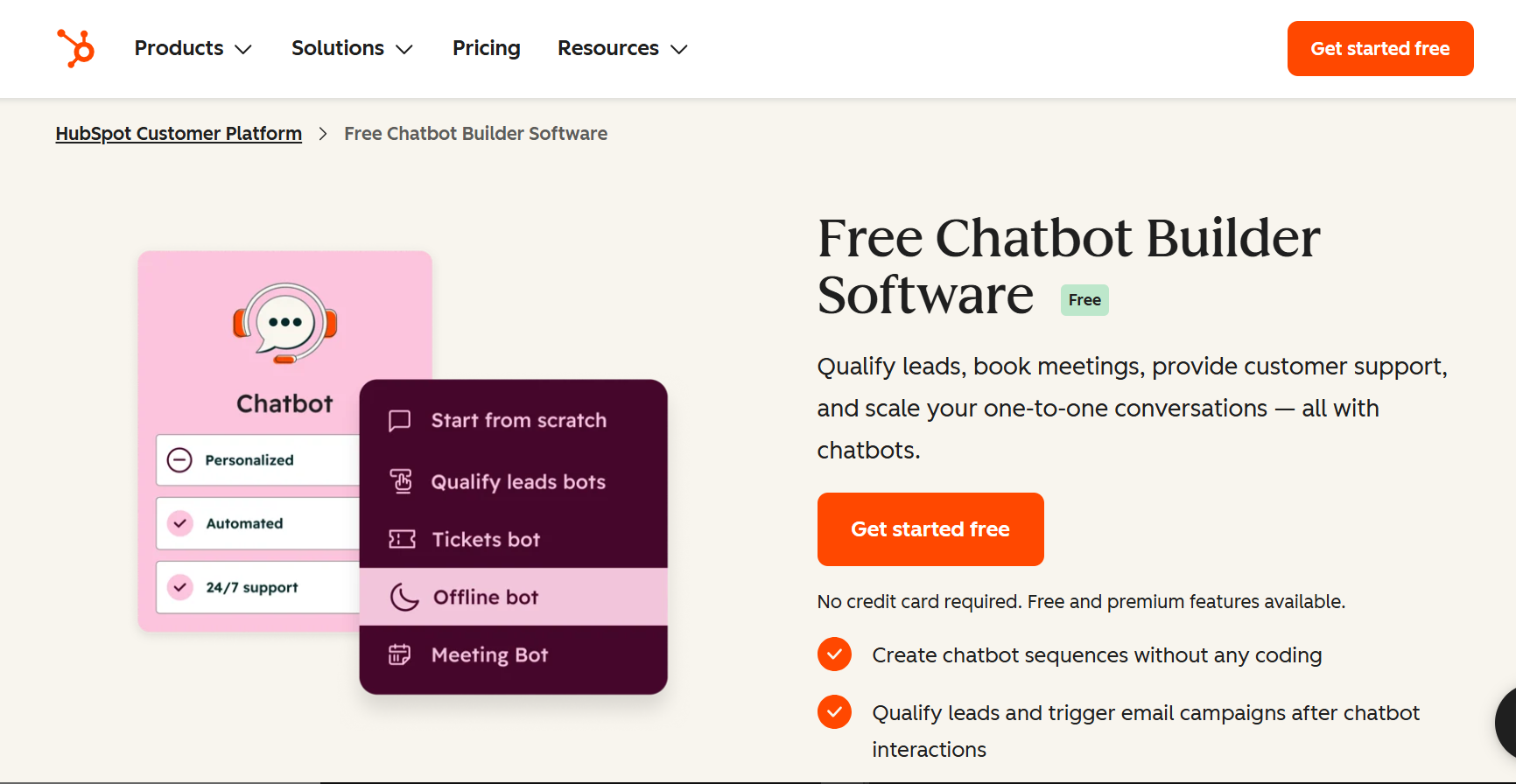
HubSpot's chatbot builder is tightly integrated with its CRM, which makes it one of the stronger options for marketing teams that already live in the HubSpot ecosystem. The bot can qualify leads, book meetings, and trigger automated workflows based on conversation outcomes, all with the lead's full CRM history visible to the sales team immediately. The conversational marketing flows are visual and straightforward to build without technical resources.
The limitation is the same one that applies to every HubSpot tool: the full value is locked inside the HubSpot platform. If you are not already using HubSpot for CRM and marketing automation, adopting the chatbot builder means adopting a larger ecosystem commitment. For teams already there, it is a natural extension.
Pricing: Free plan available. Marketing Hub Starter from $15/month. See hubspot.com/pricing
2. ManyChat
Best for: Ecommerce and DTC brands running Instagram and Facebook campaigns
.png)
ManyChat is the category leader for social media chatbot marketing, specifically on Instagram and Facebook Messenger. Its comment-to-DM automation is particularly powerful for brands running giveaways, product drops, or content campaigns: a customer comments a keyword on a post and ManyChat automatically opens a personalized DM conversation that captures their email, qualifies their interest, and moves them into a nurture sequence. This single feature drives an enormous amount of the ecommerce lead generation use case.
ManyChat is less suitable as a full marketing automation platform for businesses that need deep CRM integration, complex qualification logic, or multi-channel unification beyond Instagram and Messenger. It is narrow but very good at what it does. If your primary chatbot marketing channel is social, it is one of the strongest purpose-built options available.
Pricing: Free plan available. Pro from $17/month. See manychat.com/pricing
3. Drift (Now Part of Salesloft)
Best for: B2B companies with high website traffic and large sales teams
.png)
Drift essentially invented the term conversational marketing and remains one of the most sophisticated platforms for B2B marketing chatbots. Its AI targets specific accounts based on intent data, triggers personalized chatbot conversations for high-value visitors, and routes qualified leads directly to the right sales rep's calendar. The playbook model lets marketing teams build and test different conversation flows for different segments and campaigns without developer involvement.
Drift is built for enterprise B2B with budgets to match. Pricing is not transparent and enterprise contracts are the norm. For smaller businesses or teams without a dedicated demand generation function, the cost-to-value ratio is difficult to justify. For companies running account-based marketing at scale with high-intent traffic, it is one of the most capable platforms in the market.
Pricing: Not publicly listed. Enterprise contracts. Contact sales here
4. Tidio
Best for: Growing ecommerce brands wanting AI chat and marketing automation in one tool
.png)
Tidio sits at the intersection of customer support and chatbot marketing in a way that works well for ecommerce businesses. Its Lyro AI achieves a published resolution rate of 67%, and its marketing automation features include abandoned cart recovery sequences, product recommendation flows, and discount delivery via chat. The visual flow builder makes it accessible for teams without technical resources, and the Shopify integration gives the chatbot access to real order and product data.
Tidio works best as a unified support and marketing tool for ecommerce stores. It is less suited for B2B lead generation, enterprise use cases, or businesses whose customers are primarily on WhatsApp and Instagram rather than the website.
Pricing: Free plan available. Lyro AI from $32.50/month (billed annually). See tidio.com/pricing
5. Heyy
Best for: Multi-channel brands running chatbot marketing across WhatsApp, Instagram, Facebook Messenger, and website chat simultaneously
.png)
Heyy's approach to chatbot marketing centers on its AI Employees model: fully configurable virtual agents that run your marketing and support conversations across every channel from a single unified inbox. Where most platforms require separate setups for website chat, WhatsApp, and Instagram, Heyy handles all four simultaneously, with every conversation visible to your team in one place.
For chatbot marketing specifically, this matters because your audience is not on one channel. A campaign that drives traffic from an Instagram ad, captures a lead in a WhatsApp conversation, and follows up via website chat would normally require three separate tools and three separate conversation histories. Heyy unifies all of that. The 15-minute no-code setup means you can have your first marketing chatbot live before the end of the day, and the free forever plan means the barrier to starting is exactly zero.
The AI Employees can be trained on your product catalog, your offer details, your FAQs, and your qualification criteria, so every conversation is grounded in your specific business context rather than generic responses. For brands where social commerce is the primary acquisition channel, this is one of the more purpose-fit chatbot marketing tools available today. Explore the full detail on how it works at heyy.io
Pricing: Free forever / Hobby $49/mo / Pro $149/mo / Ultra $499/mo. Check out full pricing here
The Business Case for Chatbot Marketing
If you are still deciding whether chatbot marketing is worth investing in, here is what the data shows across businesses that have deployed it:
- Higher lead quality, not just volume. 64% of businesses using AI chatbots report an increase in qualified leads, not just more leads. Bots that qualify in real time filter out low-intent visitors before they reach your sales team, which means your team spends time on prospects that are actually worth calling.
- Significantly better conversion rates. AI chatbots deliver conversion improvements of 20% or more, with proactive chat triggering up to a 40% lift. Chatbot leads convert at three times the rate of traditional sign-up forms.
- Revenue impact that compounds. Businesses implementing chatbots report a 67% increase in sales .Many ecommerce businesses see 7 to 25% annual revenue increases after deploying chatbots, driven by higher conversions, cross-selling, and cart recovery.
- 24/7 lead capture without 24/7 headcount. The percentage of leads captured outside business hours is one of the most consistent ROI stories in chatbot marketing. Your bot is working when your team is not. That is lead volume that would otherwise simply not exist.
Faster time-to-conversation. Marketing automation that nurtures leads sees a 451% increase in qualified leads. Chatbots accelerate this by initiating the conversation at the moment of peak interest rather than waiting for a scheduled follow-up.
How to Measure Chatbot Marketing Success
Adding a chatbot to your marketing stack without measuring it is quite counter-productive. These are the five metrics that directly tell you whether your chatbot marketing is working and the benchmark numbers to measure yourself against. For deeper analytics setup, the Heyy guide to chatbot analytics covers how to configure your dashboards from day one.
Here is how chatbot marketing compares to the channels most businesses are already running:
More blog posts to read

Ready to Automate Support
Across Every Channel?
.svg)
.avif)