.svg)
Chatbot Use Cases by Industry: How Retail, Healthcare, Hospitality, and More Are Winning with AI


I’ve done the research and I hate to break it to you, but, the businesses winning with chatbots in 2026 are not the ones that deployed the most sophisticated technology. They are the ones that deployed the right use cases for their specific industry. A chatbot that transforms a healthcare clinic is useless to a streetwear brand. A chatbot that makes a hotel more profitable has nothing to do with what a law firm needs.
Industry context is everything. And yet most chatbot content treats every business as interchangeable.
This guide does not. It breaks down the highest-impact chatbot use cases for seven industries, with specific numbers, real examples, and the outcomes businesses are actually seeing in 2026. It also covers where chatbots do not work, which is information most vendors leave out deliberately.
By the end of this post you will know exactly which use cases apply to your business, what results to expect, and where to start.
Why Chatbot Adoption Is No Longer a Differentiator
Before the industry breakdowns, one macro context that frames everything.
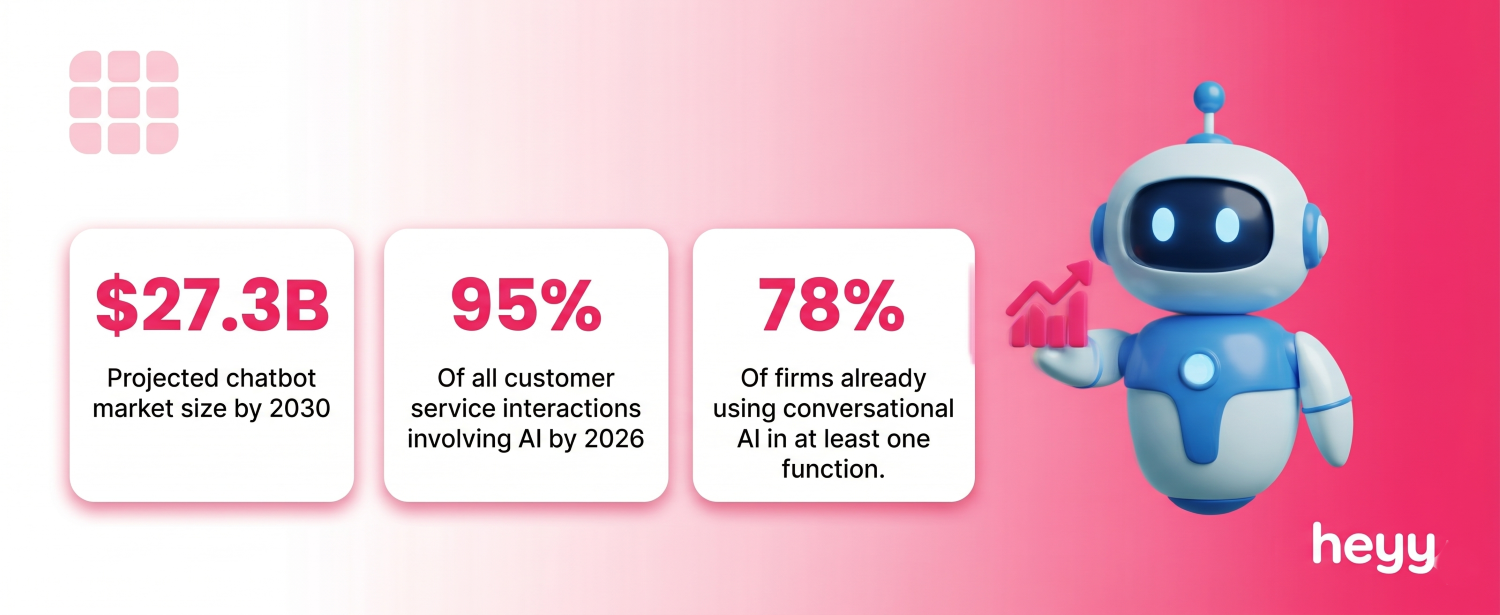
The global chatbot market is projected to reach $27.3 billion by 2030, growing at a 23.3% CAGR. In 2026, it is estimated that AI bots will power 95% of all customer service interactions. 78% of firms have already integrated conversational AI into at least one business function.
The strategic question has shifted. It is no longer "should we deploy a chatbot?" It is "which use case do we start with, and what does success look like?"
The businesses creating measurable advantages are the ones deploying for specific, high-frequency, high-value use cases rather than generically deploying "a chatbot" and hoping for results. Chatbot use cases by industry are the framework for making that distinction correctly.
At a Glance: Chatbot Adoption by Industry
1. Retail and E-Commerce
The problem chatbots solve here: Abandoned carts. Unanswered product questions at 11pm. A support team drowning in "where is my order" messages while the actual customer experience suffers.
Retail is where chatbot deployment is most mature and where the business case is most straightforward. 83% of e-commerce companies now use chatbots for support and sales, and the revenue impact is direct and measurable.
Highest-impact use cases:
Cart abandonment recovery. A customer adds three items to their cart and leaves without checking out. Sixty minutes later, a WhatsApp or SMS message arrives with their specific cart contents and a prompt to complete the purchase. Chatbots reduce cart abandonment by up to 29%. For a store generating $100,000 per month in revenue with a 70% abandonment rate, recovering even 10% of abandoned carts adds $7,000 per month.
Product discovery and recommendation. A customer messages asking "what's the best moisturizer for oily skin in your range?" A trained chatbot answers with a specific product recommendation, the ingredient rationale, and a direct purchase link. 31% of e-commerce shoppers add products to their cart after chatbot recommendations, according to Marketing LTB's chatbot data.
Order status and returns. Order status is the highest-volume inquiry category for most e-commerce businesses. A chatbot connected to your order management system handles every "where is my order" question automatically, 24/7, without a human agent typing a single word.
Post-purchase upselling. A customer just completed a purchase. The chatbot fires a post-purchase sequence offering complementary products, a discount on their next order, or a loyalty program signup. These ecommerce chatbot use cases are already running on WhatsApp and Instagram DMs for the most forward-thinking D2C brands. Integrating a referral code generator into these post-purchase chatbot flows can further encourage customer engagement by allowing brands to create personalized referral campaigns, reward loyal customers, and drive new sales through trusted recommendations.
The WhatsApp angle: Instagram ads with direct DM connections are one of the highest-converting funnels in e-commerce right now. A customer who sees a product on Instagram, taps the ad, and lands in a WhatsApp conversation with an AI that answers their questions and closes the sale is a customer who never needed to visit your website. That funnel is available today and most e-commerce brands have not built it yet.
Outcome benchmark: Retail stores using chatbots report 18% higher repeat visit rates and a 15% increase in average order value.
2. Healthcare
The problem chatbots solve here: Overwhelmed front desks. Patients calling for appointment updates that require no clinical judgment. A 15% to 20% no-show rate that costs clinics thousands of dollars per day. And a patient base that wants digital-first access to healthcare administration.
68% of healthcare organizations now use chatbots for appointment scheduling, triage, and patient onboarding. Healthcare chatbots are projected to save the industry $3.6 billion globally by reducing administrative burden.
Highest-impact use cases:
Appointment scheduling and reminders. The use case with the fastest, most measurable ROI in healthcare. A chatbot checks the physician's live calendar, books the appointment, sends a confirmation, fires a 24-hour reminder via WhatsApp or SMS, and follows up with a post-visit satisfaction message. Clinics deploying AI-driven scheduling report a 50.7% reduction in patient no-shows. For a practice running 30 appointments per day at an average ticket of $150, bringing a 20% no-show rate to 8% recovers $540 per day.
Symptom triage and routing. A patient describes their symptoms through a chat interface. The chatbot uses a structured decision tree to determine urgency: routine appointment, urgent care, or emergency. This is not clinical diagnosis. It is administrative routing based on symptom pattern matching. It reduces unnecessary emergency visits and helps patients reach the right level of care faster.
Pre-appointment intake collection. Instead of a clipboard in the waiting room, intake forms are completed via chatbot in the 24 hours before the appointment. Patient intake automation saves an average of 15 minutes per appointment, which at 30 appointments per day is 7.5 hours of clinical prep time returned to the team daily.
Mental health accessibility. 67% of US patients report feeling more comfortable making appointments about sensitive health matters with an AI chatbot than with a human receptionist. For mental health practices, this is not a minor finding. It is a structural advantage in patient acquisition.
The key constraint: Conversational AI in healthcare must operate within clear clinical boundaries. The chatbot handles administration. Any question requiring clinical judgment escalates to a human immediately. HIPAA compliance is non-negotiable in the US. Any platform handling patient data must have a Business Associate Agreement in place.
Outcome benchmark: Practices using AI scheduling reduce no-shows by 35% and administrative staff time by 30%, per Hyperleap AI's 2026 chatbot data.
3. Hospitality and Travel
The problem chatbots solve here: Booking inquiries at midnight. Repetitive pre-arrival questions about check-in times and room types. OTA commissions that erode margins on every booking that could have come direct. And an in-stay service experience where guests cannot get a response because the front desk is occupied.
44% of travel companies now use chatbots for bookings and customer service. Hotels with AI chatbots capture 35% more direct bookings by responding to after-hours inquiries instantly.
Highest-impact use cases:
Direct booking conversion. A guest finds your hotel on Instagram at 10pm. They want to know if the suite has a sea view and whether breakfast is included. If no one responds, they navigate to Booking.com and you pay a 15 to 25% commission on a booking that was yours to lose. A chatbot that responds in seconds, answers both questions, and presents a direct booking option at the best available rate keeps that commission in your revenue.
Pre-arrival concierge. In the 48 hours before a guest arrives, a chatbot collects preferences: room setup, dietary requirements, transport needs, special occasion details. The guest feels anticipated. The team has a fully briefed arrival prepared. No phone call required.
In-stay service requests. Room service orders, housekeeping requests, restaurant reservations, local recommendations. 33% of consumers express a desire to use chatbots for hotel reservations and restaurant bookings, and in-stay chatbot availability reduces front desk call volume by 40 to 60% for properties that deploy it.
Upselling at the right moment. A guest who just confirmed a two-night stay receives a chatbot message at booking confirmation: "Would you like to add daily breakfast for $25 per person? It includes our full continental spread from 7am." This is the upsell that front desk agents sometimes forget to make. Chatbot upsell recommendations generate an additional 8 to 12% revenue per guest.
Post-stay review requests. Two hours after checkout, an automated WhatsApp message asks for a Google review. The timing is optimal: the guest is still close enough to the experience to write specifically about it.
Outcome benchmark: Businesses in travel and hospitality see a 30% increase in direct bookings after deploying chatbots on their website.
4. Real Estate
The problem chatbots solve here: Leads that arrive at 9pm and get no response until the next morning. Agents spending hours on the phone with unqualified buyers. Viewing slots that go unfilled because rescheduling requires a phone call the lead never makes.
Real estate has the highest lead conversion improvement of any industry that deploys chatbots, with AI-qualified leads converting at 3.2x the rate of unqualified form submissions.
Highest-impact use cases:
Lead qualification before agent involvement. A prospect messages about a property. Before an agent spends 30 minutes on a call, the chatbot establishes budget, timeline, location preference, buying or renting status, and financing situation. Leads that do not meet the criteria are handled politely without consuming agent time. Leads that do are routed immediately with full context attached.
Viewing booking automation. The chatbot presents available viewing slots from the agent's calendar and confirms the booking directly in the conversation. No back-and-forth emails. No missed calls. Agents save an average of 12 hours per week on repetitive property queries when this process is automated.
Property matching and alerts. A prospective buyer provides their criteria once in a chatbot conversation. When a matching property is listed, they receive an automated WhatsApp message with the details and a direct link to book a viewing. This is one of the most underused ecommerce chatbot use cases adapted for real estate: product recommendation logic applied to property matching.
After-hours inquiry capture. 93% of homebuyers use a website chatbot as their primary source of property information, according to National Association of Realtors data. A real estate website without a chatbot is a website that sends the majority of its late-evening traffic to a competitor.
Outcome benchmark: Real estate chatbot leads convert 12% higher than leads from standard web forms, and chatbots boost lead conversion by up to 40% when properly configured for qualification.
5. Banking and Financial Services
The problem chatbots solve here: High-volume routine inquiries that consume expensive human time. Compliance-sensitive communications that need consistent, auditable responses. And customers who expect 24/7 account access but whose banks cannot staff for it.
72% of financial institutions deploy chatbots for account inquiries, loan applications, and fraud alerts. 91% of banks with over $10 billion in assets now use AI chatbots for customer service.
Highest-impact use cases:
Account inquiry handling. Balance checks, transaction history, fee explanations, interest rate information. These inquiries require no judgment and no relationship. They require accurate, fast retrieval. A chatbot connected to your core banking system handles all of them automatically, freeing your human agents for the conversations that require trust and nuance.
Loan application pre-qualification. A customer inquires about a home loan. The chatbot collects employment status, income range, desired loan amount, existing debts, and property type through a conversational flow that feels like guidance rather than an interrogation. The result is a pre-qualified lead that arrives at a human officer's desk with complete structured data.
Fraud alert communication. When a suspicious transaction is flagged, an automated chatbot message reaches the account holder in seconds: "We detected an unusual transaction of $847 at [Merchant] on [Date]. Did you authorize this? Reply YES or NO." Resolution happens in the channel. No hold music. No call routing.
Onboarding and compliance communication. KYC document collection, account agreement acknowledgment, regulatory disclosure delivery. All of these can be structured as guided chatbot conversations that reduce human touchpoints while creating an auditable trail.
The compliance layer: Financial services chatbots operate in a heavily regulated environment. Every deployment must account for data security, regulatory compliance, and audit requirements. The constraint is real but manageable with the right platform architecture.
Outcome benchmark: Gartner estimates conversational AI will save $80 billion in contact center labor costs by 2026, driven primarily by banking and financial services deployments.
6. Education
The problem chatbots solve here: Admissions departments overwhelmed during application season. Students asking the same enrollment questions in week one of every semester. Faculty unable to scale support for large cohorts. Administrative staff answering questions that have the same answer every time.
37% of educational institutions now use chatbots for student support and onboarding. Institutions handling admissions with AI chatbots process 3x more inquiries during peak enrollment without additional staff.
Highest-impact use cases:
Admissions inquiry handling. Prospective students ask about course requirements, application deadlines, tuition fees, scholarship availability, and campus facilities. These questions arrive in high volume during application season and require consistent, accurate answers. A chatbot trained on your admissions materials handles all of them instantly while capturing prospective student contact information for the admissions team.
Student onboarding and orientation. New students need to know about registration processes, academic calendars, support services, and campus resources. A chatbot available via WhatsApp or the student portal answers every question at any hour during the critical first weeks when confusion is highest and dropout risk is elevated.
Assignment and exam reminders. Automated reminder sequences for assignment deadlines, exam schedules, and registration windows reduce the administrative churn that pulls lecturers and coordinators away from teaching.
Alumni engagement and donation campaigns. Alumni are a relationship, not a transaction. A chatbot that recognizes an alumnus, references their cohort, and presents a donation opportunity or event invitation in a conversational format when integrated with alumni management software outperforms email blasts on every engagement metric.
Outcome benchmark: Institutions using chatbots for student support report significant reductions in repetitive administrative queries and measurable improvements in student satisfaction during the onboarding period.
7. SaaS and Technology
The problem chatbots solve here: Trial users who activate and then disappear. Support teams buried in tickets that follow predictable patterns. Onboarding sequences that assume users will read documentation when most of them will not.
SaaS companies using bots report 200% more on-site conversations compared to those without. 81% of SaaS and technology companies have chatbots deployed in at least one customer-facing function.
Highest-impact use cases:
Trial onboarding and activation. The most expensive moment in the SaaS funnel is the trial user who signs up, hits a setup step they do not understand, closes the tab, and never returns. A chatbot that triggers on behavioral signals, a user who has been on step two for 10 minutes, or who has not logged in for three days, proactively offers help at the exact moment of hesitation. SaaS companies report 15 to 25% improvements in trial-to-paid conversion after deploying in-product onboarding chatbots.
Support ticket deflection. Password resets, billing plan changes, API documentation questions, integration troubleshooting for common issues. These tickets follow predictable patterns. A chatbot trained on your help documentation resolves 40 to 70% of support tickets before they reach a human agent. AI-powered chatbots achieve 78% resolution rates compared to 52% for rule-based systems.
Lead qualification on the website. A B2B SaaS website visitor who has viewed the pricing page three times is a warm lead. A chatbot that identifies this behavior, initiates a conversation, and runs a qualification flow determines company size, use case, decision timeline, and budget before a sales representative is involved. Lead qualification time drops by 61% with automated chat workflows.
Customer health monitoring and proactive outreach. For SaaS businesses with usage analytics, a chatbot triggered by declining usage patterns can reach out proactively: "We noticed you haven't used [Feature X] in a while. Would a quick walkthrough help?" This is conversational AI in a retention role, and it directly addresses churn before it happens.
Outcome benchmark: Chatbot-led funnels convert 2.4x higher than traditional web forms for B2B SaaS companies using qualification workflows.
The Patterns That Work Across Every Industry
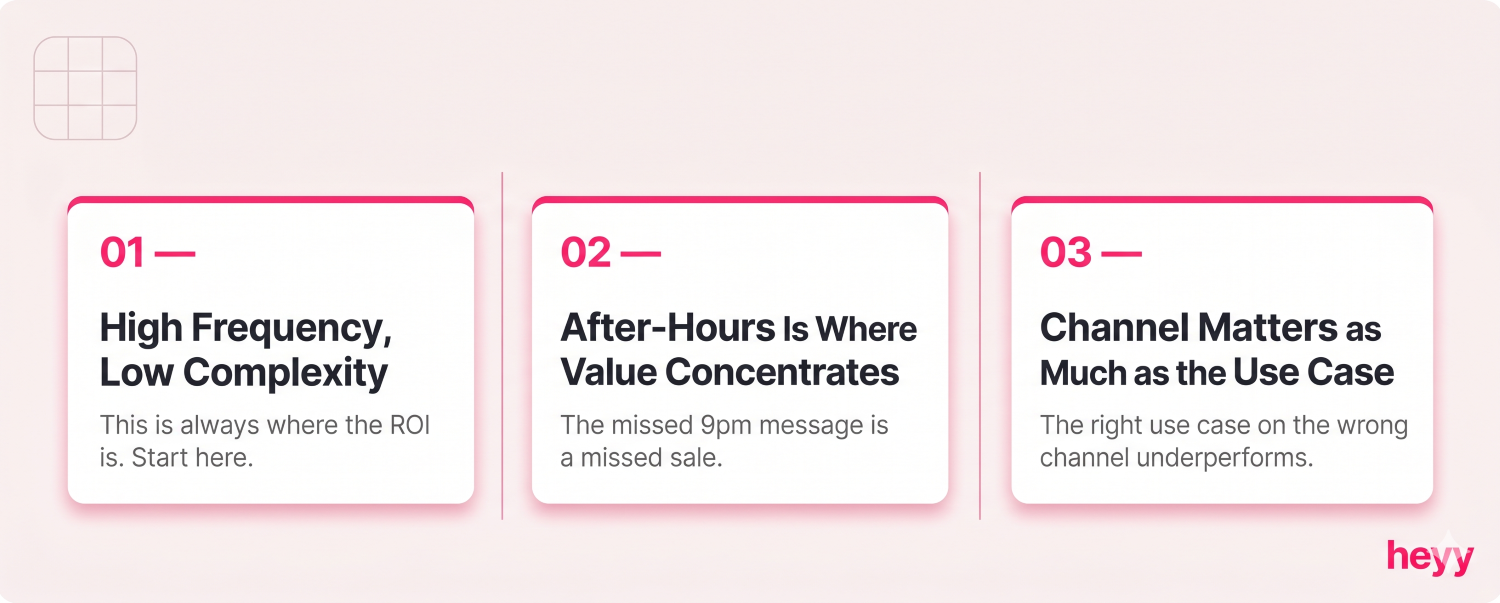
Seven industries, hundreds of use cases, and the same three principles appear in every deployment that delivers results.
High frequency plus low complexity equals the highest-return starting point. The use cases with the best ROI are always the ones where the same question or process appears dozens of times per day and requires no judgment to handle. Order status in e-commerce. Appointment booking in healthcare. Account balance in banking. These are where you start. Not because they are the most impressive, but because they produce the most measurable returns fastest.
After-hours is where the value is concentrated. Across every industry, a disproportionate share of high-intent customer actions happens outside business hours. The customer who wants to book a viewing at 9pm. The patient who remembers they need an appointment at 11pm. The SaaS trial user who hits a problem on Saturday morning. A chatbot that handles these moments captures demand that would otherwise be lost.
Channel matters as much as the use case itself. Deploying the right chatbot use case on the wrong channel produces mediocre results. Automating your support channels across WhatsApp and Instagram for consumer-facing businesses is the channel decision that most competitors have not yet made. WhatsApp has a 98% message open rate. Email has 20%. The same use case deployed on WhatsApp produces dramatically better engagement than the same use case deployed via email.
Where Chatbots Do Not Work
Most chatbot content skips this section. It should not.
Complex emotional conversations. A customer who has been failed multiple times and is considering cancelling needs a human who can own the relationship recovery. A chatbot escalation message, however well-worded, is insufficient for this situation.
High-stakes clinical or legal decisions. No chatbot should attempt to advise on whether a symptom requires emergency treatment or whether a legal clause is enforceable. The risk of a wrong answer is severe. The escalation to a human is non-negotiable.
Negotiations. Contract discussions, pricing disputes, and bespoke deal structures require human judgment and relationship management. A chatbot that attempts to negotiate creates liability and frustration simultaneously.
Early-stage brand building in new markets. A business that is not yet known in a market needs to build human relationships before it can automate them. Deploying a chatbot before the brand has sufficient recognition and trust can feel cold and transactional in markets where personal relationships drive purchase decisions.
The principle: deploy chatbots for the predictable and the repeatable. Protect human attention for the complex and the consequential. The businesses getting the most from AI customer service are the ones who have made this distinction clearly and configured their systems accordingly.
Choosing Your First Chatbot Use Case
The framework for selecting where to start is the same regardless of industry. Pick the use case that meets all three of these criteria simultaneously.
It is high frequency. It happens more than 20 times per week in your current operation.
It is low judgment. The answer is consistent regardless of who is asking and requires no contextual decision-making.
It has a measurable dollar value attached. A no-show reduction, a recovered cart, a captured after-hours lead. If you cannot put a number on what success looks like before you start, you cannot measure whether it worked.
For most businesses, the first use case is either appointment booking or FAQ handling. Both meet all three criteria. Both produce results within 30 days and are deployable without PMS integration or technical complexity. They also both create the operational confidence to expand into more sophisticated use cases once the foundation is working.
See how chatbot marketing frameworks extend from customer service into revenue generation once the foundational use cases are running reliably, and for businesses that span across retail, hospitality, healthcare, real estate, or any service industry where customer conversations happen on WhatsApp and Instagram, Heyy is built for exactly these use cases.
One inbox. Every channel. AI trained on your specific business handling the high-frequency, high-value interactions automatically. Start free and deploy your first chatbot use case before the end of the week.
FAQs
What are the most common chatbot use cases across all industries?
The three that appear in every industry are: appointment scheduling or booking management, FAQ handling and information retrieval, and lead qualification. These three share the characteristics that make a chatbot use case worth implementing: high frequency, low judgment requirement, and a measurable business outcome. Every industry-specific use case in this guide is a variation or extension of one of these three foundations.
What are the best ecommerce chatbot use cases specifically?
The five highest-impact ecommerce chatbot use cases are cart abandonment recovery, order status and returns handling, product recommendation and discovery, post-purchase upselling, and proactive engagement of high-intent website visitors. Of these, cart abandonment recovery and order status handling typically produce the fastest, most measurable ROI because the dollar value of each recovered interaction is immediately trackable.
How does conversational AI in healthcare differ from other industries?
Conversational AI in healthcare operates within stricter constraints than most other industries. It handles administrative workflows: appointment scheduling, intake collection, prescription refill requests, insurance verification, and post-visit follow-up. It does not attempt to provide clinical advice or diagnose conditions. HIPAA compliance is mandatory for any US-based deployment handling patient data. Within those constraints, the use cases are high-volume and high-value: reducing no-shows, cutting administrative burden, and improving patient access to care.
Which industry has the highest ROI from chatbot deployment?
The highest ROI tends to occur in industries with high inquiry volume, high transaction values, and clear conversion metrics. Real estate sees the highest lead conversion improvement (3.2x). Hospitality sees the clearest revenue uplift from direct booking recovery. Healthcare sees the most measurable cost savings from no-show reduction and admin time recovery. The "highest ROI" question is more usefully answered by use case than by industry: the highest ROI use case in any industry is the one that automates your highest-frequency, highest-value interaction.
Can a chatbot handle multiple use cases for my business?
Yes, but not all at once from day one. The businesses that get the best long-term results start with one well-configured use case, optimize it until it performs consistently, and then expand scope. A chatbot that handles appointment booking and order status simultaneously is twice as complex to configure and test. A chatbot that handles appointment booking excellently is twice as likely to be adopted by customers and trusted by your team.
What channels should I deploy chatbot use cases on?
The answer depends entirely on where your customers already are. For consumer-facing businesses, WhatsApp and Instagram DMs generate more first-contact volume than website chat in most markets outside North America. For B2B businesses, website chat remains primary. The channel that delivers the highest ROI is the one your customers use to reach you today, not the one you wish they used.
More blog posts to read

Ready to Automate Support
Across Every Channel?
.svg)
.avif)