.svg)
12 Ways to Use ChatGPT for Marketing in 2026

I’ll tell you a simple truth, every marketing team in 2026 is using ChatGPT. The ones using it well are producing work that sounds like them, moves fast, and converts. The ones using it badly are publishing content that reads like a committee wrote it after three rounds of watered-down editing.
The difference is not which tool they are using. It is how they are using it.
85% of marketers now use AI for content creation, up from 61% in 2023, according to Averi.ai's 2026 marketer benchmark data. Companies report 25 to 45% productivity improvements using ChatGPT in marketing workflows, per Marketing LTB's 2026 ChatGPT statistics. The productivity gain is real. What is also real is that AI-only content has 18 to 35% lower ranking longevity than human-edited AI content, per the same dataset. The formula is not "ChatGPT replaces the marketer." It is "ChatGPT does the heavy lifting while the marketer does the thinking."
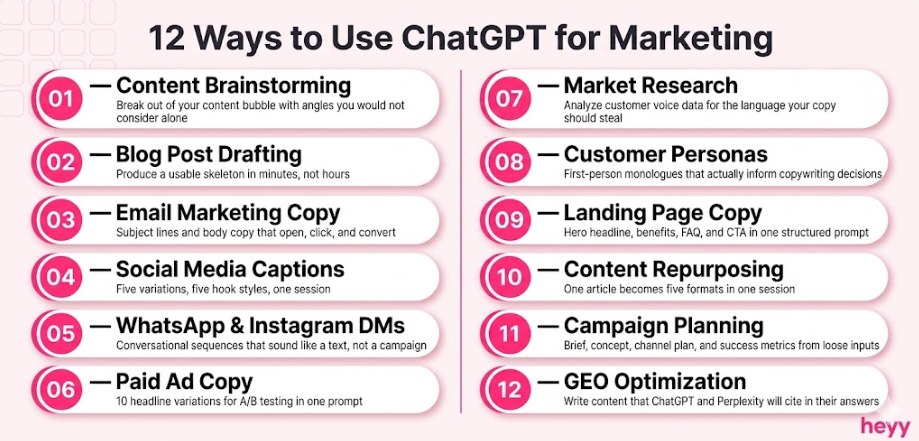
This guide covers 12 specific, actionable ways to use ChatGPT for marketing in 2026. Each one includes an actual prompt you can use today. Each one includes the edit that makes the output sound like you instead of a language model.
Before Every Prompt: The One Rule That Changes Everything
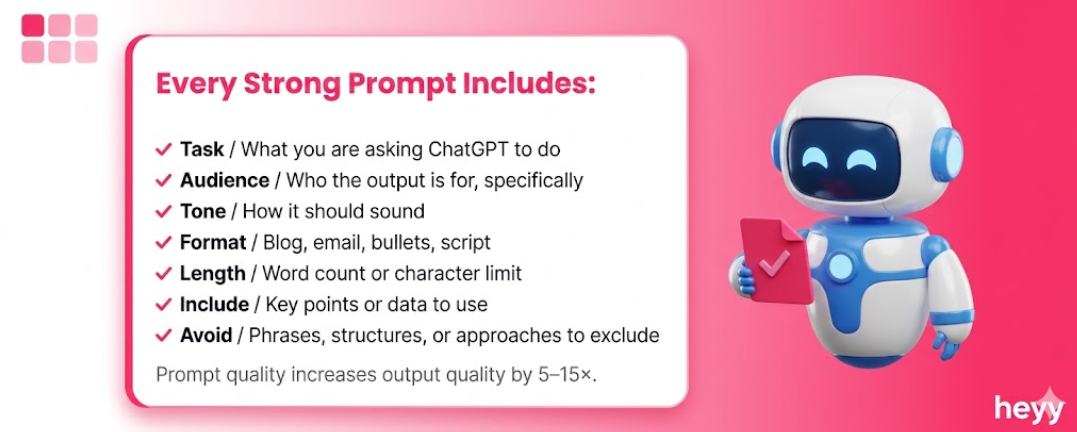
The single biggest mistake in marketing with ChatGPT is vague prompting. "Write a blog post about email marketing" produces generic output that no specific audience cares about. Prompt quality increases output quality by 5 to 15 times, per Marketing LTB's benchmark data.
Every prompt should include: the task, the target audience, the tone, the format, the length, the key points to cover, and what to avoid. Set this context at the start of every session and every output will be dramatically better than the one you would have gotten from a vague ask.
1. Content Brainstorming and Ideation
The use: Breaking out of your content bubble. ChatGPT generates angles and formats you would not have considered because it processes patterns across a much wider dataset than any single marketer's experience.
The prompt:
"I run a [type of business] targeting [specific audience]. Generate 10 blog post ideas about [topic] that go beyond the obvious. Each idea should have a specific angle that my audience hasn't seen covered in the typical [industry] content. Avoid generic list posts. Include the intended emotional response for each idea."
The edit: Review the list and kill anything that sounds like it was written for anyone. Keep the ideas that make you think "I genuinely want to write this" or "I've never seen this framed this way." The ideas that survive your filter are the ideas that will survive a reader's filter.
2. Blog Post Drafting and SEO Optimization
The use: ChatGPT drafts efficiently. The draft is the expensive part of blog production in terms of time. ChatGPT produces a usable skeleton in minutes that would take a human writer an hour.
The prompt:
"Write a 1,500-word blog post titled '[your title]' targeting [audience] with the primary keyword '[keyword]'. Structure it with a problem-led introduction (no statistics in the first sentence), three to five H2 sections with H3 subpoints, and a conclusion that ends with a specific call to action. Tone: [describe your brand voice — direct, casual, authoritative]. Do not use filler phrases like 'In today's fast-paced world' or 'It's no secret that.' Include transition sentences between sections."
The edit: The first paragraph ChatGPT writes is almost always too generic. An AI humanizer can help refine that first draft so it sounds more natural and closer to your brand voice before the final manual edit. Rewrite the opening yourself. Replace every "you might" with "you" and every "it's important to" with the actual thing that is important. Every sentence you rewrite is a sentence that sounds like your brand.
3. Email Marketing Copy That Actually Gets Opened
The use: ChatGPT prompts for email marketing cover the full lifecycle: subject line testing, body copy, nurture sequences, re-engagement campaigns, and promotional sends.
The prompt for subject lines:
"Write 10 subject lines for an email promoting [offer/content] to [audience]. Mix five curiosity-gap approaches, three benefit-first approaches, and two urgency approaches. Keep all under 50 characters. Do not use emojis. Avoid words that trigger spam filters like 'free,' 'urgent,' or 'click here.' Rank them from most to least likely to be opened by someone who receives 80 emails per day."
The prompt for email body copy:
"Write a 200-word email for [audience] about [specific offer or content]. Open with a one-sentence observation about a problem they face — not a question. The body delivers the value without preamble. The call to action is one specific thing, not multiple options. Tone: [your brand voice]. Do not use 'I hope this email finds you well' or any other opener that delays the value."
Using ChatGPT prompts for email marketing at this level of specificity, separate prompts for subject lines, body, and CTA, consistently outperforms single-prompt email generation.
The edit for email: Read the draft aloud. Every word that you would skip as a reader is a word that can be cut. ChatGPT generates email copy that is often 30% longer than it needs to be. Cut it by a third and your click rate will improve.
4. Social Media Content and Captions
The use: ChatGPT generates captions, hooks, thread structures, and caption variations faster than any individual writer can produce them. The volume it generates makes A/B testing viable at a scale most small teams could not otherwise manage.
The prompt:
"Write five Instagram captions for a post about [topic] targeting [audience]. Each caption should: start with a hook that is a single short sentence (not a question), deliver the core value or insight in the second and third sentences, and end with a call to action that is specific to [your goal: follows, link click, comment]. Keep each under 150 words. Vary the hook style: data, observation, contrarian take, story opener, and direct statement."
The edit: The first caption ChatGPT writes will usually be the most generic. Use it as a template to understand the structure, then rewrite the hook and the call to action in your brand's specific language. The structure is ChatGPT's. The voice is yours.
5. WhatsApp and Instagram DM Sequences
The use: This is the ChatGPT for marketing use case that most guides skip. WhatsApp and Instagram DM sequences require a conversational register that is completely different from email or social media copy. ChatGPT, prompted correctly, writes in that register effectively.
The prompt:
"Write a 3-message WhatsApp sequence for [business type] targeting [customer type]. Message 1: Sent immediately after a lead opts in. Acknowledge what they signed up for, deliver the promised value, and set an expectation for the next message. Keep under 60 words. Message 2: Sent 24 hours later. One specific tip or piece of value related to [topic]. No preamble. Keep under 80 words. Message 3: Sent 72 hours later. Present one specific next step with a clear reason to take it now. Keep under 70 words. Tone: [describe tone]. No formal greetings. No sign-offs. Write like a text from a knowledgeable friend."
This use case connects directly to the click-to-chat ad funnels that turn ad clicks into WhatsApp conversations, where the first automated message that arrives needs to sound like a person, not a campaign.
The edit: Test the sequence by sending it to yourself. If any message makes you feel like you are being marketed to rather than helped, rewrite that sentence.
6. Paid Ad Copy
The use: ChatGPT generates ad headlines and body copy variations at a volume that makes proper testing possible. The difference between the control and the winning variation is often a single word change that ChatGPT will produce across 20 variations where a human writer would produce three.
The prompt:
"Write 10 Facebook/Instagram ad headlines for [product/service] targeting [specific audience segment]. Each headline should be under 40 characters. Vary the approaches: pain point, benefit, social proof, curiosity, urgency, specificity. For each headline, write one supporting ad description (under 125 characters) that directly continues the promise or question from the headline. Do not use exclamation marks. Do not use the word 'amazing.'"
The edit: Run all 10 as variations in your campaign manager. The one that wins will tell you more about your audience than six months of strategy conversations.
7. Market Research and Competitor Analysis
The use: ChatGPT analyzes patterns in text-based data faster than any human researcher. For market research on publicly available information, it surfaces insights you would not have connected manually.
The prompt:
"I'm going to paste [customer reviews / competitor website copy / industry report excerpts] below. Analyze this content and identify: (1) The top three recurring customer pain points, (2) The language customers use to describe their problems (exact phrases), (3) The benefits they value most, (4) What they wish was different, (5) The emotional language they use when satisfied versus when frustrated. Do not rephrase their words — show me the actual language they use."
The important caveat: ChatGPT is not a reliable source for real-time data, current pricing, or live competitor information. Use search-grounded tools like Gemini or Perplexity for factual research, per Hashmeta's 2026 ChatGPT marketing guide. Use ChatGPT for analysis of data you paste in, not for data gathering.
8. Customer Persona Development
The use: Persona documents that sit in a folder and nobody reads. ChatGPT can turn customer data into a persona that actually informs copy because it writes it as a person, not a template.
The prompt:
"Based on the following customer information I'll provide: [paste your customer interview notes, survey responses, or support ticket categories]. Write a customer persona that is: A named individual (not a segment label), described in first person, written as if they are speaking, covering: their daily frustration related to [your product category], what they have tried before and why it failed, what success looks like to them specifically, the words they would use to describe the perfect solution, and what would make them choose one brand over another. Do not use bullet points. Write it as a monologue."
The edit: Replace any sentence that feels like a generic persona ("They value quality and are busy professionals") with something specific enough that only your customer would say it.
9. Landing Page and Conversion Copy
The use: ChatGPT writes landing page frameworks faster than briefing a copywriter. The output is never final, but it establishes the hierarchy, headlines, and argument structure that would otherwise require three rounds of revision.
The prompt:
"Write a landing page for [product/service] targeting [specific audience]. Structure: Hero headline (one benefit, under 10 words, no pun, no cleverness), Hero subheadline (what it is and who it is for, one sentence), Three bullet points (each: one specific benefit, not a feature — name what the customer gets or stops experiencing), Social proof section (format: [number] of [customer type] use [product name] to [achieve outcome]), FAQ section (5 questions that address the top objections of someone who is interested but has not converted yet), CTA button copy (not 'Submit' or 'Get Started' — write what they are actually getting)."
10. Content Repurposing Across Formats
The use: A single piece of content should not live in one format. ChatGPT repurposes faster than any human team. The shift in 2026 is from using ChatGPT for one-off tasks to using it for multi-step workflows, per Averi.ai, and repurposing is the clearest example of a workflow that ChatGPT makes viable at scale.
The prompt:
"I'm going to paste a blog post below. Repurpose it into: (1) A 5-tweet thread with each tweet as a standalone insight, (2) A LinkedIn post under 200 words that leads with the most surprising data point, (3) Three Instagram caption options under 150 words each, each with a different hook style, (4) A 3-email nurture sequence where each email covers one key section of the article, (5) A 60-second video script for a talking-head video where the presenter delivers the main insight without reading from a script. [Paste article here.]"
11. Campaign Planning and Strategy
The use: ChatGPT does not replace strategic thinking. It makes strategic thinking faster by generating scenarios, frameworks, and structured plans from loose inputs that would otherwise take hours to organize.
The prompt:
"I'm planning a marketing campaign for [product/service]. Target audience: [describe]. Goal: [specific KPI with a number]. Timeline: [weeks or months]. Budget range: [approximate]. Existing channels: [list]. Generate a campaign strategy that includes: (1) Campaign concept in one sentence, (2) Primary message and what we want the audience to feel, think, and do, (3) Channel-by-channel breakdown with specific content types per channel, (4) Content calendar structure for the timeline, (5) Three potential creative angles, (6) How to measure success for this specific goal. Flag any assumptions you are making."
The edit: ChatGPT's strategic plans are good structures with sometimes generic content. The concept it generates in point 1 is almost always too safe. Push it: "That concept is obvious. Give me a version that takes a stronger point of view or makes a more specific claim."
12. GEO Optimization — Writing Content That AI Tools Cite
The use: The most important new marketing channel in 2026 is AI-generated search results — ChatGPT, Perplexity, Claude, and Google AI Overviews. These tools pull content that is structured for extractability. ChatGPT can help you write content that these tools will cite.
The prompt:
"Audit this content for GEO optimization — its likelihood of being cited by AI search tools. Analyze: (1) Does it include a direct answer to the primary question in the first two sentences? (2) Are there explicit definitions stated as 'X is Y' sentences? (3) Does it have a numbered list or structured reference section that AI tools can easily extract? (4) Are all statistics attributed to a named source? (5) Does each section answer a specific question that someone would type into ChatGPT or Perplexity? Provide specific rewrites for any section that fails these criteria. [Paste content here.]"
This use case is what transforms ChatGPT prompts for marketing from a content production tool into a distribution strategy tool. The content that gets cited in AI responses reaches readers who never find your website. That is a new form of organic traffic that most marketing teams have not yet optimized for.
The Three ChatGPT Marketing Mistakes That Undermine Everything
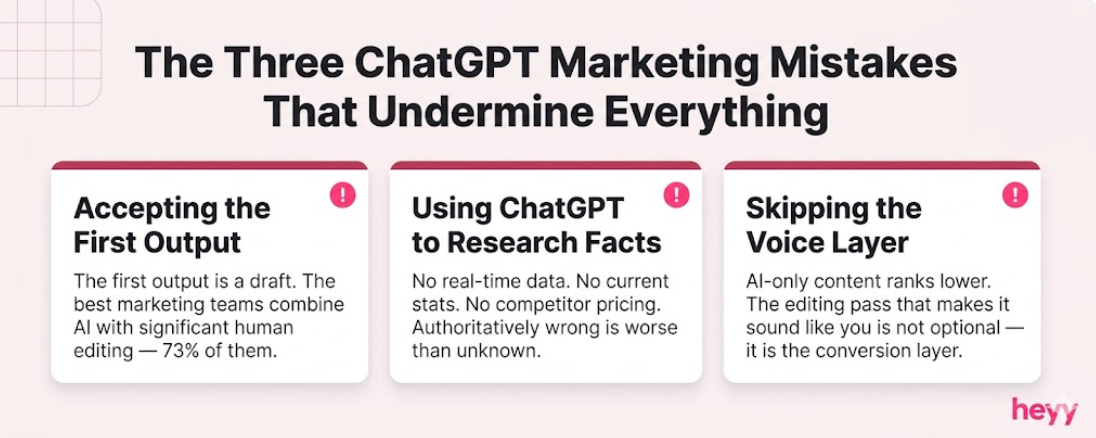
Accepting the first output: 73% of the strongest marketing teams using ChatGPT combine AI with significant human editing, per Averi.ai's 2026 benchmark. The first output is a draft. Treat it as one.
Using ChatGPT for factual research: ChatGPT does not have real-time data. Using it to find current statistics, competitor pricing, or recent news produces content that is authoritatively wrong. Use it to write and analyze. Use search-grounded tools to research.
Skipping the voice layer: Every piece of ChatGPT output needs one pass where you ask: "Would I say it this way?" Every word that fails that test should be replaced. AI-only content ranks lower and converts less consistently than content with meaningful human editing applied to it. The voice layer is not optional. It is the layer that makes the content yours.
The marketing work that takes a team a full day: a campaign brief, five email variations, ten social captions, a landing page first draft, and a repurposed article, can be in draft form by end of morning with the workflows above. The afternoon is for the part that ChatGPT cannot do: making every line sound like the brand, connecting the message to what the customer actually cares about, and deciding which direction is worth pursuing. For customer-facing conversations where those same principles apply at scale, Heyy handles the channel layer — WhatsApp, Instagram, Facebook Messenger — with AI trained on your brand voice. Start free and see what marketing-quality conversation looks like in your first week
FAQs
What is the most effective way to use ChatGPT for marketing?
The most effective way to use ChatGPT for marketing is as a drafting and iteration tool, not a final content generator. Give it specific context (audience, tone, format, length, what to avoid), generate multiple variations, and apply your brand voice to the output before publication. ChatGPT for marketing works best when it handles high-volume production tasks (drafts, variations, repurposing) and a human handles strategic decisions and voice refinement. The chatbot funnel guide covers how this production model extends into automated customer conversations.
What are the best ChatGPT prompts for marketing?
The best ChatGPT prompts for marketing are the ones that include: the specific task, a named audience with enough detail to differentiate them, the tone and format required, length constraints, what to include and what to avoid, and how the output will be used. Vague prompts produce vague output. The prompts included in each of the 12 use cases above are structured to produce immediately useful outputs. ChatGPT prompts for marketing that consistently outperform generic prompts include customer voice data (pasted customer reviews or interview quotes) as context.
How do I use ChatGPT for email marketing specifically?
ChatGPT prompts for email marketing work best when you separate the components: subject lines, preview text, opening sentence, body copy, and call to action. Prompt for each separately rather than asking for a complete email in one pass. Subject lines improve when you request specific approaches (curiosity-gap, benefit-first, urgency) and specify character limits. Body copy improves when you instruct ChatGPT to eliminate filler openers and keep to a specific word count. The AI customer service guide covers how AI communication principles that apply to email extend to chat and messaging channels.
Can ChatGPT replace my marketing team?
No. ChatGPT dramatically accelerates the production work of a marketing team but cannot replace strategic judgment, brand expertise, audience relationship knowledge, or the human editing that makes AI-generated content convert. 1 in 3 marketers uses ChatGPT for content creation, per Marketing LTB. The teams getting the most value are using it to remove the production bottleneck from high-quality thinking, not to replace the thinking itself. The AI chatbot vs ChatGPT comparison covers how these distinctions play out in customer-facing contexts specifically.
How do I stop ChatGPT marketing output from sounding robotic?
Three interventions produce the most improvement. First: include your brand voice description in every prompt (two to three sentences describing how your brand sounds and what phrases it avoids). Second: do one editing pass where you read the output aloud and replace every phrase you would not say naturally. Third: add a constraint to every prompt: "Do not use filler phrases like 'In today's competitive landscape,' 'It's important to note,' or 'In conclusion.' Begin every section with a direct statement, not a transition." These three changes make the output measurably more on-brand before any human editing is applied.
More blog posts to read


Ready to Automate Support
Across Every Channel?
.svg)
.avif)