.svg)
What Is LLM Fine-Tuning and Why Does It Make Your Business Chatbot Smarter?

Let's say you set up a chatbot. You upload your product catalog, sync your FAQ page, and add your returns policy before hitting publish. A customer drops by and asks about your most popular product, and the bot replies with something that sounds okay on the surface, but isn't quite right. It isn't completely wrong, just slightly off. The phrasing feels generic, and the recommendation misses that exact, specific detail that would have closed the sale.
The thing is, your chatbot has direct access to your information. The real problem is it hasn't actually internalized it. It is just pulling text and rephrasing things on the fly instead of reasoning with a genuine familiarity about how your business operates.
That gap is exactly why companies are shifting their approach. In fact,the LLM market is projected to reach USD 36.1 billion by 2030 , growing at a 33.2% CAGR, according to MarketsandMarkets. Every business deploying AI chatbots is making decisions, often without realizing it, about which techniques they are using to make those chatbots intelligent. Fine-tuning is one of those techniques, and it is widely misunderstood.
What Is LLM Fine-Tuning?
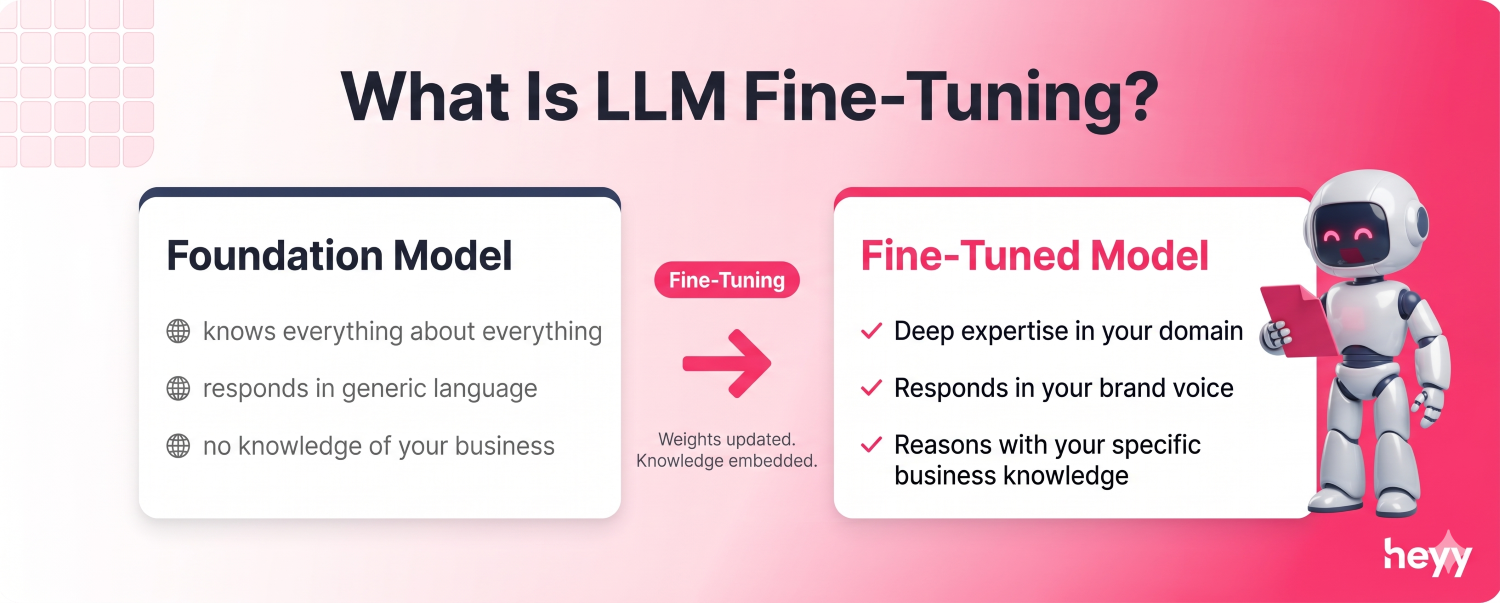
What is LLM fine-tuning? It is the process of taking a pre-trained large language model and continuing its training on a smaller, domain-specific dataset so that the model develops expertise in that particular domain.
Every modern AI chatbot starts life as a foundation model: a large language model trained on vast amounts of text from the internet, books, and other sources. This foundation model understands language at a sophisticated level. It can write, reason, summarize, translate, and answer questions across almost any topic.
The problem is it knows everything about everything at a surface level. Your business chatbot does not need to know everything about everything. It needs to know your products deeply, understand your customer base specifically, respond in your brand voice consistently, and handle your most common scenarios with accuracy and confidence.
Fine-tuning takes the foundation model's broad language capability and sharpens it for your specific context through additional training. The model's weights are updated. Not reset. Updated. It does not forget what it learned during pre-training. It builds on top of it. The result is a model that retains general language intelligence while developing genuine expertise in your domain.
According to IBM's research on fine-tuning, fine-tuning is the process of adapting a pre-trained model for specific tasks through further training on a smaller dataset, and it is one of the most effective ways to align AI behavior with domain-specific requirements.
How Fine-Tuning Actually Works (Without the Jargon)
Think of a foundation model as a highly educated generalist. They can discuss any topic intelligently. But if you need them to advise on your specific product line, apply your exact return policy, or speak in your brand's specific voice, you need to spend time with them. You teach them your business.
Fine-tuning is that teaching process, run at a computational level.
During fine-tuning, the model is exposed to a curated dataset of examples specific to your use case. These examples might include: thousands of high-quality customer service exchanges from your business, your complete product documentation with questions and expert answers, examples of on-brand responses that demonstrate the tone and style you want, and examples of what the model should say and should not say in specific situations.
The model processes these examples and adjusts its internal parameters: the numerical weights that determine how it interprets and generates text. After fine-tuning, when a customer asks a question, the model's response is shaped by everything in that training dataset, not just what it retrieves in the moment.
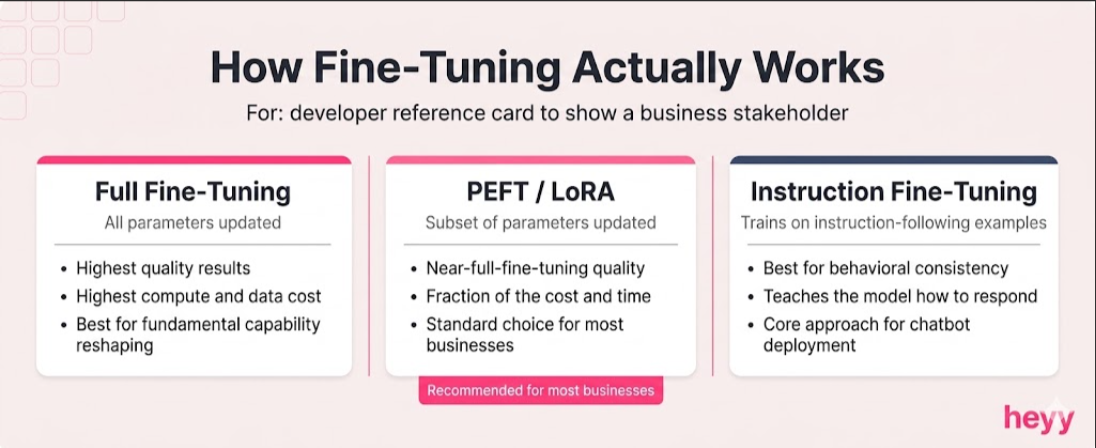
There are different approaches to fine-tuning:
Full fine-tuning updates all the model's parameters. It produces the highest quality results but requires the most computational resources and the most data.
Parameter-Efficient Fine-Tuning (PEFT) and specifically a technique called LoRA (Low-Rank Adaptation) update only a small subset of the model's parameters. It produces results close to full fine-tuning quality at a fraction of the cost and time. This is the approach most businesses use when they need fine-tuning without enterprise-scale compute budgets.
Instruction fine-tuning trains the model specifically on instruction-following examples: how to respond when asked to do specific things. This is particularly relevant for chatbots, where the model needs to reliably follow the rules of its operational context.
What Fine-Tuning Actually Makes Better in Your Chatbot
Not all chatbot problems require fine-tuning. The problems it specifically and reliably addresses:
Domain-specific accuracy. A fine-tuned model does not just retrieve information about your products. It reasons with it. It understands the relationships between your product variants, the implications of your policies, and the nuances of your customer base. Fine-tuned models show 30 to 40% improvements in domain-specific task accuracy compared to equivalent base models using retrieval alone, according to IBM's fine-tuning benchmarks.
Brand voice consistency. A base model writes in a generic, neutral voice. A fine-tuned model writes in your voice, applying the register, vocabulary, and personality that your brand has established. This is not achievable through system prompt instructions alone at the depth that fine-tuning produces.
Behavioral reliability. A base model given instructions about how to behave follows them reasonably well most of the time. A fine-tuned model has those behaviors embedded in its weights. The difference shows in edge cases: the unusual question, the ambiguous request, the conversation that goes off-script. Fine-tuned models handle these more consistently because the behavior is trained rather than instructed.
Reduced hallucination on domain content. A base model hallucinating about your specific product features or policies is not because the model is generally inaccurate. It is because it does not have the depth of knowledge about your specific domain to reason accurately under uncertainty. Fine-tuning on your accurate documentation reduces this significantly.
Handling proprietary terminology. Your business uses terms, acronyms, product names, and processes that do not exist in the foundation model's training data. Fine-tuning introduces these to the model's understanding so it uses them correctly and interprets them correctly when customers use them.
The Benefits of Fine-Tuning LLM for Chatbot Deployment
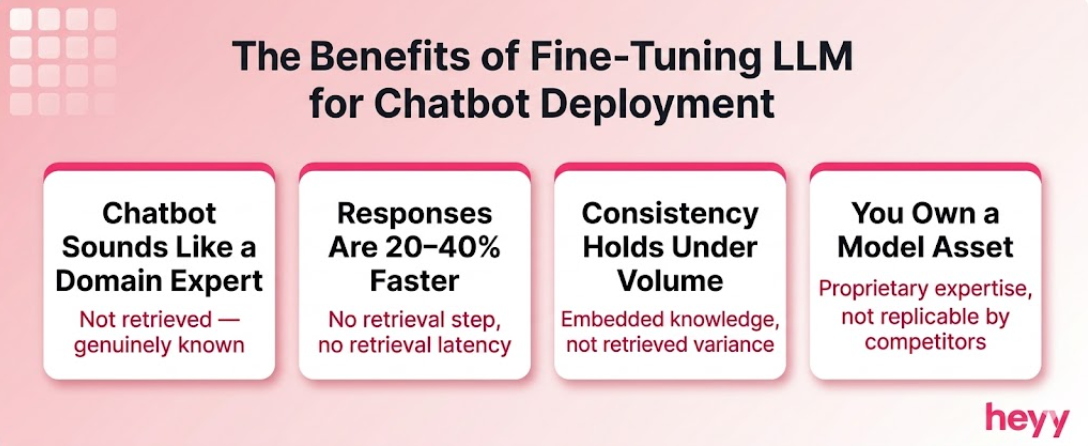
Your Chatbot Behaves Like a Domain Expert
The qualitative difference between a retrieval-based chatbot and a fine-tuned chatbot is most visible in the texture of conversations. A retrieval-based chatbot often sounds like someone who just looked something up. A fine-tuned chatbot sounds like someone who has worked in your business for two years.
Response Latency Decreases
A chatbot using RAG retrieval fetches documents, passes them as context to the model, and generates a response from that combined input. Fine-tuned models carry the knowledge in their weights and generate responses directly without the retrieval step. Fine-tuned models typically respond 20 to 40% faster than RAG-dependent approaches for standard queries, per Aisera's comparison data, because there is no retrieval latency.
Consistency Holds Under Volume
At scale, a retrieval-based system introduces variance: retrieval results change slightly based on phrasing, context, and document ranking. A fine-tuned model produces more consistent responses to semantically similar questions because the knowledge is embedded rather than retrieved.
You Own a Model Asset
A fine-tuned model is a proprietary business asset. Fine-tuning LLM for chatbot deployment creates something that cannot be replicated by a competitor simply using the same platform. Unlike a knowledge base that any platform can connect to, a fine-tuned model encodes your business's expertise in a form specific to your deployment.
LLM Fine-Tuning vs RAG: The Comparison That Actually Matters for Business
This is the decision most businesses face when building a sophisticated chatbot. LLM fine-tuning vs RAG are not competing philosophies. They are different tools with different appropriate use cases. Understanding both determines which one is right for your situation.
Retrieval-Augmented Generation (RAG) is the process of fetching relevant documents from a knowledge base and passing them to the model as context when generating a response. The model uses the retrieved information to answer accurately without being fine-tuned on that information.
LLM fine-tuning updates the model's weights based on training examples, encoding knowledge and behavior permanently rather than supplying it at query time.
Here is the practical distinction:
The practical verdict: For most business chatbots, RAG with well-structured knowledge bases handles the majority of use cases effectively. Fine-tuning becomes the right answer when the chatbot needs to develop deep domain expertise, maintain sophisticated brand voice, handle complex multi-step reasoning in your domain, or when retrieval quality is consistently insufficient for accuracy requirements.
The strongest deployments typically use both. RAG for current, factual, frequently-updated information. Fine-tuning for style, tone, behavioral consistency, and domain reasoning. This hybrid is what the best LLM models for customer service chatbots increasingly use in 2026.
The Honest Truth: Most Businesses Do Not Need Fine-Tuning to Start
Here is the content most fine-tuning articles leave out because it works against the interests of vendors selling fine-tuning services.
For the majority of business chatbot use cases — FAQ handling, appointment booking, order status, lead qualification, basic product recommendation — a well-configured RAG system with a high-quality knowledge base and a thoughtful system prompt performs as well as or better than a fine-tuned model for a fraction of the cost and implementation time.
Fine-tuning becomes worth the investment when:
- Your chatbot needs to handle genuinely complex domain reasoning that retrieval alone cannot support
- Brand voice consistency at depth matters more than the setup cost
- Your knowledge base is too large or complex for efficient retrieval
- You have identified specific failure modes in your RAG deployment that fine-tuning would address
- You are building a customer-facing AI product where the quality of the model itself is a competitive differentiator
If none of these apply, start with RAG and a well-engineered system prompt. The chatbot development frameworks guide covers how to build an effective knowledge base that maximizes RAG performance before you consider fine-tuning.
Skipping to fine-tuning because it sounds more sophisticated is one of the most common and expensive mistakes in chatbot development. Build the right foundation first. Fine-tune when you have identified the specific gaps that only fine-tuning can address.
How to Fine-Tune an LLM for a Chatbot: The Process
If you have reached the conclusion that fine-tuning is appropriate for your use case, here is the practical process.
Step 1: Define the Specific Capability You Are Training For
Fine-tuning is most effective when the goal is specific. "Make the chatbot better" is not a fine-tuning goal. "Train the model to consistently apply our four-step objection handling framework when a customer expresses price sensitivity" is a fine-tuning goal.
Define the capability. Map the scenarios where the base model or RAG deployment is currently failing. These failure scenarios are your training targets.
Step 2: Curate Your Training Dataset
The quality of a fine-tuned model is determined almost entirely by the quality of the training data. You need labeled examples: input-output pairs that demonstrate the correct behavior for every scenario you are training.
For a customer service chatbot, this might include 500 to 5,000 examples of real customer exchanges where the ideal response demonstrates the capability you are training. Each example should show the input (customer message plus context) and the ideal output (the response you want the model to produce).
Quality matters more than quantity. One hundred carefully curated, genuinely ideal examples produce better fine-tuning results than one thousand mediocre ones.
Step 3: Choose Your Fine-Tuning Approach
For most business applications, LoRA-based PEFT is the right choice. It requires significantly less compute and training data than full fine-tuning while producing strong results for style, tone, and domain-specific behavior.
Full fine-tuning is appropriate when you need to fundamentally reshape the model's capabilities rather than just align them.
Step 4: Train, Evaluate, and Iterate
Fine-tuning is not a one-pass process. Train the model, evaluate its performance on a held-out test set of examples it was not trained on, identify where it still fails, and iterate. The evaluation step is where most of the investment of time and expertise goes.
Evaluation should cover both quality (does the response meet the standard?) and safety (does the model respect its constraints?). Use your real failure scenarios from Step 1 as your primary test cases.
Step 5: Deploy With Ongoing Monitoring
A fine-tuned model deployed without ongoing monitoring will drift in quality as your business, products, and customer base evolve. Schedule quarterly reviews of model performance. Track the conversations where the fine-tuned behavior is failing. Use those failures to plan the next fine-tuning iteration.
Fine-tuning LLM for chatbot is not a setup event. It is a capability development practice. See how AI chatbot vs ChatGPT comparisons frame the ongoing optimization argument for business-deployed AI.
When to Use Fine-Tuning, RAG, or Both: The Decision Framework

Use RAG when:
- Your information changes frequently (pricing, availability, policies)
- You need the chatbot live quickly without a training data collection phase
- Your knowledge base is well-structured and retrieval quality is high
- Budget and timeline do not support a full fine-tuning project
Use fine-tuning when:
- Brand voice consistency at depth is a business requirement
- Your chatbot needs to reason with complex domain-specific expertise
- Retrieval-based approaches are producing persistent accuracy failures
- You have sufficient high-quality training data (500+ labeled examples minimum)
- You are building a customer-facing product where AI quality is a differentiator
Use both when:
- You need deep domain expertise (fine-tuning) plus current, factual, frequently-updated information (RAG)
- Your chatbot handles both reasoning tasks that benefit from embedded knowledge and factual queries that benefit from live retrieval
- Quality requirements are high enough to justify the combined investment
In conclusion, if you want a business chatbot that uses your knowledge base intelligently without requiring you to manage a fine-tuning pipeline, Heyy handles the AI architecture for you. Your product catalog, policies, and brand voice train the AI. It runs across WhatsApp, Instagram, Facebook Messenger, and your website simultaneously. The knowledge layer is yours. The engineering infrastructure is handled. Start free and have your first AI conversation reflecting your business accurately today.
FAQs
What is LLM fine-tuning in simple terms?
LLM fine-tuning is the process of taking an AI language model that has been pre-trained on general internet data and continuing to train it on a smaller, specific dataset so it develops expertise in your domain. Think of it as the difference between a generalist and a specialist. A base model is educated about everything. A fine-tuned model is educated about your business specifically. The underlying language capability comes from the pre-training. The business expertise comes from the fine-tuning.
What is the difference between LLM fine-tuning vs RAG?
LLM fine-tuning updates the model's internal parameters permanently based on training examples. RAG retrieves relevant documents from a knowledge base and passes them to the model at query time. Fine-tuning embeds knowledge and behavior into the model. RAG supplies knowledge externally when needed. Fine-tuning is better for brand voice, complex reasoning, and behaviors you want permanently embedded. RAG is better for current information, large and frequently updated knowledge bases, and situations where you need fast deployment without a training data collection phase.
How much data do I need to fine-tune an LLM for a chatbot?
The answer depends on the fine-tuning approach and what you are training for. For LoRA-based PEFT, which is the standard approach for business applications, effective fine-tuning can be achieved with as few as 500 high-quality labeled examples. For full fine-tuning, several thousand to tens of thousands of examples are typically needed. Quality consistently matters more than quantity. Five hundred excellent examples will outperform five thousand mediocre ones in almost every fine-tuning scenario.
Can I fine-tune a chatbot without technical expertise?
Not easily, and this is the honest answer that most articles avoid. Full fine-tuning and even PEFT approaches require machine learning expertise, access to GPU compute resources, and engineering time for data preparation, training pipeline setup, and evaluation. If you do not have in-house ML capabilities, you are looking at either an AI development partner or a platform that abstracts the fine-tuning process. The no-code chatbot platforms that work for most businesses handle RAG-based knowledge training automatically. True fine-tuning is still primarily in the domain of technical teams.
Does fine-tuning prevent hallucinations?
It reduces them on domain-specific content, not eliminates them. Fine-tuning on your accurate documentation gives the model deeper, more reliable knowledge about your specific domain. When a customer asks about your products, a fine-tuned model has more grounded knowledge to draw from and is less likely to confabulate. But hallucination remains a characteristic of all large language models regardless of fine-tuning. Human review processes and system prompt guardrails remain necessary complements to fine-tuning in production customer-facing deployments.
How often should a fine-tuned chatbot model be retrained?
As often as the gap between your training data and your current business reality grows large enough to affect performance. For businesses with stable products and policies, quarterly evaluation with annual or semi-annual retraining is a reasonable baseline. For businesses with frequent product updates, pricing changes, or evolving customer needs, more frequent retraining cycles may be necessary. The trigger for retraining is always performance degradation: the model producing responses that are accurate to your training data but no longer accurate to your current business.
If you want a business chatbot that uses your knowledge base intelligently without requiring you to manage a fine-tuning pipeline, Heyy handles the AI architecture for you. Your product catalog, policies, and brand voice train the AI. It runs across WhatsApp, Instagram, Facebook Messenger, and your website simultaneously. The knowledge layer is yours. The engineering infrastructure is handled. Start free and have your first AI conversation reflecting your business accurately today.
More blog posts to read

Ready to Automate Support
Across Every Channel?
.svg)
.avif)