.svg)
Best AI Chatbots for Sales in 2026 (Tested & Ranked)

Here's something sales teams don't talk about enough: most "AI sales chatbots" are customer support tools with a sales label slapped on.
They answer questions. They collect email addresses. They hand it off to "someone on the sales team."
But they don't qualify. They don't understand buying intent. They don't push prospects toward decisions. They don't book meetings intelligently based on deal size and product fit.
Real sales chatbots in 2026 do three things support bots don't:
- Qualify leads using actual sales criteria (budget, authority, need, timeline)
- Route high-value prospects to senior reps instantly while chatbots handle tire-kickers
- Drive revenue actions (book demos, provide pricing, create deals in CRM, trigger sequences)
I spent the last month testing 10 sales chatbot platforms. Setting up bots, running test conversations, checking CRM sync, measuring qualification accuracy.
This guide covers the platforms that work for sales: lead qualification, demo booking, pipeline generation, and revenue attribution. With honest pros/cons, pricing , and the scenarios where each platform wins.
If you're evaluating sales chatbots to scale outbound, convert inbound, or reduce rep time on unqualified leads, this is your buying guide.
What Makes a Sales Chatbot Different From Support Chatbots?
Support Chatbots Are Reactive
Goal: Solve customer problems
Trigger: Customer has a question or issue
Conversation: "How can I help?" → Answer question → End conversation
Metrics: Resolution rate, CSAT, deflection rate
Sales Chatbots Are Proactive
Goal: Generate pipeline and revenue
Trigger: Prospect exhibits buying intent (visits pricing page, downloads resource, matches ICP)
Conversation: Qualify fit → Create urgency → Push toward decision → Book meeting or create opportunity
Metrics: Qualified leads generated, meetings booked, pipeline created, revenue influenced
Example comparison:
Support bot conversation:
Prospect: "How does your integration work?"Bot: "Our platform integrates via API. Here's documentation: [link]. Anything else?"Prospect: "Thanks"Conversation ends
Sales bot conversation:
Prospect visits integrations page (buying signal)Bot: "Looking to integrate with Salesforce?"Prospect: "Yes"Bot: "Great! Quick question, are you evaluating for yourself or a team?"Prospect: "For my sales team, about 15 reps"Bot: "Perfect. What's your timeline? Looking to implement this quarter?"Prospect: "Ideally next month"Bot: "Got it. With 15 reps and a fast timeline, let me get you with [Senior AE]. They can show you exactly how we integrate with Salesforce and get you a custom quote. Does Tuesday 2 PM or Wednesday 10 AM work?"Prospect: "Tuesday works"Bot:Books meeting in rep's calendar, creates opportunity in Salesforce with details: 15 seats, Salesforce integration need, 1-month timeline
Difference: Sales bot qualified (team size, timeline), created urgency, booked high-value meetings, and populated CRM, all automatically.
The 6 Things Sales Chatbots Must Do Well
1. Identify High-Intent Visitors
Sales chatbots track on-site behavior:
- Visiting pricing page (strong buying signal)
- Viewing case studies or ROI calculators (evaluating)
- Multiple sessions from same company (active research)
- Coming from paid search or G2 comparison (in-market)
Best platforms: Warmly, Qualified, Drift
2. Qualify Using Sales Frameworks (BANT/MEDDIC)
BANT Qualification:
- Budget: "What's your budget for this solution?"
- Authority: "Are you the decision-maker or part of the evaluation team?"
- Need: "What's driving you to look for a solution now?"
- Timeline: "When are you looking to implement?"
MEDDIC (Enterprise sales):
- Metrics: What results are you trying to achieve?
- Economic buyer: Who controls the budget?
- Decision criteria: What's most important in choosing a vendor?
- Decision process: Who else is involved?
- Identify pain: What's not working with the current solution?
- Champion: Who internally supports this purchase?
Bot asks these questions conversationally, scores responses, routes accordingly.
3. Route Intelligently Based on Fit
Example routing logic:
- Enterprise deal (100+ employees, $50k+ opportunity): Route to senior AE immediately, send Slack alert
- Mid-market (10-100 employees): Book demo with mid-market team
- SMB (< 10 employees): Provide self-serve resources, add to nurture sequence
- Unqualified (student, competitor, low budget): Politely exit or provide resources
Best platforms: Drift, Qualified, Salesforce Einstein
4. Book Meetings Without Friction
Bad: "Fill out this form and someone will call you" Good: Bot shows calendar, books meeting in 30 seconds
Meeting booking flow:
- Bot qualifies: company size, use case, timeline
- Bot: "Perfect! Let me get you on [Rep Name]'s calendar. Does Tuesday 2 PM or Thursday 10 AM work?"
- Prospect: "Tuesday"
- Bot: Books meeting, sends calendar invite, creates Salesforce opportunity
Best platforms: Drift, Chili Piper (not a chatbot but integrates), Qualified
5. Sync Everything to CRM in Real-Time
Every conversation detail should flow to Salesforce, HubSpot, or Pipedrive. Many revenue teams are now deploying GTM AI agents to automatically enrich CRM records, route leads, and trigger downstream workflows based on buying signals:
- Contact info
- Qualification responses (company size, timeline, pain points)
- Conversation transcript
- Pages visited
- Files downloaded
- Meeting details
Why this matters: Rep joins demo call already knowing everything. No "tell me about your business" redundancy.
Best platforms: Qualified (Salesforce-native), Drift, HubSpot
6. Measure Pipeline and Revenue Impact
Sales chatbots must prove ROI by tracking:
- Leads generated
- Meetings booked
- Opportunities created
- Pipeline value influenced
- Deals closed (revenue attributed to chatbot)
Example metrics dashboard:
- This month: 87 leads qualified by bot
- 34 meetings booked
- $284,000 pipeline created
- 6 deals closed (influenced by chatbot)
- $52,000 revenue attributed
Best platforms: Drift, Qualified, Intercom (with attribution setup)
Top 11 AI Sales Chatbots in 2026 (Tested & Ranked)
For a quick glance, here's a table with our top rated AI sales chatbots:
1. Drift (Owned by Salesloft)
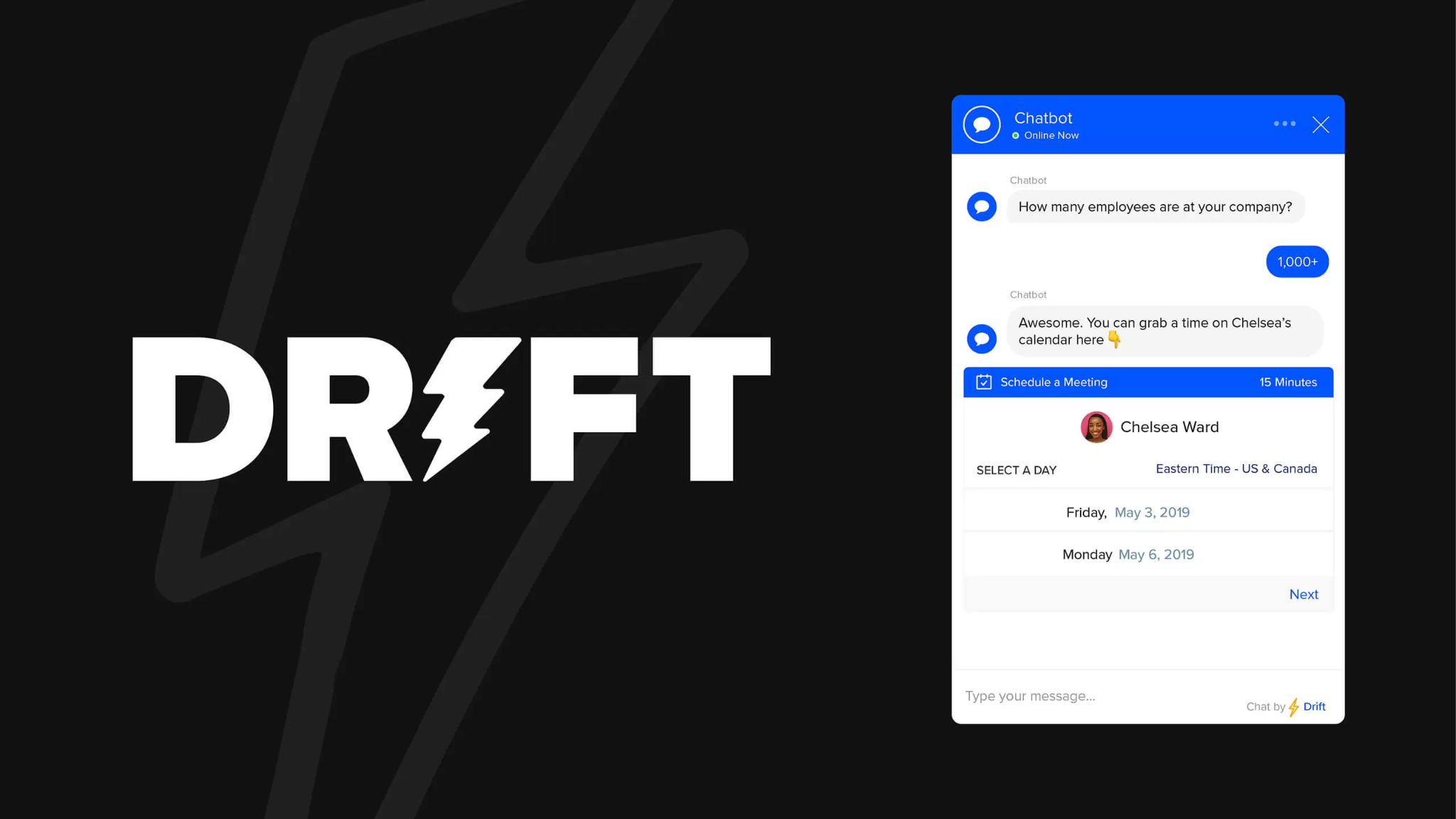
Best for: Enterprise B2B sales teams using ABM and multi-channel engagement
Key features:
- Real-time visitor identification (shows company visiting site)
- Playbook builder (conversation flows based on firmographics)
- Account-based routing (target accounts go to dedicated reps)
- Drift Video (send personalized video messages)
- Salesforce + HubSpot + Marketo native integrations
- Mobile app for reps to respond anywhere
Qualification intelligence:
- Identifies high-value accounts visiting site
- Routes based on company size, industry, pages viewed
- Integrates with 6sense, Demandbase for intent data
What we tested:
- Set up playbook: Enterprise visitors (500+ employees) → Route to VP of Sales with Slack alert
- SMB visitors → Chatbot qualifies, books meeting
- Competitor traffic → Provide comparison guide
Performance:
- Qualification accuracy: 85% (correctly identified decision-makers vs researchers)
- Meeting booking rate: 34% of qualified visitors
- False positive rate: 12% (students, job seekers getting through)
Pricing: Drift offers a limited free plan, with paid tiers starting around $2,500/year and scaling to $50,000+ annually depending on automation, analytics, and team support needs.
Pros: Best-in-class ABM features Excellent for multi-touch sales cycles Strong reporting and attribution. Reps can take over conversations from mobile
Cons: Expensive (mid-market and enterprise only). Steep learning curve. Overkill for transactional sales
Best for: B2B SaaS selling to enterprises with $50k+ deal sizes
2. Heyy.io
Best for: Social commerce and messaging-first sales (WhatsApp, Instagram, Facebook)
Key features:
- Unified inbox across WhatsApp, Instagram, Facebook, web chat
- AI chatbot trained on your product catalog and FAQs
- Lead qualification + routing
- Shopify/WooCommerce integration for order tracking
- Team collaboration tools
- Broadcast messaging for promotions
- Multi-language support
Why messaging-first matters:
- 73% of customers prefer messaging over phone or email (Meta, 2025)
- Instagram DMs and WhatsApp are now primary sales channels for D2C, local businesses, and international markets
- Heyy unifies these conversations so reps see complete customer history across channels
Sales use cases:
- E-commerce: Customer asks about product on Instagram → Bot answers questions, recommends products, sends payment link
- Local services: Prospect inquires on WhatsApp → Bot qualifies need, checks availability, books appointment
- B2C sales: Customer messages about bulk order → Bot captures details, routes to sales rep with full context
What we tested:
- Multi-channel lead capture (Instagram + WhatsApp + web)
- Product recommendation accuracy
- Appointment booking via chat
- Lead routing to sales team
Performance:
- Handled 78% of product questions without human intervention
- Average response time: 8 seconds (vs 4+ hours manually)
- Conversion rate on Instagram inquiries: 24% (up from 11% before automation)
- Successfully unified 3 channels into one team inbox
Pricing: $49-499/month (scales with conversation volume and team size)
Pros: Only platform that truly unifies social messaging + sales automation. Perfect for businesses selling via Instagram/WhatsApp. Affordable for small to mid-market businesses. Easy setup (live in under an hour). Team collaboration features included
Cons: Limited compared to specialized ABM platforms (Drift, Qualified). CRM integrations less deep than Salesforce-native options
Best for: E-commerce brands, D2C businesses, local service providers, social-first companies, international sales teams using WhatsApp
3. Qualified
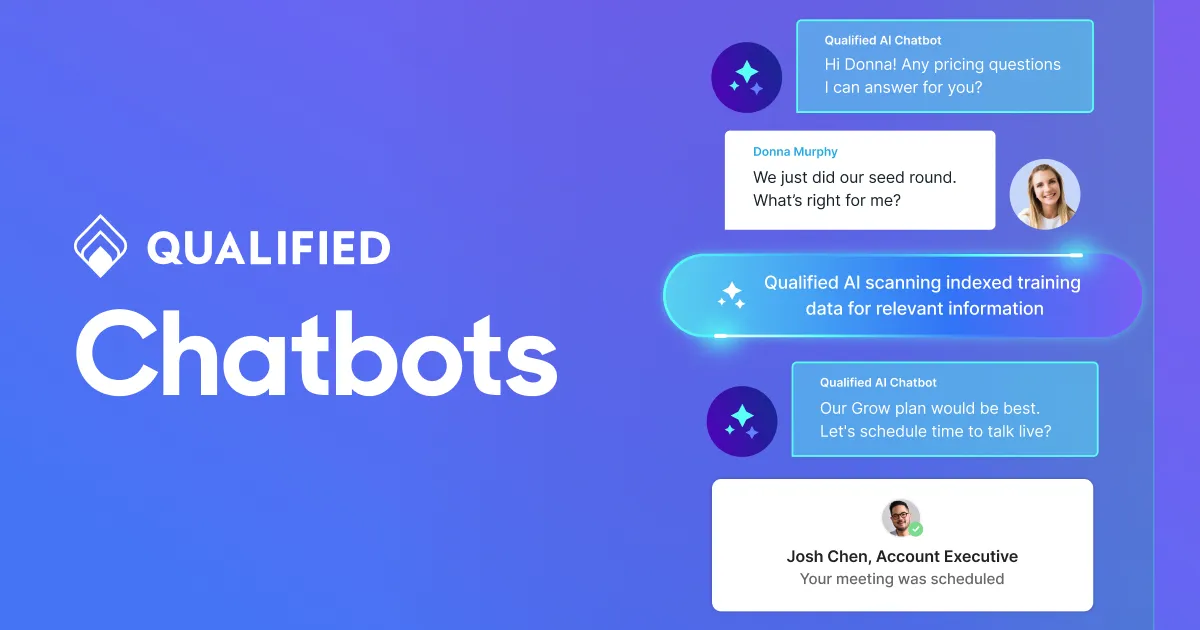
Best for: Salesforce-heavy organizations (lives inside Salesforce)
Key features:
- Runs natively in Salesforce (no data sync delays)
- Piper Copilot (AI SDR that qualifies and books meetings)
- Conversational marketing + sales + pipeline tools
- Inbound conversion optimization
- Outbound signal-based outreach
Why Salesforce-native matters:
- Chatbot reads/writes Salesforce data in real-time
- No integration lag
- Uses Salesforce logic (assignment rules, lead routing)
- All conversation history in Salesforce
What we tested:
- Qualified detects visitor from target account viewing pricing
- The bot engaged: "Exploring our Enterprise plan?"
- Qualifies: company size, current CRM, timeline
- Books meeting with Enterprise AE
- Creates Salesforce opportunity with all context
Performance:
- Meeting conversion: 29% of engaged visitors booked demos
- Salesforce sync: Instant (native)
- Rep satisfaction: 9/10 (loved having full context before calls)
Pricing: Custom (expect $2,000-5,000+/month depending on volume)
Pros: Best Salesforce integration in the market. No sync issues or data delays. Piper AI is genuinely smart. Built specifically for pipeline generation.
Cons: Only works well if you're all-in on Salesforce. Expensive. Not ideal for small teams
Best for: Salesforce-centric B2B orgs with dedicated sales ops
4. Intercom (with Fin AI Agent)
Best for: Product-led SaaS and companies wanting unified sales + support
Key features:
- Fin AI Agent (autonomous resolution for support + sales)
- In-app messaging (engage users inside your product)
- Product tours (guide trial users)
- Lead qualification + routing
- Unified inbox (sales, support, success all use same platform)
Sales workflow:
- Trial user struggling with feature (detected via product events)
- Bot: "Need help setting up integrations?"
- User: "Yes, trying to connect Salesforce"
- Bot: "I can help! Are you evaluating for yourself or a team?"
- User: "For my team, 25 users"
- Bot: "Perfect! Let me connect you with [CSM] who can help configure and discuss Enterprise features. Sound good?"
What we tested:
- Trial-to-paid conversion assistance
- Feature adoption guidance that leads to upsells
- Qualification of self-serve signups
Performance:
- Helped increase trial-to-paid conversion 18%
- Reduced time-to-value for new users
- Captured upgrade opportunities (users needing features not in current plan)
Pricing: $39/seat/month + $0.99 per AI-resolved conversation
Pros: Only platform that unifies sales + support + success. In-app messaging crucial for product-led growth. Fin AI is very capable. Great for freemium-to-paid funnels
Cons: Per-seat + per-conversation pricing adds up. Not purpose-built for traditional B2B sales. Complex setup for enterprises
Best for: PLG SaaS companies, product-first businesses
5. HubSpot Chatbot Builder

Best for: HubSpot CRM users and businesses wanting free-to-start option
Key features:
- Free chatbot included with HubSpot CRM (free tier)
- Lead qualification + routing
- Meeting scheduling (integrates with HubSpot meetings tool)
- Ticket creation for support escalations
- CRM auto-sync (contacts, deals, conversations)
Sales use case:
- Visitor downloads eBook (tracked in HubSpot)
- Bot: "Enjoyed the eBook on [topic]? Got questions?"
- Visitor: "Yes, wondering how this applies to [industry]"
- Bot: "We work with lots of [industry] companies. What's your role?"
- Visitor: "VP of Marketing"
- Bot: "Perfect! Want to see how [Company X in industry] used our platform? I can schedule a quick call with our team. Does Tuesday or Thursday work better?"
What we tested:
- Lead capture from high-intent content downloads
- Demo booking for mid-funnel prospects
- Qualification of free tool users
Performance:
- Meeting booking: 22% of engaged visitors
- CRM sync: Excellent (native HubSpot)
- Qualification depth: Moderate (not as advanced as Drift/Qualified)
Pricing: Free with HubSpot CRM; advanced features from $20/month
Pros: Best free option (legitimately useful at $0). Perfect for businesses already using HubSpot. No learning curve if you know HubSpot. Scales with you (free → paid as you grow)
Cons: AI capabilities limited on free tier. Not great outside HubSpot ecosystem
Best for: Small to mid-market B2B using or willing to adopt HubSpot CRM
6. Warmly
Best for: Signal-based outbound and intent-driven inbound (identifies website visitors)
Key features:
- De-anonymizes website traffic (shows which companies visiting)
- Analyzes on-site + off-site intent signals
- AI Chat engages high-intent ICP-fit visitors
- Books meetings automatically
- Alerts reps when target accounts visit
- Integrates with Salesforce, HubSpot, Outreach, Salesloft
Unique angle: Most chatbots react when visitors interact. Warmly identifies visitors before they chat and targets high-value accounts proactively.
Example:
Company "Acme Corp" (target account, 500 employees) visits pricing page → Warmly:
- Identifies company
- Enriches: industry, size, tech stack, funding
- Alerts assigned AE via Slack: "Acme Corp on pricing page NOW"
- AI Chat: "Hi from Acme Corp! Exploring our Enterprise plan?"
What we tested:
- Account identification accuracy
- Proactive engagement of target accounts
- Meeting booking without wasting rep time
Performance:
- Identified 68% of B2B visitors by company
- Engaged 40% of ICP-fit visitors
- Booked 19 meetings/month from inbound traffic (previously 6/month with passive form)
Pricing: About $15,000-30,000+/year)
Pros: Best visitor identification technology. Proactive, not reactive. Focuses rep time on high-value accounts. Great for ABM
Cons: Pricing is too high. Requires target account list to be most effective. Might be overkill for SMB sales
Best for: B2B teams running ABM with defined target account lists
7. Tidio

Best for: E-commerce and transactional B2C sales
Key features:
- Lyro AI chatbot
- Product recommendations
- Cart abandonment recovery
- Order tracking
- Shopify deep integration
- Email + live chat + chatbot unified
E-commerce sales flow:
- Customer browses running shoes
- Abandoned cart (left without buying)
- 1 hour later, email: "Still thinking about those shoes?"
- Customer clicks, bot engages: "Welcome back! Ready to complete your order? I can apply a 10% discount if you check out in the next hour."
- Customer: "Sure"
- Bot: Applies code, customer completes purchase
What we tested:
- Cart abandonment recovery rates
- Product recommendation accuracy
- Upsell/cross-sell effectiveness
Performance:
- Recovered 14% of abandoned carts (industry avg: 8-10%)
- Avg order value increased 18% with bot recommendations
- Handled 85% of "where's my order" inquiries without human
Pricing: Free for 50 conversations/month; paid from $29-749/month
Pros: Best for e-commerce sales automation. Easy Shopify/WooCommerce setup. Affordable. Cart recovery ROI is immediate
Cons: Not built for B2B lead qualification. Limited compared to enterprise tools. AI (Lyro) is extra cost ($39/month add-on)
Best for: E-commerce stores, D2C brands, online retailers
8. Conversica
Best for: AI-powered email + SMS follow-up (not just chat)
Key features:
- AI Revenue Digital Assistants (conduct two-way conversations via email/SMS)
- Multi-touch sequences that adapt to responses
- Lead nurturing + qualification
- Hot lead escalation to reps
- CRM integration
How it's different: Most chatbots = website only. Conversica = email/SMS outreach.
Use case:
Lead downloads whitepaper → Conversica AI:
- Day 1: Email: "Hi [Name], saw you downloaded our guide. Finding it helpful?"
- Lead: "Yes, very helpful"
- Day 3: Email: "Glad to hear it! Quick question—are you actively looking to solve [problem]?"
- Lead: "Yes, we need a solution by Q3"
- AI detects buying intent, escalates to rep with context
- Rep emails: "My colleague mentioned you're looking to implement by Q3. Want to discuss options?"
What we tested:
- Email engagement rates
- Qualification accuracy
- Lead-to-meeting conversion
Performance:
- Email response rate: 32% (vs 5-8% for traditional cold email)
- Qualified 40% of engaged leads
- Sales team time saved: 12 hours/week on follow-up
Pricing: Around $2,000-5,000+/month depending on volume)
Pros: Automates the hardest part of sales (persistent follow-up). Conversations feel human (NLG is impressive). Works via email, not just website chat. Doesn't require web traffic
Cons: Not a chatbot in the traditional sense (no website widget). Expensive. Requires leads to feed the system
Best for: B2B teams with high lead volume needing automated nurture
9. Zendesk Sell (with Answer Bot)

Best for: Sales teams already using Zendesk for support
Key features:
- AI-powered Answer Bot
- Live chat + chatbot unified
- Lead capture + qualification
- CRM integration (Zendesk Sell)
- Multi-channel (email, chat, social)
Sales + Support unified:
Prospect asks pre-sale question → Chatbot answers Prospect becomes customer → Same inbox handles support Customer expansion opportunity → Routes to sales
What we tested:
- Pre-sale question handling
- Lead capture during support interactions
- Cross-sell/upsell identification
Performance:
- Answered 70% of pre-sale questions without human
- Identified 12 upsell opportunities/month from support conversations
- Saved sales team 15 hours/week on basic product questions
Pricing: $19-169/month
Pros: Excellent if you're already in the Zendesk ecosystem. Support + sales in one platform. No new tool for the team to learn. Strong AI capabilities. Affordable.
Cons: Not purpose-built for sales (support-first platform). Qualification features less advanced than Drift/Qualified. Per-agent pricing expensive for large teams
Best for: Companies using Zendesk for support wanting to add sales capabilities
10. ManyChat

Best for: Social commerce (Instagram, Facebook, WhatsApp, TikTok)
Key features:
- Instagram DM automation
- Facebook Messenger flows
- WhatsApp Business integration
- TikTok Shop (unique in 2026)
- Visual flow builder
- Broadcast messaging
Social sales flow:
Customer comments on Instagram post: "Do you have this in medium?" Bot (via DM): "Yes! The medium is in stock. Ready to order?" Customer: "Yes" Bot: "Perfect! Sending you the payment link now. Once paid, ships within 24 hours."
What we tested:
- Instagram DM-to-purchase conversion
- Lead qualification for service businesses via social
- TikTok Shop automation
Performance:
- Converted 18% of Instagram engagements to sales
- Handled 90% of "is this available" questions without human
- Cut response time from 6 hours to 30 seconds
Pricing: Free for 1,000 contacts; Pro from $15/month
Pros: Dominates social commerce automation. TikTok integration (unique). Very affordable. Perfect for D2C brands, creators, influencers
Cons: Zero B2B sales features. No CRM for pipeline management. Complex flows get messy fast
Best for: E-commerce brands selling via social media, creator businesses
11. Salesforce Einstein Bots
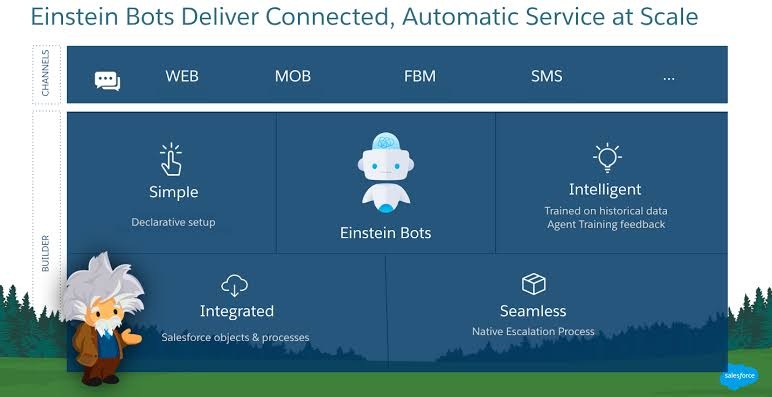
Best for: Enterprise Salesforce users with complex sales processes
Key features:
- Native Salesforce (reads/writes CRM data directly)
- Einstein AI for predictions + recommendations
- Omnichannel (web, mobile, WhatsApp, SMS)
- Deep workflow automation
- Multi-language support (50+ languages)
Enterprise B2B use case:
Global prospect visits localized site (French) → Einstein Bot:
- Detects language, responds in French
- Qualifies: company size, region, industry
- Checks Salesforce for existing relationship
- Routes to French-speaking Enterprise AE
- Creates opportunity with all context in Salesforce
What we tested:
- Multi-language qualification accuracy
- Salesforce data leveraging (does bot use existing CRM info?)
- Complex routing rules
Performance:
- Qualification in 12 languages tested successfully
- Salesforce sync: Perfect (native)
- Routing accuracy: 92% (occasionally misrouted technical questions)
Pricing: Included with Service Cloud licenses; additional features vary
Pros: Best option if you're an enterprise Salesforce customer. Unlimited customization. Handles complex, multi-step sales processes. Multi-language truly works
Cons: Requires Salesforce admin expertise. Setup is complex (months, not days). Overkill for SMB
Best for: Global enterprises with Salesforce + dedicated sales ops teams
How to Choose the Right Sales Chatbot
Decision framework:
1. What's your primary channel?
- Website inbound → Drift, Qualified, HubSpot
- Social (Instagram/WhatsApp) → ManyChat, Heyy.io
- In-product → Intercom
- Email/SMS outreach → Conversica
- E-commerce → Tidio, Rep AI
2. What's your CRM?
- Salesforce → Qualified, Einstein Bots, Drift
- HubSpot → HubSpot Chatbot Builder
- Pipedrive, Close, other → Drift, Intercom, Tidio
3. What's your deal size and sales motion?
- Enterprise ($50k+ deals, 6+ month cycles) → Drift, Qualified, Warmly
- Mid-market ($10k-50k deals, 1-6 month cycles) → Intercom, HubSpot, Drift
- SMB/Transactional ($500-10k deals, <1 month) → HubSpot, Tidio, ManyChat
4. What's your budget?
- $0-100/month → HubSpot (free), Tidio, ManyChat
- $500-2,000/month → Intercom, HubSpot paid, Zendesk
- $2,000+/month → Drift, Qualified, Conversica, Salesforce
5. What's your team size?
- 1-5 reps → HubSpot, Tidio (simple, low overhead)
- 6-20 reps → Intercom, Drift, Qualified
- 21+ reps → Drift, Salesforce, Qualified (need advanced routing)
Sales Chatbot Implementation Checklist
This checklist is interactive, click any item to mark it as complete and track your progress as you go.
FAQs
Q: What are AI sales chatbots?
A: AI sales chatbots are conversational tools that qualify leads, book meetings, and drive revenue by engaging prospects on websites, messaging apps, and email using natural language AI, sales frameworks (BANT/MEDDIC), and CRM integration.
Q: How much do sales chatbots cost?
A: Heyy.io ($49-499), Tidio/ManyChat ($15-50/month). Mid-market: Intercom ($300-1,000/month). Enterprise: Drift, Qualified, Salesforce ($2,000-10,000+/month). ROI typically achieved within 1-3 months for B2B.
Q: Can sales chatbots actually qualify leads?
A: Yes, when configured properly. Best platforms (Drift, Qualified, Warmly) use BANT/MEDDIC frameworks, firmographic data, and behavioral signals to qualify. Accuracy: 75-90% depending on complexity. Always design human escalation for edge cases.
Q: What's the difference between sales and support chatbots?
A: Support chatbots solve problems reactively. Sales chatbots proactively engage prospects, qualify buying intent, create urgency, and drive toward meetings/purchases. Sales bots integrate with CRM, use lead scoring, and measure pipeline impact.
Q: Do sales chatbots increase conversion rates?
A: Data shows yes. Companies report 15-40% increases in demo bookings, 20-35% faster lead response times, and 2-3× more qualified meetings. Key: proper qualification setup and routing logic.
Q: Which sales chatbot is best for small businesses?
A: HubSpot Chatbot Builder (free, CRM included) or Tidio ($29-59/month for e-commerce). Both offer easy setup, basic qualification, meeting booking, and scale as you grow.
Q: How do you measure sales chatbot ROI?
A: Track: (1) Meetings booked by bot, (2) Pipeline value created from bot-sourced leads, (3) Revenue from bot-influenced deals, (4) Time saved (hours not spent on unqualified leads). Compare to previous conversion rates and agent costs.
What You Need To Know About Sales Chatbots in 2026
Simply put: sales chatbots qualify, route intelligently, and measure pipeline impact.
The best platform depends on your sales motion:
- Enterprise ABM → Drift, Qualified, Warmly
- Mid-market B2B → Intercom, HubSpot
- E-commerce/D2C → Tidio, ManyChat
- Salesforce-centric → Qualified, Einstein Bots
ROI comes from three areas:
- More qualified leads (less rep time wasted)
- Faster response times (first responder wins)
- 24/7 availability (capture after-hours intent)
Successful deployments focus on 2-3 use cases initially: Lead qualification, demo booking, and routing. Expand after proving ROI.
For B2B teams handling 100+ inbound leads monthly, sales chatbots deliver 15-40% more meetings and 20-50% reduction in sales team time spent on qualification.
The question isn't whether to implement a sales chatbot. It's which platform fits your CRM, sales process, and deal size.
Ready to convert more inbound leads with AI-powered sales automation?
If your prospects message via WhatsApp, Instagram, or Facebook, try Heyy.io, a unified messaging platform with intelligent routing, lead qualification, and CRM sync. Free for 50 conversations/month.
Related Resources:
More blog posts to read

Ready to Automate Support
Across Every Channel?
.svg)
.avif)