.svg)
10 Ways Businesses Are Using ChatGPT for Customer Service (And Where It Still Falls Short)

When ChatGPT launched in late 2022, one of the first questions most customer service teams asked was: can this answer customer emails?
Three years later, that question has a more complicated answer than either the enthusiasts or the skeptics predicted. ChatGPT is transforming customer service operations in specific, measurable ways. It is also failing in specific, measurable ways that most vendor case studies quietly leave out.
This post covers both sides honestly. Ten specific ways businesses are using ChatGPT for customer service right now, with real results. The limitations that determine where a business should deploy it cautiously or not at all. And the direct answer to the question that keeps appearing in search data: can ChatGPT replace customer service, and what does the evidence actually say?
ChatGPT now has over 300 million weekly active users, making it the most widely adopted AI tool in history. 78% of customer service professionals using generative AI report improved efficiency, according to Salesforce's State of Service research. That adoption is real. But so is the 4.8% rate of major incorrect claims found in production ChatGPT responses, per Suprmind's 2026 benchmark data. Both numbers belong in the same conversation.
What ChatGPT Actually Is in a Customer Service Context

Before the use cases, a framing clarification that most posts skip.
ChatGPT is a large language model accessed through a chat interface. In customer service, it is used in two distinct modes:
As a tool for your team: Agents use ChatGPT to draft responses, summarize conversations, translate messages, generate knowledge base content, and process customer feedback. The human stays in the loop. ChatGPT accelerates their work.
As a deployed conversational agent: Via the ChatGPT API, businesses embed ChatGPT-powered responses into their chatbot or customer-facing messaging channels. The AI responds to customers directly, without a human agent involved unless escalation is triggered.
The use cases below cover both modes. The limitations section is especially important to understand for the second mode, where errors reach customers without a human reviewer in between.
The Benefits of Using ChatGPT in Customer Service Operations
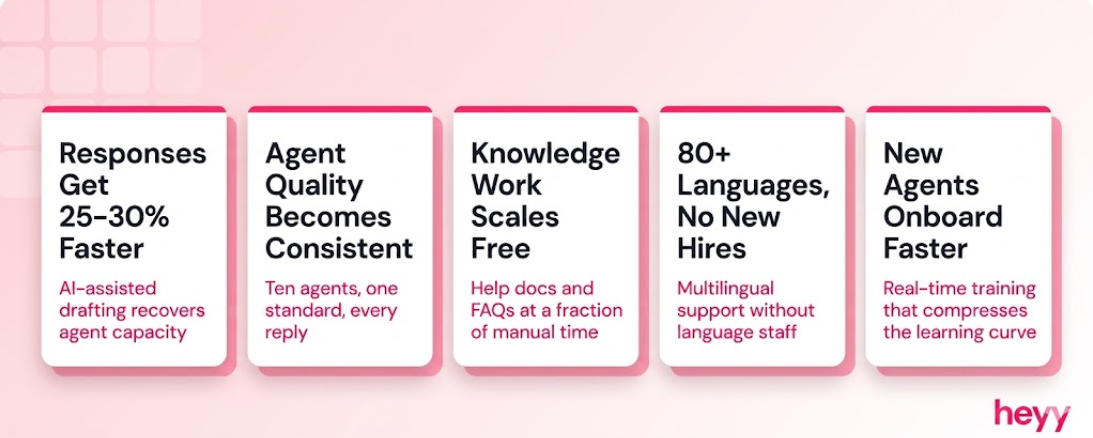
Response Speed Increases Immediately
AI can handle up to 80% of routine customer queries without human involvement, according to IBM. Whether ChatGPT is assisting agents with faster reply drafting or handling conversations directly, the throughput improvement is real and measurable within the first week of deployment.
Agent Quality and Consistency Improve
Left to their own devices, ten agents write ten different responses to the same question with ten different tones. ChatGPT-assisted reply drafting produces consistent language, catches missing information before the reply goes out, and brings lower-performing agents closer to the quality of your best ones.
Knowledge Work Scales Without Proportional Headcount
Writing help documentation, generating FAQ responses, creating training materials, producing post-interaction follow-ups. These are high-volume, high-skill tasks that currently consume significant team time. ChatGPT handles the production layer of all of them, with human review retained for accuracy.
Multilingual Support Becomes Accessible
Running a multilingual support team is expensive. ChatGPT supports over 80 languages with conversational fluency, making first-line multilingual support accessible without hiring language-specific agents.
Training and Onboarding Accelerate
New agents can use ChatGPT as a real-time training resource: simulating customer scenarios, testing response quality against a prompt, and getting immediate feedback on drafts. The onboarding curve compresses noticeably.
10 Ways Businesses Are Using ChatGPT for Customer Service
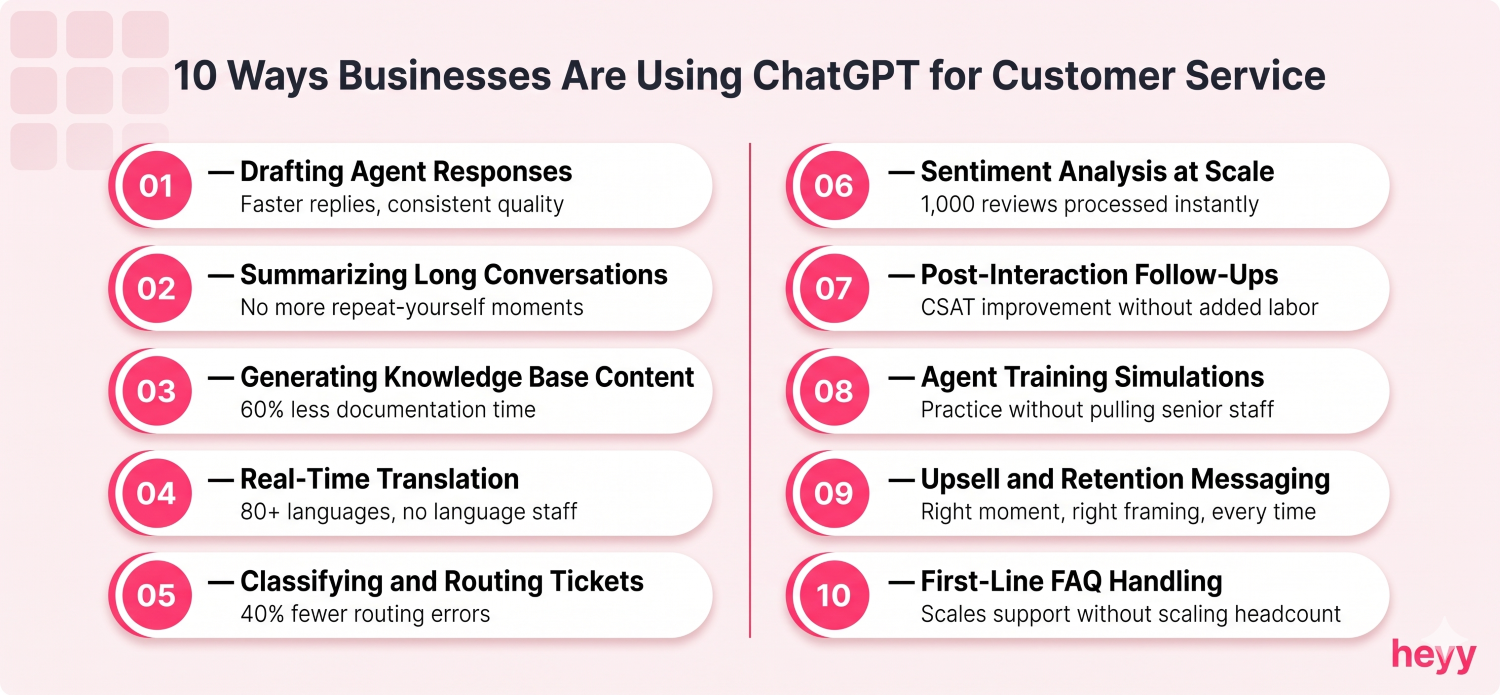
1. Drafting and Improving Agent Responses
The most widespread use of ChatGPT for customer service is not replacing agents. It is making agents faster.
An agent receives a complex complaint about a delayed shipment with a frustrated tone. Instead of writing the response from scratch under pressure, they paste the customer message into ChatGPT with a prompt: "Draft a response that acknowledges the delay, apologizes sincerely, explains the situation clearly, and offers the relevant compensation according to our policy."
The agent reviews, personalizes, adjusts the tone, and sends. The response that would have taken five minutes to write takes ninety seconds. At scale, across a team of ten agents handling fifty messages each per day, that time reduction is material.
What businesses report: Teams using AI-assisted response drafting report 25 to 30% reductions in average handle time, according to Salesforce's State of Service data. That is not a soft metric. It is agent capacity recovered without additional headcount.
2. Summarizing Long Customer Conversations for Faster Agent Handoffs
A customer has been in contact with your support team for three separate conversations over five days. A new agent picks up the case. Without AI, they read through every message to understand the history. With ChatGPT, they paste the full thread and receive a structured summary in ten seconds: what the issue is, what has been tried, what was promised, and what the customer's current sentiment is.
The no-repetition experience for the customer is one of the most reliable drivers of satisfaction scores. 72% of customers cite having to repeat their problem to multiple agents as their biggest support frustration. ChatGPT-powered handoff summaries directly address this without requiring CRM rebuilds or ticketing system upgrades.
3. Generating and Maintaining Knowledge Base Content
Help centers and FAQ pages go stale fast. A policy changes. A product feature is updated. A new integration launches. Most teams fall behind on documentation updates because writing accurate, clear, well-structured help articles requires time and skill that is always competing with live ticket volume.
ChatGPT generates first drafts of help articles, FAQ responses, troubleshooting guides, and policy explanations at a fraction of the manual writing time. A product manager describes the new feature in bullet points. ChatGPT produces a structured, customer-readable help article. The team reviews for accuracy and publishes.
AI-generated content for knowledge bases reduces documentation time by up to 60% in enterprise deployments, per IBM's AI in customer service research. The quality of the output depends entirely on the quality of the input and the accuracy of the human review.
4. Real-Time Translation for Multilingual Support
A customer sends a message in Arabic. Your support team works in English. Without translation support, the response is delayed while someone finds a solution, and the quality of the translated response is inconsistent.
With ChatGPT integrated into the agent interface, the incoming message can be translated instantly, the English draft reply generated, and the final reply translated back into Arabic before sending. The customer never knows the agent does not speak their language natively. The agent never loses time managing the language gap manually.
This use case is particularly high-value for businesses operating in markets where WhatsApp and Instagram are primary customer communication channels and where the customer base is multilingual by default.
5. Classifying and Routing Incoming Tickets
A support inbox receiving 500 messages per day needs classification before routing: billing questions to the billing team, technical issues to the engineering-trained agents, complaints to senior handlers, pre-sale questions to the sales team.
Manual classification is slow and inconsistent. Rule-based automation misses nuance. ChatGPT, prompted with your routing criteria, classifies incoming messages with a high degree of accuracy and assigns them to the correct queue in seconds. AI-powered ticket classification reduces routing errors by up to 40% in high-volume support environments, according to IBM's benchmarks.
This is one of the highest-leverage uses of ChatGPT in customer service because the routing decision affects every subsequent interaction, and errors at this stage compound throughout the support process.
6. Sentiment Analysis on Customer Feedback at Scale
A business receiving 1,000 customer reviews, NPS responses, and post-interaction surveys per month cannot read all of them. They read the one-stars and the five-stars and make decisions based on the extremes.
ChatGPT processes bulk feedback and returns structured sentiment analysis: percentage positive, percentage negative, the most frequently mentioned product or service issues, the language customers use when they are satisfied versus when they are about to churn. That analysis informs product roadmaps, staff training priorities, and service policy changes in ways that manual review never could at scale.
7. Writing Post-Interaction Follow-Up Messages
The follow-up after a resolved support interaction is one of the lowest-cost, highest-ROI touches in customer service. A short, specific message referencing the resolved issue and checking whether the solution held drives satisfaction scores, review generation, and retention.
Most teams never send these because writing personalized follow-ups at scale is impractical without automation. ChatGPT generates them from a structured prompt template: the customer's name, the resolved issue, and the outcome. The output requires only a review before sending.
Combined with a WhatsApp or SMS delivery channel (where open rates exceed 95%), post-interaction follow-up sequences driven by ChatGPT represent one of the fastest ways to improve CSAT scores without adding human labor.
8. Agent Training Through Simulated Customer Scenarios
New agents need practice before they handle live customer interactions. Role-playing with a supervisor is useful but expensive in terms of senior staff time. ChatGPT can simulate a frustrated customer, a confused first-time user, a customer threatening to cancel, or any other scenario the training program requires.
The new agent interacts with the simulation, the supervisor reviews the transcript, and the session produces specific, evidence-based feedback. Training scenarios that once required scheduled supervisor time can now happen on demand, at the agent's own pace, without pulling experienced team members away from live volume.
9. Generating Upsell and Retention Messaging
A customer contacts support because their current plan does not cover a feature they need. The agent resolves the immediate question. The upsell opportunity is clear. Without AI assistance, the agent either misses the moment or improvises a pitch of variable quality.
With a ChatGPT prompt trained on your product tiers and upgrade benefits, the agent receives a specific, well-framed upsell suggestion in seconds: "Your current plan covers X. The next tier includes Y and Z, which would address your current need. It is $X more per month." The framing is accurate. The moment is not missed.
10. First-Line FAQ Handling via API Deployment
Via the OpenAI API, businesses embed ChatGPT as the first-line responder in their customer-facing chat interfaces. The AI answers product questions, explains policies, handles order status inquiries when connected to an order management system, and escalates to human agents when questions fall outside its configured scope.
This is the most powerful application of ChatGPT for customer service and also the one with the highest operational risk if the limitations below are not managed carefully. When it works, it scales first-line support indefinitely. When it fails, the failures reach customers directly.
Where ChatGPT Still Falls Short
This is the section most ChatGPT content leaves out. The limitations of ChatGPT for customer service are not minor edge cases. For several high-stakes use cases, they are disqualifying. Understanding them determines where ChatGPT delivers value and where it creates risk.
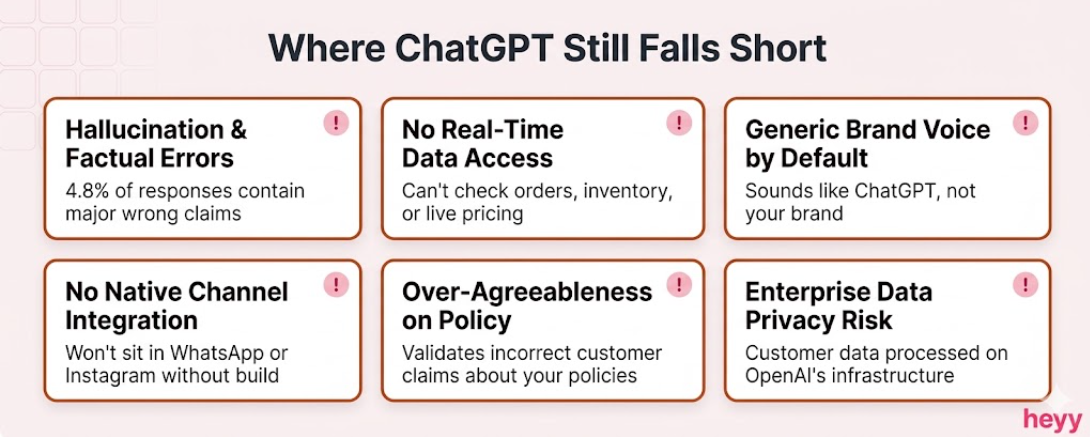
1. Hallucination: The Persistent Accuracy Problem
ChatGPT generates responses that sound confident regardless of whether they are accurate. GPT-4's hallucination rate on the HaluEval benchmark is 19.5%, meaning roughly one in five responses contains inaccurate, nonsensical, or unverifiable information. In production ChatGPT deployments, 4.8% of responses contain major incorrect claims.
For agent-assisted use cases where a human reviews the output before it reaches a customer, this is manageable. For fully automated customer-facing deployments, a 4.8% major error rate means that out of every 1,000 customer interactions, approximately 48 receive materially wrong information. At a business handling 500 conversations per day, that is 24 incorrect responses delivered to customers daily.
The solution is not to avoid ChatGPT. It is to restrict fully automated deployment to narrow, well-defined use cases where the output can be verified against a known data source, and to maintain human oversight for anything with a significant error consequence.
2. No Access to Real-Time Data
ChatGPT does not know your current inventory. It does not know the status of a specific customer's order. It does not know what your pricing changed to last week. Without an integration that feeds real-time data into the model's context, ChatGPT answers these questions based on whatever training data it has, which is either outdated or entirely absent.
A customer asking "is the blue version still in stock?" receives an answer based on nothing relevant. A customer asking "where is my order?" gets a generic response about how to track orders rather than their specific shipment status.
Real-time data integration via API connections resolves this, but it requires technical implementation. Until it is in place, ChatGPT cannot replace the data-connected tools that handle live operational queries.
3. No Brand Voice by Default
ChatGPT writes like ChatGPT. It is fluent, clear, and reasonable. It is not your brand. Without explicit system prompt engineering and training on your brand voice guidelines, ChatGPT produces responses that are technically correct but tonally disconnected from the voice your marketing team spent years establishing.
The fix is system prompt configuration, as covered in the training AI chatbots guide. But it requires deliberate effort and ongoing maintenance as brand voice evolves.
4. No Native Channel Integration
ChatGPT the product does not sit inside your WhatsApp Business inbox or your Instagram DMs. Deploying it in those channels requires API integration, middleware, and either a platform that handles the connection or a development team that builds it.
For businesses whose customers primarily communicate through WhatsApp, Instagram, or Facebook Messenger, the integration gap between ChatGPT's capabilities and the channels where those capabilities are needed is a real operational barrier. This is one of the primary reasons purpose-built customer service AI platforms exist: they handle the channel infrastructure so the AI can focus on the conversation.
5. The Agreeableness Problem
ChatGPT is trained to be helpful and agreeable. In customer service, this becomes a liability. A customer who makes an incorrect claim about your policy will often receive a response that validates their framing rather than gently correcting it. A customer who demands a refund outside your stated policy window may receive a response that implies the refund is possible when it is not.
Research consistently identifies over-agreeableness as one of ChatGPT's most persistent behavioral limitations in high-stakes communication contexts. For customer service, where accurate policy communication is a legal and operational requirement, this tendency needs to be explicitly corrected through system prompt instructions.
6. Data Privacy and Enterprise Security
Every message passed to the ChatGPT API is processed by OpenAI's infrastructure. For businesses handling sensitive customer data, including payment information, health data, or any personally identifiable information subject to GDPR, HIPAA, or equivalent regulations, the data residency and processing policies of the ChatGPT API require careful evaluation before deployment.
OpenAI offers enterprise-grade options with stronger privacy guarantees, but the default API configuration may not meet the requirements of regulated industries without additional configuration.
Can ChatGPT Replace Customer Service?
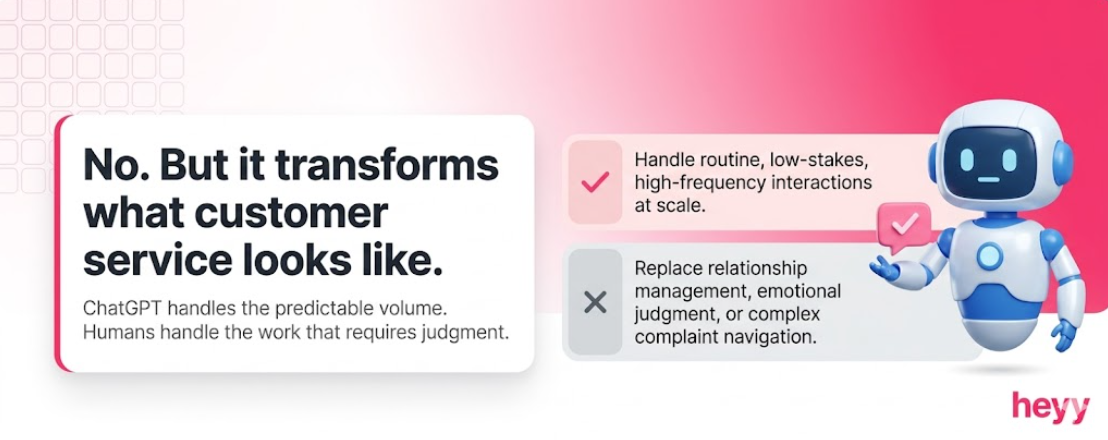
This is the question the secondary search data shows customers asking most frequently, so it deserves a direct answer.
No, ChatGPT cannot replace customer service. It can handle a significant portion of routine, low-stakes interactions faster and more consistently than a human team. It can assist human agents in ways that measurably improve their performance. It can scale first-line support without proportionally scaling headcount.
But it cannot replace the judgment required for complex complaints. It cannot build the relationship that prevents churn in high-value accounts or carry a deal through a structured negotiation the way a trained account manager running a Shipley proposal process can. It cannot navigate the emotional nuance of a customer who is distressed about something that matters to them. And it currently produces enough errors in enough contexts that full replacement would create more problems than it solved.
The accurate framing is: ChatGPT transforms customer service by handling the predictable volume so that human agents can focus on the interactions that actually require human judgment. That transformation is real and valuable. It is not replacement.
The businesses getting the most from AI customer service are the ones that have mapped their customer interactions clearly: which ones can be automated, which ones should be human-assisted by AI, and which ones require humans without AI in the primary role.
How to Use ChatGPT in Customer Service Without Creating New Problems
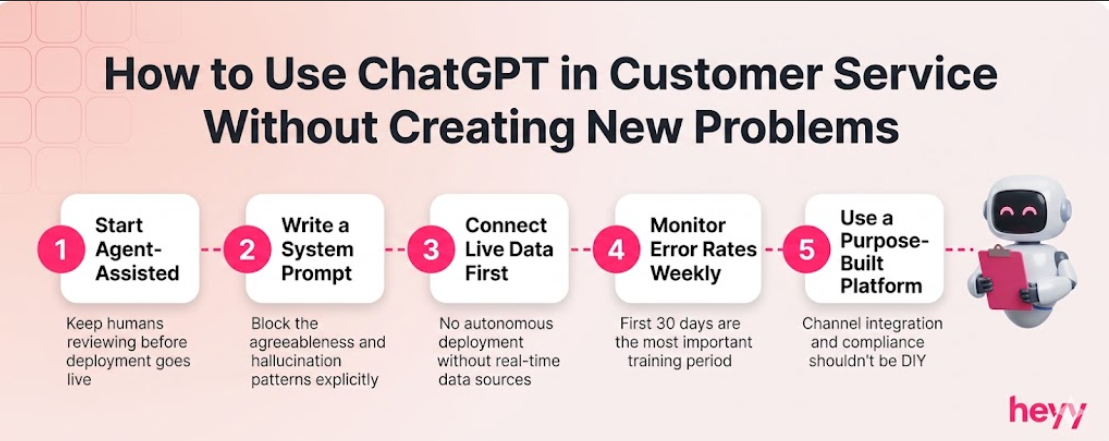
Start with agent-assisted use cases before autonomous deployment. Drafting, summarizing, translating, and classifying all keep a human in the loop. The failure modes are caught before they reach customers. Start there, learn how the model behaves in your context, and expand to autonomous deployment only for use cases where you have validated the accuracy.
Write a system prompt that addresses the known failure modes. Tell the model explicitly: do not make commitments about refunds outside the stated policy, do not confirm inventory you cannot verify, do not agree with incorrect claims about policy, escalate immediately if the customer is expressing significant distress. A system prompt that addresses the agreeableness and hallucination tendencies in your specific context is the most effective single intervention available.
Connect live data for any use case that requires it. Order status, inventory, pricing, account details. Any FAQ that requires current information needs a live data connection, not a static knowledge base. Without it, deploy ChatGPT only for questions with static, verifiable answers.
Monitor error rates actively, especially in the first 30 days. Review a random sample of AI-generated responses weekly. Track escalation rates. Track the conversations where customers had to repeat themselves or expressed frustration with the bot's response. These are your training signals.
Use a purpose-built platform for channel deployment. The best AI chatbots for customer service wrap the ChatGPT API in the channel integrations, escalation logic, and compliance configurations that make it safe and effective in a production environment. Do not deploy the raw API to customer-facing channels without that infrastructure around it. And If you want ChatGPT-quality AI running across your WhatsApp, Instagram, Facebook Messenger, and website chat without building the integration infrastructure yourself, Heyy handles all of it.
The AI is trained on your product, your policies, and your brand voice. It runs on the channels your customers actually use. Escalation logic, compliance configuration, and performance analytics are built in. Start free and have your first AI-powered customer conversation live today.
FAQs
Is ChatGPT good for customer service?
Yes, with clear scope. ChatGPT is excellent for agent-assisted use cases: drafting responses, summarizing conversations, classifying tickets, generating knowledge base content, and handling multilingual translation. For autonomous customer-facing deployment, it is effective for narrow, well-defined use cases with static information. It is not suitable for autonomous deployment in use cases that require real-time data, complex judgment, or zero tolerance for factual errors.
What are the main limitations of ChatGPT for customer service?
The limitations of ChatGPT for customer service fall into six categories: hallucination and factual errors, no access to real-time operational data, generic brand voice by default, no native channel integration for WhatsApp or Instagram, over-agreeableness that can miscommunicate policy, and data privacy considerations for regulated industries. Each limitation has a mitigation, but each requires deliberate implementation work before deployment.
Can ChatGPT replace customer service representatives?
No, not fully. ChatGPT can handle a large portion of routine, repetitive, low-stakes customer interactions. It cannot replace the relationship management, emotional judgment, and contextual decision-making that complex customer situations require. The most effective deployments use ChatGPT to handle the predictable volume and free human agents for the work that requires human judgment.
How do businesses connect ChatGPT to their WhatsApp or Instagram channels?
Through the ChatGPT API combined with a platform that handles channel integration. ChatGPT does not natively integrate with WhatsApp Business or Instagram DMs. A platform like Heyy handles the channel infrastructure, the AI configuration, and the escalation logic so that ChatGPT-level conversation quality runs in the channels your customers are already using.
What is the best way to prevent ChatGPT from giving wrong answers to customers?
Three mechanisms working together. First, restrict autonomous deployment to use cases with static, verifiable answers. Second, write a detailed system prompt that explicitly prohibits commitments the model cannot verify and instructs it to escalate when it lacks confidence. Third, connect live data sources for any use case that requires current operational information. Review the AI chatbot accuracy guide for a detailed breakdown of accuracy management in production deployments.
How does ChatGPT compare to purpose-built customer service AI?
ChatGPT is a general-purpose language model. Purpose-built customer service AI is ChatGPT or an equivalent model wrapped in channel integrations, compliance configurations, escalation logic, business-specific training, and operational tooling. For most businesses, the purpose-built platform delivers the ChatGPT capability they need with the production-ready infrastructure they require. Building directly on the raw API is the right choice only when your use case requires customization that off-the-shelf platforms cannot provide.
More blog posts to read

Ready to Automate Support
Across Every Channel?
.svg)
.avif)