.svg)
10 HR Chatbots That Save Your HR Team Hours Every Single Week

Your HR team is not struggling because they lack expertise. They are struggling because the majority of their day is consumed by questions that have the same answer every time.
"When is the next payroll date?" "How do I submit a leave request?" "What is the maternity leave policy?" "Can I see my contract?" These questions arrive by email, by Slack message, by WhatsApp, and by someone walking to the HR desk. And every single one of them pulls an HR professional away from the work that actually requires their training: performance management, strategic hiring, culture building, and employee development.
According to McKinsey, HR teams spend 40 to 50% of their time on routine, answerable tasks that require no judgment to complete. Deloitte's Future of Work research shows AI can reduce HR administrative time by up to 40%. For a two-person HR team, that recovery is the equivalent of one full working day returned per person every week.
This post covers the 10 HR chatbots doing that work in 2026, with specific use cases, real results, and the information you need to choose the right one for your team size and workflow.
Quick Comparison: 10 HR Chatbots at a Glance
Why HR Teams Need Chatbots in 2026
The case for HR chatbots is not about replacing HR professionals. It is about giving them their time back.
72% of HR professionals report that AI tools help them focus on strategic work rather than administrative tasks, according to SHRM's 2026 workforce technology survey. The HR teams that deploy chatbots are not reducing headcount. They are changing what their headcount spends time on.
The problem is specific and measurable. A 10-person HR team receiving 50 routine inquiries per day, each requiring 3 minutes to answer, spends 2.5 hours per day answering questions that do not require HR expertise. That is 12.5 hours per week. Over a year, it is 650 hours of HR professional time spent on tasks a well-trained chatbot handles in under 10 seconds.
HR chatbot use cases in onboarding alone save an average of 30% in time-to-productivity for new employees, according to SHRM's onboarding research. New hires get answers to their day-one questions without waiting for an HR team member to be available. The onboarding experience improves. HR gets back the hours previously spent fielding those questions.
The Benefits of HR Chatbots for Busy Teams
HR Professionals Reclaim Strategic Time
The hours recovered from routine inquiry handling go toward the work that actually requires HR expertise. Performance reviews, succession planning, compensation analysis, culture initiatives. These are the functions that determine whether your organization attracts and retains talent. They suffer when the team is buried in "what is our holiday policy?" messages.
Employees Get Answers Without Waiting
An employee with a question at 9pm on a Tuesday about their parental leave entitlement does not want to wait until the next business day. A chatbot that answers instantly, accurately, and in the employee's preferred channel, whether that is Slack, WhatsApp, or your intranet, removes a friction point that affects employee satisfaction at a basic level.
New Employee Onboarding Becomes Consistent
Manual onboarding produces inconsistent employee experiences. One new hire gets a thorough walkthrough from an attentive HR team member. Another gets a brief email with five attachments during a busy week. An HR chatbot for employee onboarding delivers the same structured, complete, and welcoming experience to every new hire regardless of how busy the HR team is on their start date.
Recruiting Volume Scales Without Proportional Staffing
67% of candidates prefer chatbot-assisted scheduling over waiting for human coordination, according to Master of Code's HR chatbot research. Automated screening, scheduling, and candidate communication allows a two-person recruiting team to manage the volume that previously required five. The quality of the recruiter's time improves because they spend it on assessment and relationship-building, not coordination.
HR Data Becomes Visible and Analyzable
Every question your chatbot handles is a data point. Which policies generate the most confusion? Which benefits questions appear most frequently? Which onboarding steps produce the most follow-up questions? Manual HR communication generates none of this data systematically. AI chatbots for HR support capture all of it automatically, and that data improves your documentation, your training, and your policy communication over time.
The 10 HR Chatbots
1. Heyy — Best for Employee Communication on WhatsApp and Messaging Channels
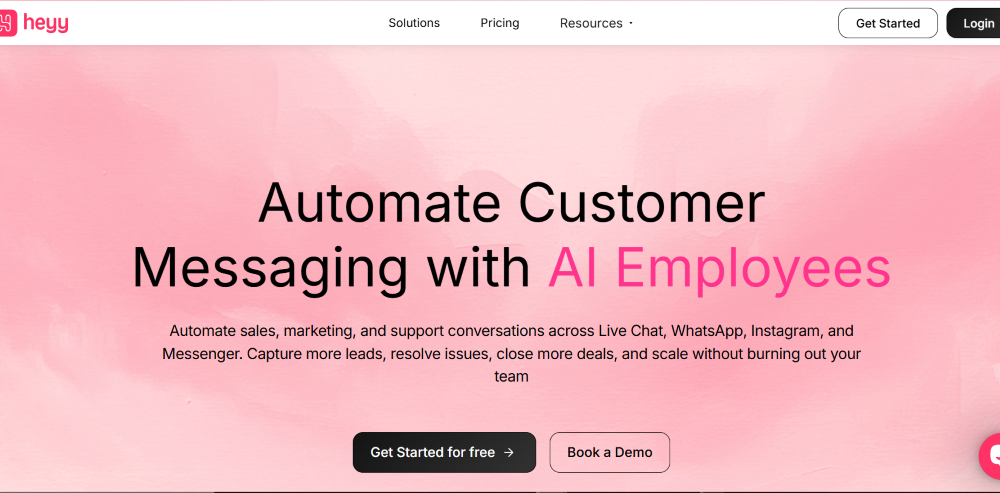
Most HR chatbot platforms are built around Slack, Teams, and your company intranet. That infrastructure works well for office-based knowledge workers. It does not work for the significant portion of the workforce that operates primarily through WhatsApp: field teams, warehouse staff, remote workers in markets where WhatsApp is the primary communication tool, and distributed international teams.
Heyy connects WhatsApp, Instagram, Facebook Messenger, Slack, and web chat into a single unified inbox. HR teams configure the AI on their policies, onboarding materials, links to essential early-career platforms, benefits documentation, and FAQs. Employees ask questions in the channel they already use. The AI answers instantly, 24/7, and escalates to a human HR team member when the question requires judgment.
For new employee onboarding specifically, Heyy handles the week-one question volume that consumes significant HR time: IT setup instructions, first-day logistics, benefits enrollment windows, payroll dates, leave request processes. The new hire gets immediate answers in their phone. HR gets that time back.
For distributed teams operating across time zones, the 24/7 availability of an HR chatbot for employee onboarding means a team member in Lagos or Nairobi gets the same instant support as someone in the same city as the HR office.
Best for: Businesses with distributed or field workforces where WhatsApp is a primary communication channel, and any HR team deploying onboarding support across messaging apps.
Pricing: Free to start. Paid plans scale with usage, not headcount.
Pros:
- WhatsApp, Instagram, and web chat from one inbox
- No-code setup deployable in hours
- Usage-based pricing that does not penalize headcount growth
- AI trains on your specific HR documentation and policies
Cons:
- Does not offer deep HRIS integration with Workday or SAP out of the box
- Best suited for communication-layer HR support, not complex workflow automation
2. Leena AI — Best for Enterprise HR Helpdesk and Policy Q&A
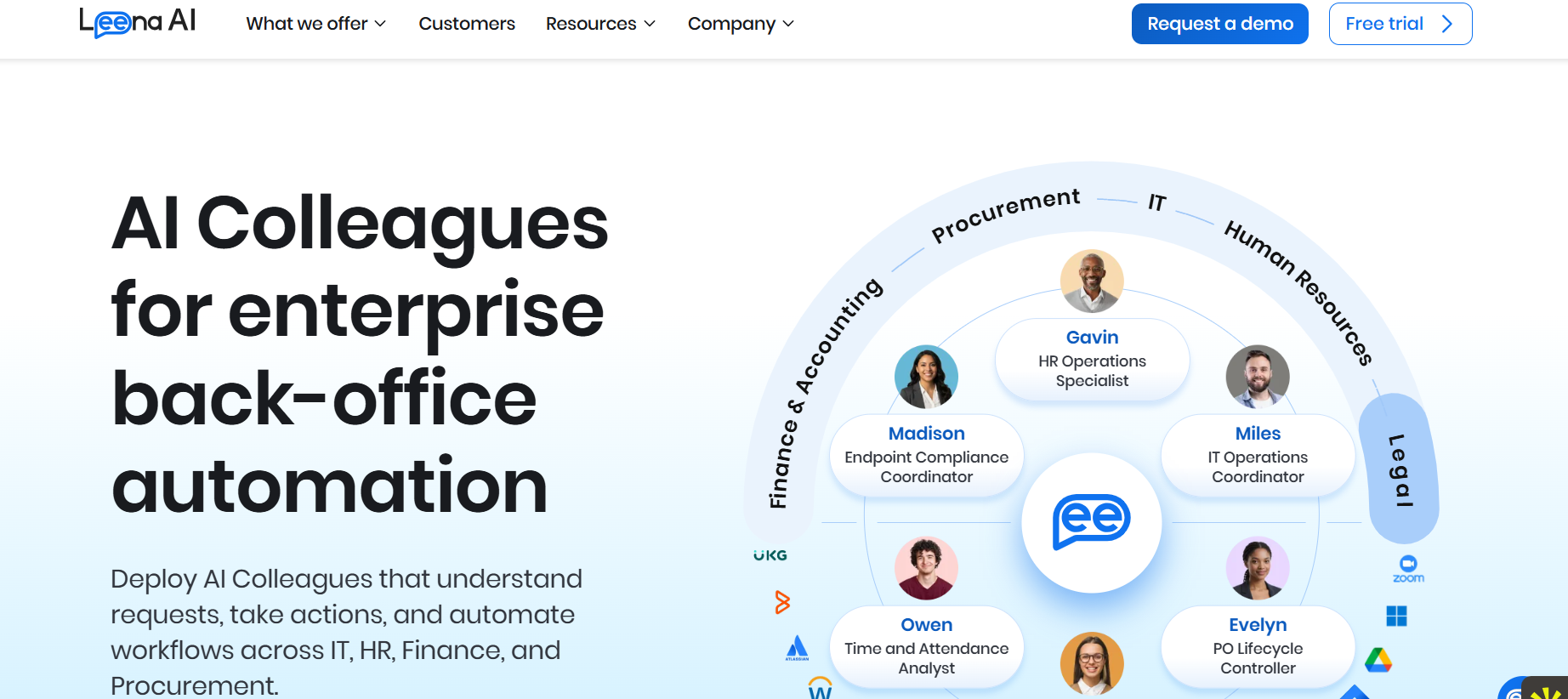
Leena AI is purpose-built for enterprise HR teams needing a scalable self-service layer for employee support. It handles benefits questions, policy queries, leave management, payroll inquiries, and IT/HR ticket routing from a single AI-powered interface.
The enterprise integration depth is Leena's differentiator. It connects to SAP SuccessFactors, Workday, ServiceNow, and Oracle HCM, reading live data to answer questions accurately rather than relying on a static knowledge base. When an employee asks "how many leave days do I have left?", Leena pulls the answer from the HR system in real time.
Leena AI users report a 70% reduction in HR ticket volume within the first 90 days of deployment, per Leena's published customer data. For a team receiving 200 HR tickets per week, that is 140 fewer tickets per week answered without human involvement.
Best for: Enterprise HR teams with 500+ employees already running Workday, SAP, or ServiceNow who need AI-powered self-service at scale.
Pricing: Custom. Requires a demo.
Pros:
- Deep HRIS integration with live data retrieval
- Handles complex multi-system queries with real-time accuracy
- Strong multilingual support for global workforces
- Proven at enterprise scale across multiple industries
Cons:
- Implementation complexity requires onboarding time and IT coordination
- Custom pricing without a public rate card
- Positioned for large enterprises; pricing and complexity disproportionate for small teams
3. MeBeBot — Best for Slack and Teams HR FAQ Deflection

MeBeBot is the simplest and most accessible HR FAQ chatbot on this list. It sits inside Slack or Microsoft Teams and answers employee questions about HR policies, IT procedures, and operational processes from a knowledge base your team builds and maintains.
Setup is fast: the platform provides hundreds of pre-built HR FAQ templates covering the most common employee questions. Your team reviews, customizes, and adds company-specific content. The chatbot is live within days. There is no API integration required for the core FAQ functionality.
For small and mid-sized HR teams managing high inquiry volume through Slack or Teams, MeBeBot delivers the highest speed-to-value of any tool on this list. The per-employee pricing model is transparent and predictable.
MeBeBot customers report handling 65 to 80% of common HR questions automatically after full knowledge base setup, according to MeBeBot's published customer data. That coverage level, achieved without HRIS integration or technical implementation, represents a practical immediate improvement for most HR teams.
Best for: Small to mid-sized businesses running primarily on Slack or Teams who need fast, affordable HR FAQ automation without technical implementation overhead.
Pricing: Starts at approximately $2/employee/month. Transparent per-employee model.
Pros:
- Live within days using pre-built HR FAQ templates
- No HRIS integration required for core functionality
- Transparent per-employee pricing
- Handles Slack and Teams natively
Cons:
- Limited to FAQ-style interactions; does not handle complex HR workflow automation
- No real-time HRIS data retrieval without separate integration
- Less depth than enterprise platforms for large, complex deployments
4. Paradox Olivia — Best for High-Volume Recruiting Automation

Paradox's AI assistant, Olivia, handles the recruiting coordination that consumes disproportionate recruiter time: screening candidates, answering application questions, scheduling interviews, sending reminders, and collecting pre-interview information. All of it runs as a conversational flow through text, WhatsApp, and email without recruiter involvement.
The measurable outcome for recruiting teams is the time recovered from scheduling coordination specifically. A recruiter who previously spent 30 to 40% of their week managing interview logistics can redirect that time to candidate assessment and offer management. Paradox customers report reducing time-to-hire by an average of 30% after deployment.
For high-volume frontline and hourly hiring, Olivia's 24/7 availability means candidates apply and schedule at any hour. Applications that previously sat unacknowledged overnight are processed and advanced in real time.
Best for: In-house recruiting teams managing high-volume hiring or frontline roles where scheduling coordination consumes significant recruiter time.
Pricing: Custom. Requires a demo.
Pros:
- Deep ATS integration (Workday, iCIMS, Greenhouse, and others)
- Candidate-facing conversations in multiple languages
- 24/7 scheduling reduces application abandonment significantly
- Proven at enterprise scale across retail, healthcare, and logistics
Cons:
- Focused on recruiting; not a general HR support tool
- Custom pricing without a public rate card
- Implementation requires recruiter workflow redesign to fully capitalize on automation
5. Espressive Barista — Best for Enterprise Employee Self-Service Across HR, IT, and Benefits
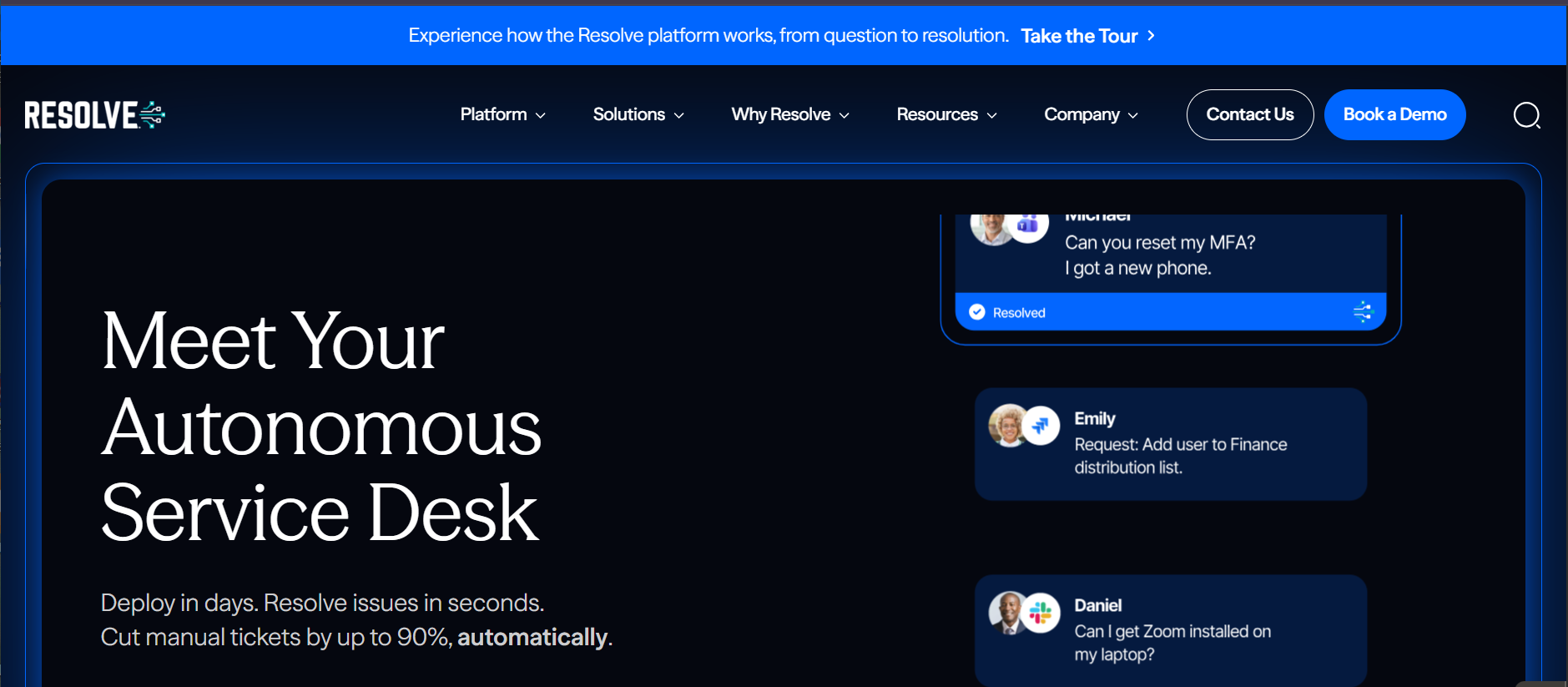
Espressive Barista is the broadest employee self-service chatbot on this list. It handles HR inquiries, IT support, and benefits questions from a single conversational interface. For large organizations where HR, IT, and benefits are separate departments but employees experience them as a single "getting support" journey, Barista removes the routing problem: the employee asks, and the right department's answer comes back automatically.
The natural language processing depth is what makes Barista work for complex queries. An employee asking "I've had a lot of expenses this month, can I get an advance on my salary, and also my laptop keeps crashing" receives an HR response about advance policies and an IT ticket creation in the same conversation.
Espressive reports an average of 73% resolution rate without human involvement across customer deployments, per their published results data. For enterprise teams managing thousands of employee inquiries weekly, that resolution rate represents significant operational savings.
Best for: Enterprise organizations managing HR, IT, and benefits support centrally who want a unified self-service AI across all three functions.
Pricing: Custom. Enterprise-positioned.
Pros:
- Unified HR, IT, and benefits support in one conversational interface
- Strong NLP handles complex, multi-part employee questions
- Deep HRIS and ITSM integration
- 73% average resolution rate without human involvement
Cons:
- Enterprise pricing and implementation overhead
- Overkill for organizations under 500 employees
- Initial setup requires significant knowledge base configuration
6. Lindy — Best for Building Custom Multi-Step HR Workflow Automation
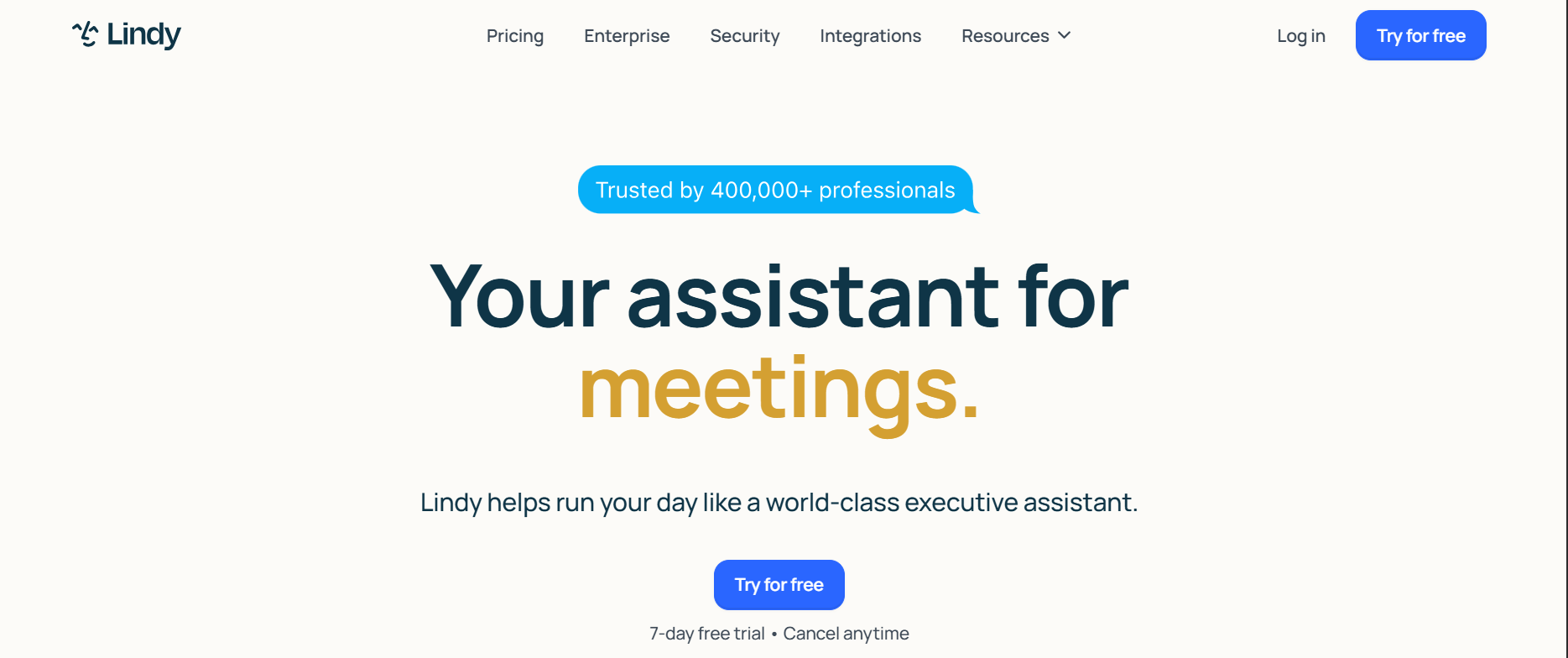
Lindy is not a pre-built HR chatbot. It is a no-code AI agent builder that HR teams use to construct custom multi-step workflows connecting their existing tools. The distinction matters: where other tools on this list handle specific HR functions, Lindy can be configured to automate any HR workflow that can be described in a sequence of steps.
A Lindy deployment might: receive a new hire email, trigger the HRIS to create an employee record, send the new hire a welcome message on Slack, schedule their first-week meetings, assign their online compliance training, and notify their manager, all without a human touching any step.
With over 4,000 integrations and support for OpenAI, Claude, and Gemini as underlying models, Lindy is the most flexible tool on this list for organizations with unique HR workflows that off-the-shelf chatbots cannot accommodate.
Best for: HR teams with non-standard workflows, multiple connected tools, and a need for custom automation logic that pre-built platforms cannot address.
Pricing: Free tier available. Plus at $49.99/month. Pro at $99.99/month.
Pros:
- No-code interface for building complex multi-step automations
- 4,000+ integrations covering virtually every HR tool
- Multi-agent coordination for sophisticated workflow logic
- Flexible LLM options (GPT-4, Claude, Gemini)
Cons:
- Learning curve for building complex logic-heavy flows
- Not a pre-built HR chatbot — requires configuration time
- Credit-based pricing can escalate with heavy workflow volume
7. XOR — Best for High-Volume Frontline and Hourly Hiring
XOR automates the candidate communication workflow at high volume: screening questions, qualification routing, interview scheduling, and reminders via text, WhatsApp, and email. For companies hiring hundreds of frontline, warehouse, or service-sector employees monthly, XOR removes the human touchpoints that create bottlenecks at scale.
The channel flexibility is particularly relevant for frontline hiring. Candidates for hourly roles are more likely to be reachable via SMS and WhatsApp than via email or a career site chat widget. XOR's multi-channel approach meets candidates where they are, which directly affects application completion rates.
HR chatbot use cases in high-volume recruiting are where the hours-saved calculation is most dramatic. Companies using XOR report saving 2 to 4 hours of recruiter time per hire, per XOR's published customer data. For an organization hiring 200 employees per month, that is 400 to 800 recruiter hours saved monthly.
Best for: Organizations with high-volume frontline hiring needs where candidate volume consistently exceeds what a manual coordination process can handle efficiently.
Pricing: Custom. Volume-based pricing.
Pros:
- WhatsApp, SMS, and email all supported natively
- Handles high-volume screening without recruiter involvement
- 24/7 candidate engagement reduces application drop-off
- ATS integrations for major platforms
Cons:
- Focused on recruiting; not a general HR support tool
- Custom pricing requires a sales conversation
- Less suited for professional or executive-level hiring where relationship matters more than speed
8. Eightfold AI — Best for Talent Intelligence and Internal Mobility
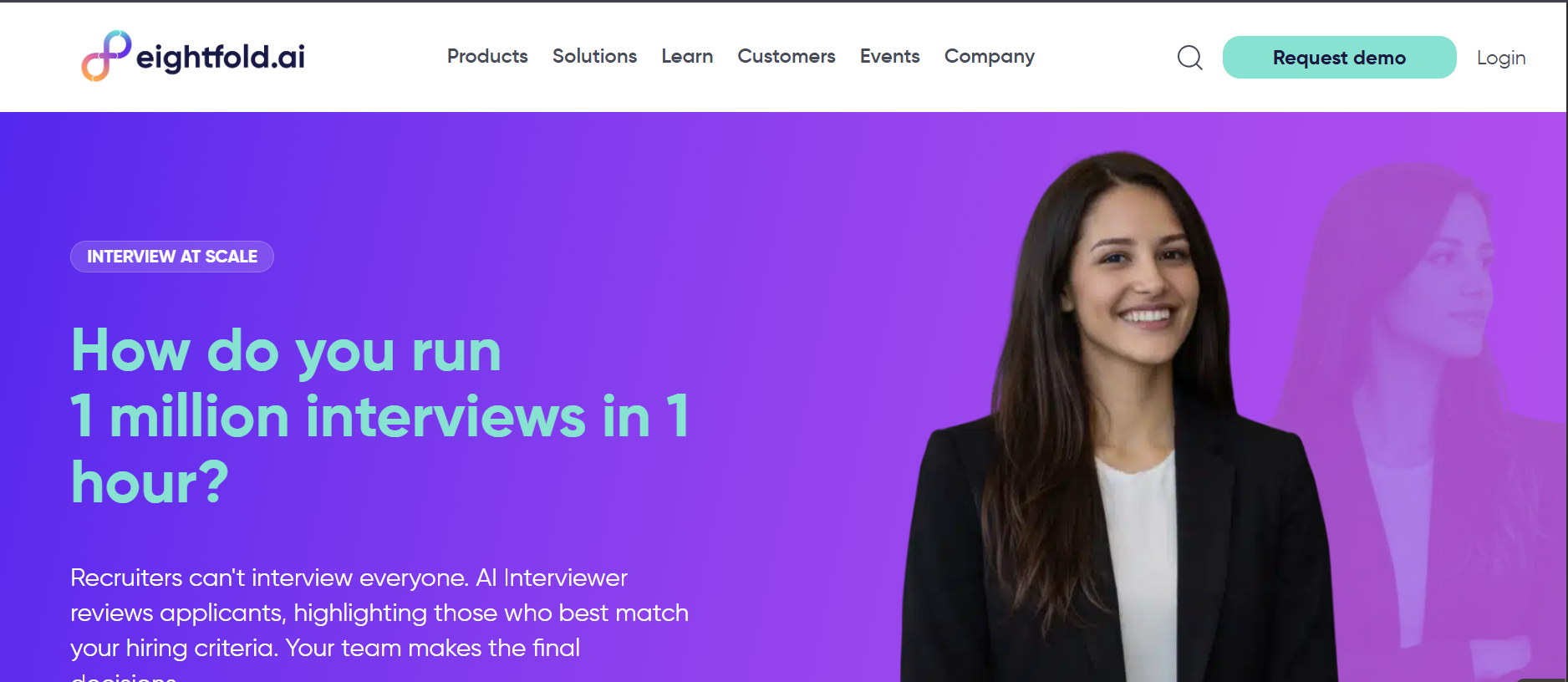
Eightfold AI approaches HR from the talent intelligence angle rather than the support chatbot angle. It builds dynamic skill profiles for every employee and candidate, uses them to power hiring recommendations, and, critically, surfaces internal mobility opportunities that most organizations miss entirely.
The internal mobility use case is where Eightfold generates ROI that is harder to quantify but deeply meaningful. Organizations that lose high performers because they did not see a path forward internally pay significant replacement costs. The average cost of replacing an employee is 50 to 200% of their annual salary, per SHRM's retention research. Eightfold's AI identifies employees who are at risk of leaving because their current role does not match their evolving skills, and surfaces relevant internal opportunities before they start looking externally.
Best for: Enterprise talent teams wanting to use AI for skills-based hiring, internal talent matching, and proactive retention management.
Pricing: Custom, requires a demo.
Pros:
- Skills-based matching beyond keyword resume filtering
- Internal mobility engine reduces regrettable attrition
- AI copilots for job description generation and candidate surfacing
- Deep integration with Workday, SAP, and Oracle
Cons:
- Complex implementation and steep learning curve
- Positioned for large enterprises — disproportionate for smaller teams
- Dense interface requires training for effective adoption
9. Guru — Best for Internal Knowledge Base With AI-Powered HR Q&A
Guru is an internal knowledge management platform with an AI layer that makes company knowledge findable through natural language questions. HR teams use it to centralize policies, benefits documentation, onboarding guides, and process documentation, and employees find that information through a conversational search interface embedded in Slack, Teams, or Chrome.
The AI chatbot for HR support function sits on top of the knowledge base: instead of searching for a document, employees ask a question and Guru retrieves the relevant section from the appropriate document automatically. For HR teams whose primary challenge is not automation but documentation accessibility, Guru is the most direct solution.
Knowledge workers spend 1.8 hours per day searching for information they need to do their jobs, according to McKinsey. Guru's AI search layer cuts that search time significantly for HR policies and procedures.
Best for: HR teams whose primary pain point is information accessibility rather than workflow automation — where the documentation exists but employees cannot find it efficiently.
Pricing: Custom. Requires a call with their team
Pros:
- Fast to set up with existing HR documentation
- AI natural language search reduces time spent hunting for policies
- Slack, Teams, and Chrome integration for in-workflow access
- Transparent per-user pricing
Cons:
- Not an agentic chatbot, it retrieves and surfaces information but does not take actions
- Knowledge base quality determines output quality, requires documentation investment
- Does not replace HRIS-connected HR support for live data queries
10. Humanly — Best for Structured, Compliance-Conscious High-Volume Hiring
Humanly handles candidate screening and engagement with a specific focus on compliance and DEI consistency. Every candidate receives the same structured screening questions, in the same order, without the variation that human-led phone screens introduce. The consistency is not just operationally efficient, it is legally defensible.
Humanly customers report a 93% reduction in recruiter screening time per hire, per their published case study data. For organizations where compliance risk in hiring is a significant concern alongside volume, Humanly addresses both simultaneously.
The Greenhouse and Lever integrations allow candidate data collected through Humanly's conversational screening to flow directly into the ATS without manual transfer.
Best for: HR and recruiting teams in regulated industries or organizations where hiring compliance and DEI consistency are as important as scheduling efficiency.
Pricing: Custom. Requires a consultation.
Pros:
- Structured screening ensures legal consistency across all candidates
- 93% reduction in recruiter screening time per hire
- Built-in DEI analytics and bias detection
- ATS integration with Greenhouse, Lever, and iCIMS
Cons:
- Focused on recruiting screening; not a general HR support tool
- Custom pricing without a public rate card
- Best value in regulated industries or high-volume context, less relevant for small-scale hiring
How to Choose the Right HR Chatbot for Your Team
By Team Size and HR Function
Small businesses and startups with lean HR teams: Heyy or MeBeBot. Both offer fast deployment, transparent pricing, and immediate impact without implementation overhead. Heyy if your employees communicate primarily on WhatsApp. MeBeBot if your team runs on Slack or Teams and needs straightforward FAQ automation.
Mid-market HR teams with complex workflows: Lindy for custom workflow automation. Leena AI for employee self-service at scale with HRIS integration.
Enterprise HR and talent teams: Leena AI for self-service, Espressive Barista for unified HR/IT/benefits, Eightfold AI for talent intelligence, and Paradox Olivia for recruiting coordination.
High-volume recruiting operations: Paradox Olivia, XOR, or Humanly depending on whether your priority is scheduling speed, channel flexibility, or compliance consistency.
By Primary Time-Recovery Goal
Reduce time on policy and FAQ questions: Heyy, MeBeBot, Guru, Leena AI. These are the tools that address the 40 to 50% of HR time spent on answerable questions directly.
Reduce recruiting coordination time: Paradox Olivia, XOR, Humanly. All three automate the scheduling and screening tasks that consume recruiter hours without adding strategic value.
Improve new employee onboarding: Heyy's WhatsApp-first onboarding FAQ handling, combined with any HRIS your team uses, creates an accessible onboarding support layer that works on day one without any new hire needing to learn a new platform.
Retain employees through better internal mobility: Eightfold AI. The talent intelligence use case is specifically about using AI to match existing employees to roles before they start looking externally.
By Budget Reality
Model your cost at current headcount, then at 2x headcount. MeBeBot's per-employee model and Heyy's usage-based model scale predictably. Enterprise platforms like Leena AI, Espressive, and Eightfold require custom quotes that should include a 3-year projection given the implementation investment required.
If your employees are already messaging your HR team on WhatsApp or Instagram, or if your distributed workforce needs HR support that operates outside business hours, Heyy is built for exactly that use case. Train the AI on your HR policies, your onboarding materials, and your benefits documentation. Deploy it across WhatsApp, Instagram, and your website simultaneously. Employees ask their questions in the channel they already use and get immediate, accurate answers. Your HR team gets their time back. Start free and handle your first employee inquiry with AI today.
FAQs
What is an HR chatbot and how does it save time?
An HR chatbot is an AI-powered assistant that handles routine employee questions, onboarding support, and HR administrative tasks automatically. It saves time by removing the repetitive inquiry volume that currently consumes HR team capacity: policy questions, leave balance checks, benefits queries, onboarding FAQs, and recruiting coordination. The time recovered goes toward strategic HR work that requires human expertise.
What are the most common HR chatbot use cases?
The highest-impact HR chatbot use cases are: answering employee policy and benefits questions, automating new hire onboarding communication, handling recruiting screening and scheduling, managing leave requests, and routing HR tickets to the correct team. For recruiting specifically, scheduling automation and candidate pre-screening consistently deliver the highest hours-saved per deployment. See the full chatbot use cases by industry breakdown for how HR compares to other sectors.
How does an HR chatbot for employee onboarding specifically work?
An HR chatbot for employee onboarding delivers structured support to new hires during their first days and weeks. It answers questions about IT setup, benefits enrollment, payroll timing, company policies, leave procedures, and organizational structure through a conversational interface available 24/7 in the channel the new hire is already using. The chatbot replaces the informal "email the HR team and wait" experience with immediate, consistent, accessible support.
Are HR chatbots secure for handling sensitive employee data?
Security and compliance depend on the platform. For tools handling personally identifiable employee information, salary data, or health-related benefits queries, GDPR compliance and SOC 2 certification are baseline requirements to verify. Platforms built specifically for enterprise HR, like Leena AI and Espressive, have enterprise-grade security built in. Tools like Heyy that handle primarily communication and FAQ support have a lower data sensitivity exposure than HRIS-connected platforms.
Can an HR chatbot replace an HR professional?
No, and framing it this way misunderstands what HR chatbots do. They remove the volume of low-complexity, high-frequency tasks that currently prevent HR professionals from doing their highest-value work. The HR professional who used to spend 2 hours per day answering routine questions is now available for performance management, compensation planning, and strategic workforce development. The chatbot handles what should never have required a trained professional in the first place. AI customer service principles applied to internal HR operations follow the same logic: automate the predictable, protect the human judgment for what requires it.
How long does it take to set up an HR chatbot?
It depends on the tool and the scope. Simple FAQ chatbots like Heyy and MeBeBot can be live with your core HR documentation in one to three days. Platform-level deployments like Leena AI and Espressive require HRIS integration, knowledge base setup, and testing cycles that typically take two to six weeks. The variable that most extends implementation timelines is knowledge base quality: the HR documentation you feed the system determines the accuracy of the answers it gives. Invest in clean, current documentation before beginning technical setup.
More blog posts to read

Ready to Automate Support
Across Every Channel?
.svg)
.avif)